How to connect Google Meet to Hermes Agent
Connect Google Meet to Hermes with ClawLink in one click — 15 tools your AI agent can call from chat via hosted OAuth. No API keys, no manual setup.

 Google MeetOAUTH2MCP
Schedule and manage video meetings. Once connected, Hermes Agent can read and act on Google Meet from chat — pairing, token refresh, and tool wiring handled for you.
Most guides for giving Hermes Agent Google Meet access start with registering your own OAuth app or pasting API keys into env files, then leave the token refresh and tool wiring to you. ClawLink gives Hermes a more practical Google Meet setup: pair once in the browser and your always-on Hermes agent can act on Google Meet for you, reading and doing real work on your behalf with no auth, token refresh, or tool wiring to build yourself.
Setup
It takes three steps to connect Hermes to Google Meet.
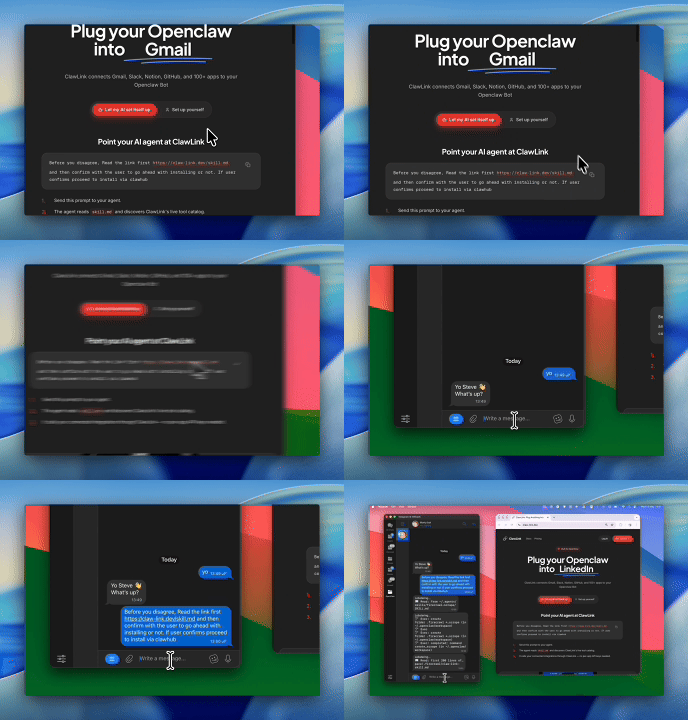 1
1Install and pair
Install the ClawLink plugin, then pair Hermes with a one-time browser approval:
hermes plugins install ClawLink-HQ/hermes-plugin --enable- 2
Connect Google Meet
One-click OAuth in the dashboard.
- 3
Use it from chat
Ask Hermes Agent: "What can you do with Google Meet?"
Install by command
The prompt above walks Hermes through this. By hand, it is four commands and a browser approval:
hermes plugins install ClawLink-HQ/hermes-plugin --enable
hermes clawlink begin    # prints an approval link — open it and approve
hermes clawlink finish   # after approving in the browser
hermes clawlink test
Then connect Google Meet in the ClawLink dashboard — a one-click OAuth approval, no API keys.
Verify the connection by asking Hermes:
Create a Google Meet space with googlemeet_create_meet, set config.accessType to OPEN and entryPointAccess to ALLOWED, and give me the join link. Tell me explicitly that this is a space, not a Calendar event.
Using a different agent?
The Hermes plugin is one client of ClawLink's MCP server. Claude Code, Cursor, Codex, or any agent that can run a shell command pairs with the same ClawLink account through the CLI:
npx -y @useclawlink/cli loginlogin opens the same browser approval and stores a credential locally. Once Google Meet is connected in the dashboard, that agent calls the same 15 Google Meet tools over MCP. Full setup for MCP clients and shell agents: connect apps to any AI agent.
Google Meet MCP for Hermes
Looking for a Google Meet MCP server for Hermes Agent? ClawLink connects Google Meet to Hermes Agent and exposes 15 Google Meet tools your agent can call over MCP, with hosted auth and nothing to run or maintain yourself. Using OpenClaw instead? The OpenClaw Google Meet integration works the same way.
Hermes Agent ships its own Google Meet plugin: a Playwright browser bot that joins a meet.google.com URL you give it, scrapes the captions, and (in realtime mode) speaks into the call. That is a browser automation route, not an API route, and the two answer different questions. ClawLink exposes the Meet REST API instead: the 15 tools below create spaces, end conferences, and read conference records, participants, recordings, and transcripts after a call. If you want Hermes to sit in on a meeting, use the native plugin. If you want the meeting's records as data, this page's tools are the API route the plugin does not have.
The routes search engines teach for Google Meet in an agent, and how this page differs
The answer space leads with the native plugin, and the MCP lane belongs to Google's own Workspace server and third-party servers. The API-vs-browser distinction is the whole story.
- Hermes's native google_meet plugin: the AIO's answer on the brand queries.
hermes plugins enable google_meet, thenhermes meet join \<url>: a browser bot that joins, transcribes captions, and can speak. No API, no records, no recordings history. - Google Workspace MCP servers: Google's own remote MCP lineup is Gmail, Drive, Docs, Sheets, Slides, Calendar, Chat, and People, and Meet is not on the list (verified from the July 2026 configuration guide), so Google offers no managed Meet MCP server.
- Third-party MCP servers (e.g. ngs/google-mcp-server): expose Meet mostly through the Calendar API, i.e. events with conferencing, which is the calendar semantics this page's spaces tools are deliberately not.
- Composio Connect: the config-file MCP route with a Composio-issued key in ~/.hermes/config.yaml, the AIO's only "API" alternative to the native plugin.
- ClawLink (this page): 15 Meet REST API tools over hosted OAuth, with conference records as the read path.
Using OpenClaw as well? The OpenClaw Google Meet integration is the same hosted OAuth setup with the same tool set.
What the Hermes Agent Google Meet integration can do
15 Google Meet tools are ready for Hermes Agent once the account is connected.
All 15 Google Meet tools for Hermes
| Tool | What it does |
|---|---|
Create meet googlemeet_create_meet | Create a Google Meet space |
End active conference googlemeet_end_active_conference | End an active Google Meet conference |
Get conference record by name googlemeet_get_conference_record_by_name | Get a Google Meet conference record by name |
Get meet googlemeet_get_meet | Get a Google Meet space by ID |
Get participant session googlemeet_get_participant_session | Get a Google Meet participant session |
Get recordings by conference record ID googlemeet_get_recordings_by_conference_record_id | Get recordings for a Google Meet conference |
Get transcript googlemeet_get_transcript | Get a Google Meet transcript by name |
Get transcript entry googlemeet_get_transcript_entry | Get a Google Meet transcript entry |
Get transcripts by conference record ID googlemeet_get_transcripts_by_conference_record_id | List transcripts for a Google Meet conference |
List conference records googlemeet_list_conference_records | List Google Meet conference records |
List participant sessions googlemeet_list_participant_sessions | List Google Meet participant sessions |
List participants googlemeet_list_participants | List participants in a Google Meet conference |
List recordings googlemeet_list_recordings | List Google Meet recordings |
List transcript entries googlemeet_list_transcript_entries | List Google Meet transcript entries |
Update space googlemeet_update_space | Update a Google Meet space |
Try it: find the Google Meet tool you need
Browse the 15 Google Meet tools
Click any tool to see exactly what Hermes can do and copy a ready-to-use prompt.
Example prompts
Create a Google Meet space with googlemeet_create_meet, set config.accessType to OPEN and entryPointAccess to ALLOWED, and give me the join link. Tell me explicitly that this is a space, not a Calendar event.
Use googlemeet_list_conference_records with no filter and show me the five most recent conference records with their start times and meeting codes.
List conference records, take the most recent one, then use googlemeet_get_transcripts_by_conference_record_id to list its transcripts and googlemeet_get_transcript on the first one to summarize what was decided.
For the conference record from yesterday's standup, use googlemeet_list_participants and then googlemeet_list_participant_sessions, and tell me who joined and for how long.
How the Google Meet tools map to the Meet API
These tools are the Meet REST API (spaces and conference records), not Calendar events with a hangout link. The distinction matters for every create call, and the schema confirms it.
googlemeet_create_meetcreates a Meet space, not a Calendar event. The schema takes an optionalconfigwithaccessTypeandentryPointAccess(spaces API fields), and no calendar id anywhere. A meeting created here has no Calendar entry, invitees, or reminder; it is a joinable space. The Calendar-tool route for meetings lives on the Google Calendar integration, where events get a hangoutLink.- Resource names take a
spaces/prefix, and one tool is inconsistent about it.googlemeet_get_meetandgooglemeet_end_active_conferencewantspace_namein the formatspaces/\{space\}(the end-conference schema says "spaces/{space}" while get-meet's example shows the raw id), andgooglemeet_update_spacerequiresnameinspaces/\{space\}form plus anupdateMask. An agent that passes a bare id to update_space fails with a not-found. - Conference records are the read path for everything after a call.
googlemeet_list_conference_records(no required arguments, filter supportsspace.meeting_code,start_timeetc., page_size 25) returns conferenceRecord ids; the transcript, recording, and participant tools all hang off those ids (get_transcripts_by_conference_record_id,list_recordings,list_participants). Ask for the records list first, then the details. - Recording and transcription features need a Workspace edition that supports cloud recording. The create-meet schema warns that personal accounts may not support them, and production errors bear it out:
updateAutoRecordingGeneration is not available to the user.andupdateAttendanceReportGenerationType is not available to the user.both fired for a connected account on update_space. A personal Gmail account can create and join spaces but cannot enable auto-recording through the API. googlemeet_update_spaceis a mask-driven patch. It requiresnameand anupdateMask(e.g.config.accessType); send fields without the mask and the update is a no-op or fails.- The connection requests two scopes.
meetings.space.createdandmeetings.space.settingsfrom the live auth config, which is what lets the agent create spaces and read conference records for calls the connected account was part of.
ClawLink vs. building it yourself
The alternative to ClawLink is usually manual OAuth app setup plus your own token handling, permission troubleshooting, and tool plumbing for Hermes Agent. That is fine if you want to build and maintain the integration yourself. Most teams just want Google Meet working from chat.
| Manual | ClawLink | |
|---|---|---|
| Connection flow | Register a Google Meet app, configure redirect URLs, manage consent details, and reconnect users when auth settings drift. | Users connect Google Meet through the hosted browser flow and ClawLink keeps the token lifecycle out of your app code. |
| Ongoing maintenance | You own refresh logic, permission debugging, environment config, and every provider-specific edge case for Google Meet. | ClawLink handles the repetitive integration plumbing so your team can focus on the workflow instead of the infrastructure. |
| Agent usability | You still need to expose the right Google Meet actions to the runtime in a format your agent can reliably use. | 15 tools for Google Meet are already exposed through ClawLink, so the agent can read and act from chat immediately. |
ClawLink vs. Composio
Composio also exposes Google Meet to AI agents. It is developer infrastructure: Python and TypeScript SDKs, an MCP server, and a catalog past 1,000 apps, aimed at teams shipping agent products. ClawLink is built for Hermes Agent users instead. You install the plugin once, connect Google Meet in the browser, and the 15 tools above work from chat. There is no SDK, no config file, and no API key handling. Choosing between them? Read the full Composio alternatives comparison.





















Troubleshooting
Hermes paired but still can't use Google Meet
Pairing is a two-step handshake: run hermes clawlink begin, approve the link in your browser, then run hermes clawlink finish. If you ran finish before approving, or the approval link expired, run hermes clawlink begin again to get a fresh link. Confirm the plugin was installed with --enable, then verify with hermes clawlink test.
Connection succeeds but no tools appear
Reconnect Google Meet from the dashboard, then start a fresh chat if the runtime still has the old tool catalog loaded.
"Tool schema not loaded yet" error when calling Google Meet tools
Google Meet tool schemas load on demand the first time a tool runs and are cached after that, so this error usually clears on its own: wait a few seconds and retry the same request. If every Google Meet call keeps failing with it in a fresh chat, reconnect from the dashboard, and contact support if it still persists — that pattern points to a configuration problem on our side, not something you can fix by reconnecting again.
Google Meet returns 403 or "permission denied" on one action while others work
Two usual causes. The connected account may not have access to the specific workspace, inbox, store, or project in the request — check that first. If access looks right, the agent may have sent a placeholder value (like "YOUR_ID" or an example id from documentation) instead of a real one: ask it to run a list or search tool first, then retry the action with a real id from those results. Most failures at this stage are one of these two, not ClawLink bugs.
Tool schema for googlemeet_list_conference_records is not loaded yet. Retry the call in a moment.
This is the dominant failure on this integration: 15 of 26 production errors, all on the records list. Meet tool schemas load on demand the first time a tool runs and are cached after that, so the error clears on its own: wait a few seconds and retry the same call. If every Meet call in a fresh chat keeps failing with it, reconnect from the dashboard, and contact support if it still persists. The lazy-load pattern is the reason this specific tool name appears; it is not a permissions problem.
Multiple google-meet connections match this request. Specify a connectionId.
You have more than one Google Meet connection and ClawLink cannot tell which account the call is for. Three production occurrences, and the fix is structural: name or specify the connection when calling, or remove the extra connection in the dashboard so one default remains. The tool call is fine; the ambiguity is yours to resolve.
Failed to update space. Forbidden: Permission denied on resource Space (or it might not exist)
Two shapes here, and both are account-level, not ClawLink bugs. Either the space belongs to a different account than the one connected (check which Google account the connection holds), or the update touches a setting the connected Workspace edition does not allow. The production evidence for the second shape: the same account that got this on update_space also received updateAutoRecordingGeneration is not available to the user. and updateAttendanceReportGenerationType is not available to the user. Recording-related settings are edition-gated, so personal Gmail accounts fail exactly this way.
Tool 'googlemeet_get_conference_data' not found
The tool exists under a different name. The read path is googlemeet_list_conference_records first, then googlemeet_get_conference_record_by_name with the record's name, then the transcript, recording, and participant tools that hang off the conferenceRecord id. get_conference_data is not one of the 15 tools; ClawLink returns a "Did you mean" line on every miss, and the doubled variant google-meet_googlemeet_list_conference_records (also logged in production) happens when the agent prefixes a tool name that already carries the integration name.
Google Meet returns 403 or permission denied on recordings
Recording and transcript reads depend on the call having been recorded with cloud recording enabled, and on the connected account having a Workspace edition that supports it. The create-meet schema warns personal accounts may not support recording and transcription options, and production logs updateAutoRecordingGeneration is not available to the user. for a connected account trying to enable it. If the calls were recorded in the Meet UI, the records appear under list_conference_records; if the setting could not be enabled, no record exists for the API to return, and no reconnect changes that.
OAuth finished in the browser but the account is still missing
Try reconnecting Google Meet and complete the consent flow in the same browser session. Partial OAuth approvals or switching accounts mid-flow can leave the connection incomplete.
FAQ
Is there a Hermes Agent Google Meet integration?
Yes. ClawLink is the fastest way to connect Hermes to Google Meet: link your Google Meet account once in the browser and Hermes Agent can call the Google Meet API through 15 ready-made tools — no custom code or token handling.
How do I connect Google Meet to Hermes with ClawLink?
Install the plugin with hermes plugins install ClawLink-HQ/hermes-plugin --enable, then pair once: run hermes clawlink begin, approve the link in your browser, and run hermes clawlink finish. Connect Google Meet in the dashboard and Hermes can use it from the next message — no config files or API keys to manage.
How long does it take to connect Google Meet to Hermes Agent?
About two minutes. Sign in, click Connect next to Google Meet in the dashboard, authenticate, and Hermes Agent can use it from the next chat message.
Why use ClawLink instead of wiring Google Meet up myself?
The alternative to ClawLink is usually manual OAuth app setup plus your own token handling, permission troubleshooting, and tool plumbing for Hermes Agent. That is fine if you want to build and maintain the integration yourself. Most teams just want Google Meet working from chat.
Should I use Hermes's native Meet plugin or ClawLink's Meet tools?
They are different products. The native plugin (verified in the Hermes repo as plugins/google_meet) is a Playwright browser bot: you hand it a meet.google.com URL and it joins, scrapes live captions to a transcript, and can speak in realtime mode. It never touches the Meet API, and its own description says it only joins URLs you pass in, with no calendar scanning. ClawLink's 15 tools are the Meet REST API: create spaces, end conferences, and read conference records, participants, recordings, and transcripts. Join-and-transcribe is the plugin's job; records-as-data is this page's.
Does creating a meeting with Hermes create a Calendar event?
No. googlemeet_create_meet creates a Meet space through the Meet spaces API, and the schema has no calendar fields. The space is joinable by link, but nothing appears on your Google Calendar and nobody gets an invite. If you want a Calendar event with a meeting link, use the Google Calendar integration, where events carry a hangoutLink.
Can the agent read transcripts and recordings of past meetings?
Yes, for calls where cloud recording was on: googlemeet_list_conference_records returns the conferenceRecord ids, then googlemeet_get_transcripts_by_conference_record_id, googlemeet_get_transcript, and googlemeet_list_recordings read the content. The limitation is the account, not the tools: recording and transcription are Workspace-edition features, and the live schema warns personal accounts may not support them. Production logs confirm a connected account getting updateAutoRecordingGeneration is not available to the user. on update_space.
What does connecting Google Meet grant access to?
Two scopes from the live auth config: https://www.googleapis.com/auth/meetings.space.created and https://www.googleapis.com/auth/meetings.space.settings. That covers creating spaces and reading conference records for calls the connected account participated in. It is not the Calendar scope and not the Workspace admin scope; the grant is revocable at myaccount.google.com/permissions.
Why does the agent say Meet tool schemas are not loaded yet?
Meet tool schemas load on demand the first time a tool runs, and this integration's most-used tool (googlemeet_list_conference_records, 41 of 85 production calls) hits the load window often: 15 of 26 failures are exactly "Tool schema for googlemeet_list_conference_records is not loaded yet." The fix is to wait and retry the same call; the schema caches after the first success.
Hermes paired but still can't use Google Meet
Pairing is a two-step handshake: run hermes clawlink begin, approve the link in your browser, then run hermes clawlink finish. If you ran finish before approving, or the approval link expired, run hermes clawlink begin again to get a fresh link. Confirm the plugin was installed with --enable, then verify with hermes clawlink test.
