How to connect Sevdesk to Hermes Agent
Connect SevDesk to Hermes Agent, the AI assistant (not Hermes parcel shipping): paste one admin API key and 115 tools work from chat. Stored server-side.


 SevdeskAPI KEYMCP
sevDesk is an online accounting software designed for small businesses and freelancers, offering features like invoicing, expense management, and financial reporting.. Once connected, Hermes Agent can read and act on Sevdesk from chat — pairing, token refresh, and tool wiring handled for you.
Most guides for giving Hermes Agent Sevdesk access start with registering your own OAuth app or pasting API keys into env files, then leave the token refresh and tool wiring to you. ClawLink gives Hermes a more practical Sevdesk setup: pair once in the browser and your always-on Hermes agent can act on Sevdesk for you, reading and doing real work on your behalf with no auth, token refresh, or tool wiring to build yourself.
Copy this prompt into Hermes to install the plugin and pair your account.
Set up ClawLink for Hermes and tell me when it's ready.

1. Install the plugin:
hermes plugins install ClawLink-HQ/hermes-plugin --enable

2. Start pairing. It prints an approval link, so show me the link and stop, don't wait:
hermes clawlink begin

3. I'll approve it in my browser, then reply "approved".

4. When I say approved, finish setup:
hermes clawlink finish

5. Then run `hermes clawlink test` and tell me whether ClawLink is ready.
Setup
It takes three steps to connect Hermes to Sevdesk.
 1
1Install and pair
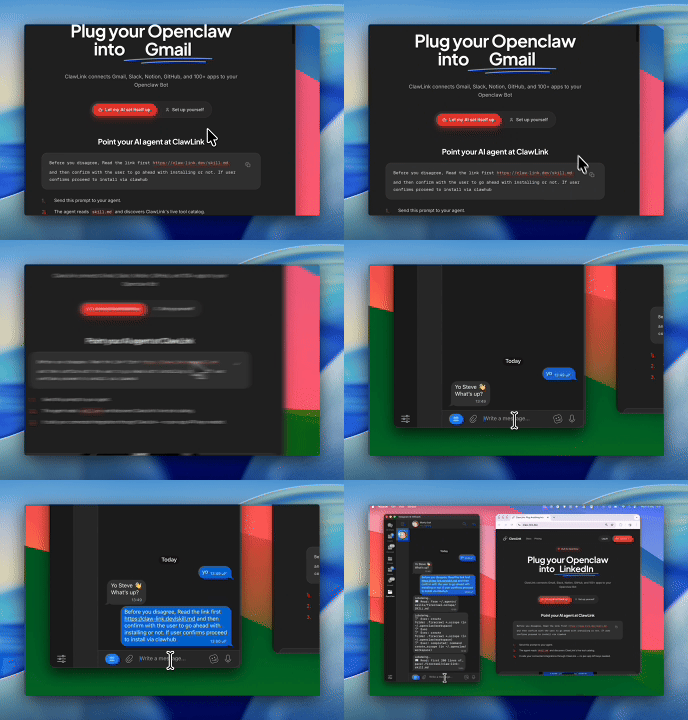
Install the ClawLink plugin, then pair Hermes with a one-time browser approval:
hermes plugins install ClawLink-HQ/hermes-plugin --enable- 2
Connect Sevdesk
Paste your API key in the dashboard.
- 3
Use it from chat
Ask Hermes Agent: "What can you do with Sevdesk?"
The whole pairing handshake. Run these once, then paste your SevDesk key in the dashboard:
hermes plugins install ClawLink-HQ/hermes-plugin --enable
hermes clawlink begin     # approve the link in your browser
hermes clawlink finish
hermes clawlink test
The key comes from SevDesk: Settings → Users → your user → API Token (Erweiterungen → Integrationen in the German UI). It must be an admin user, and in Germany the plan must be Buchhaltung Pro or higher. The token never expires and dies with the admin account that owns it.
Using a different agent?
The Hermes plugin is one client of ClawLink's MCP server. Claude Code, Cursor, Codex, or any agent that can run a shell command pairs with the same ClawLink account through the CLI:
npx -y @useclawlink/cli loginlogin opens the same browser approval and stores a credential locally. Once Sevdesk is connected in the dashboard, that agent calls the same 115 Sevdesk tools over MCP. Full setup for MCP clients and shell agents: connect apps to any AI agent.
Sevdesk MCP for Hermes
Looking for a Sevdesk MCP server for Hermes Agent? ClawLink connects Sevdesk to Hermes Agent and exposes 115 Sevdesk tools your agent can call over MCP, with hosted auth and nothing to run or maintain yourself. Using OpenClaw instead? The OpenClaw Sevdesk integration works the same way.
To be clear about the name first: this is Hermes Agent, the AI assistant, not Hermes parcel shipping, which is what search engines answer for this query unless the page says otherwise. Now the real story: SevDesk's API is one key per user, 32 characters of hex, admin-only, created in Settings → Users → your user → API Token, valid forever, and gone when that admin account goes. Search results are right that a connection is impossible without some credential, and then they leave you holding it. This page changes who holds it: you paste the key into a hosted setup page once, and the agent calls the 115 SevDesk tools through it while your machine never stores the key. Same API, same token, different custody.
What the Hermes Agent Sevdesk integration can do
115 Sevdesk tools are ready for Hermes Agent once the account is connected. The 30 below are the ones people reach for most; your agent can call all 115.
30 of 115 Sevdesk tools for Hermes
| Tool | What it does |
|---|---|
Book invoice amount sevdesk_book_invoice_amount | Book an invoice amount in SevDesk |
Check customer number availability sevdesk_check_customer_number_availability | Check if a customer number is available in sevDesk |
Create accounting contact sevdesk_create_accounting_contact | Create a new accounting contact in sevDesk |
Create check account transaction sevdesk_create_check_account_transaction | Create a new check account transaction in SevDesk |
Create clearing account sevdesk_create_clearing_account | Create a new clearing account in sevDesk |
Export credit note CSV sevdesk_export_credit_note_csv | Export credit notes as CSV from SevDesk |
Fetch dictionary entries by type sevdesk_fetch_dictionary_entries_by_type | Retrieve placeholders (dictionary entries) for a specific object type in sevDesk |
Find contacts by custom field value sevdesk_find_contacts_by_custom_field_value | Find contacts by custom field value |
Generate progress download hash sevdesk_generate_progress_download_hash | Generate a download hash for an export job progress |
Get account invoices sevdesk_get_account_invoices | Retrieves all sevDesk account invoices for the authenticated client |
Get accounting contact by ID sevdesk_get_accounting_contact_by_id | Retrieve accounting contact details by ID |
Get accounting contacts sevdesk_get_accounting_contacts | Retrieve accounting contacts from sevDesk |
Get check account balance at date sevdesk_get_check_account_balance_at_date | Get the balance of a check account at a specific date |
Get check account by ID sevdesk_get_check_account_by_id | Retrieve details of a specific check account by ID |
Get check account transaction by ID sevdesk_get_check_account_transaction_by_id | Retrieve a specific check account transaction by its ID |
Get check account transactions sevdesk_get_check_account_transactions | Retrieve list of check account transactions |
Get check accounts sevdesk_get_check_accounts | Retrieve a list of all check accounts |
Get communication way keys sevdesk_get_communication_way_keys | Retrieve a list of communication way keys from sevDesk |
Get communication ways sevdesk_get_communication_ways | Retrieve communication ways from sevDesk |
Get communicationway by ID sevdesk_get_communicationway_by_id | Retrieve details of a specific communication way by ID |
Get contact address by ID sevdesk_get_contact_address_by_id | Retrieve details of a specific contact address by ID |
Get contact addresses sevdesk_get_contact_addresses | Retrieve contact addresses from sevdesk |
Get contact by ID sevdesk_get_contact_by_id | Retrieve details of a specific contact by ID |
Get contact custom field by ID sevdesk_get_contact_custom_field_by_id | Retrieve a contact custom field by its ID |
Get contact custom field setting by ID sevdesk_get_contact_custom_field_setting_by_id | Retrieve details of a specific contact custom field setting by ID |
Get contact custom field setting reference count sevdesk_get_contact_custom_field_setting_reference_count | Receive the count of references for a contact custom field setting |
Get contact custom field settings sevdesk_get_contact_custom_field_settings | Retrieve contact custom field settings from sevDesk |
Get contact custom fields sevdesk_get_contact_custom_fields | Retrieve contact custom fields from sevDesk |
Get contact tabs item count sevdesk_get_contact_tabs_item_count | Get the count of items across all tabs for a specific contact |
Get contacts sevdesk_get_contacts | Retrieve a list of contacts |
Try it: find the Sevdesk tool you need
Browse the 30 Sevdesk tools
Click any tool to see exactly what Hermes can do and copy a ready-to-use prompt.
Example prompts
Use sevdesk_get_account_invoices and split open from booked. For the open ones, pull the contact with sevdesk_get_contact_by_id and show me totals by contact.
Book <amount> of invoice <id> with sevdesk_book_invoice_amount against check account <id> and show me the resulting transaction before confirming.
Get the balance at date with sevdesk_get_check_account_balance_at_date for <account> and list the last 10 check account transactions.
List accounting contacts with sevdesk_get_accounting_contacts and flag any contact that does not have an accounting contact yet.
How the SevDesk tools behave
Details that matter once the key is in and the agent is working through German bookkeeping.
- Key is admin-scoped. One 32-hex token per user; module access follows the plan, not the token.
- Accounting contacts are the join. Contacts and accounting contacts are separate objects, and booking an invoice needs the accounting contact set up.
- Check accounts are their own family. Bank-like accounts, transactions, balances at date, and clearing accounts are all separate tools.
- Custom fields and dictionary entries are readable.
sevdesk_find_contacts_by_custom_field_valueandsevdesk_fetch_dictionary_entries_by_typemake filter questions answerable. - Writes change the books. Booking invoice amounts and creating transactions are accounting actions; confirm before executing.
ClawLink vs. building it yourself
The alternative to ClawLink is usually manual API key setup plus your own token handling, permission troubleshooting, and tool plumbing for Hermes Agent. That is fine if you want to build and maintain the integration yourself. Most teams just want Sevdesk working from chat.
| Manual | ClawLink | |
|---|---|---|
| Credential handling | Collect, validate, store, and rotate the Sevdesk API key yourself, then make sure every tool call uses the right account. | Users complete the hosted ClawLink setup once and the connected Sevdesk account becomes available to the agent without you building credential management. |
| Ongoing maintenance | You own refresh logic, permission debugging, environment config, and every provider-specific edge case for Sevdesk. | ClawLink handles the repetitive integration plumbing so your team can focus on the workflow instead of the infrastructure. |
| Agent usability | You still need to expose the right Sevdesk actions to the runtime in a format your agent can reliably use. | 115 tools for Sevdesk are already exposed through ClawLink, so the agent can read and act from chat immediately. |
ClawLink vs. Composio
Composio also exposes Sevdesk to AI agents. It is developer infrastructure: Python and TypeScript SDKs, an MCP server, and a catalog past 1,000 apps, aimed at teams shipping agent products. ClawLink is built for Hermes Agent users instead. You install the plugin once, connect Sevdesk in the browser, and the 115 tools above work from chat. There is no SDK and no config file, and the Sevdesk key you paste at setup is stored server-side rather than kept in your environment. Choosing between them? Read the full Composio alternatives comparison.

























Troubleshooting
Hermes paired but still can't use Sevdesk
Pairing is a two-step handshake: run hermes clawlink begin, approve the link in your browser, then run hermes clawlink finish. If you ran finish before approving, or the approval link expired, run hermes clawlink begin again to get a fresh link. Confirm the plugin was installed with --enable, then verify with hermes clawlink test.
Connection succeeds but no tools appear
Reconnect Sevdesk from the dashboard, then start a fresh chat if the runtime still has the old tool catalog loaded.
"Tool schema not loaded yet" error when calling Sevdesk tools
Sevdesk tool schemas load on demand the first time a tool runs and are cached after that, so this error usually clears on its own: wait a few seconds and retry the same request. If every Sevdesk call keeps failing with it in a fresh chat, reconnect from the dashboard, and contact support if it still persists — that pattern points to a configuration problem on our side, not something you can fix by reconnecting again.
Sevdesk returns 403 or "permission denied" on one action while others work
Two usual causes. The connected account may not have access to the specific workspace, inbox, store, or project in the request — check that first. If access looks right, the agent may have sent a placeholder value (like "YOUR_ID" or an example id from documentation) instead of a real one: ask it to run a list or search tool first, then retry the action with a real id from those results. Most failures at this stage are one of these two, not ClawLink bugs.
SevDesk returns 403 or "insufficient permissions"
The engines teach three causes: a missing or non-admin token, a plan tier that lacks the module, with materials management and similar modules rejecting with 403 even when the token is a valid admin token, and a wrong token: header. The hosted-flow causes are the same shape: the pasted key came from a non-admin user, the plan does not include the module the tool touches, or the agent passed a placeholder value from documentation, which this API answers with 403 like everything else. Check the token's user and the plan before assuming the connection is broken.
Ask the agent to diagnose it:
Tell me which SevDesk tool failed and quote the exact error. Then list the tools you have access to so we can see whether the failure is module-scoped or argument-scoped. Do not retry the failed call yet.SevDesk calls fail or a list comes back shorter than expected
SevDesk's rate limit is not published, the AIO calls it hidden, and countAll-style endpoints cap their results, so an agent walking many objects is the traffic shape that stalls. The response is to narrow the work, not to retry in a loop: fewer objects per call, a date-bounded query, and the agent telling you what it intends to enumerate before it starts. A list that comes back short can also be the token's scope rather than the rate limit, so have the agent report what it actually got.
Ask the agent to diagnose it:
Tell me how many SevDesk calls you made in the last minute and what you were enumerating. Quote the result count versus what you expected. Do not call SevDesk again until I reply.'Tool not found' or SevDesk tools missing
The taught fixes for this symptom are Claude Code config issues: checking client config, restarting, forcing tool discovery. None apply to a hosted flow. The real causes are: pairing incomplete, fixed by rerunning hermes clawlink begin and hermes clawlink finish and confirming SevDesk shows as connected; schemas loading on demand, so the opening call in a fresh session can arrive before the catalog and needs one retry; and a wrong tool name, where the error lists the closest real ones.
Ask the agent to diagnose it:
List the SevDesk tools you actually have access to. If there are none, say so plainly. If there are, tell me which one gets contacts and use that exact name.API key setup works but results look incomplete
Double-check that the API key for Sevdesk has the right scopes or account access. A valid key can still be too limited for some reads or writes.
FAQ
Is there a Hermes Agent Sevdesk integration?
Yes. ClawLink is the fastest way to connect Hermes to Sevdesk: link your Sevdesk account once in the browser and Hermes Agent can call the Sevdesk API through 115 ready-made tools — no custom code or token handling.
How do I connect Sevdesk to Hermes with ClawLink?
Install the plugin with hermes plugins install ClawLink-HQ/hermes-plugin --enable, then pair once: run hermes clawlink begin, approve the link in your browser, and run hermes clawlink finish. Connect Sevdesk in the dashboard and Hermes can use it from the next message — no config files, and the Sevdesk key you paste is stored server-side instead of in your environment.
How long does it take to connect Sevdesk to Hermes Agent?
About two minutes. Sign in, click Connect next to Sevdesk in the dashboard, authenticate, and Hermes Agent can use it from the next chat message.
Why use ClawLink instead of wiring Sevdesk up myself?
The alternative to ClawLink is usually manual API key setup plus your own token handling, permission troubleshooting, and tool plumbing for Hermes Agent. That is fine if you want to build and maintain the integration yourself. Most teams just want Sevdesk working from chat.
Which SevDesk key does this need?
The per-user API token from Settings → Users → your user → API Token, which is under Erweiterungen → Integrationen in the German UI. It is admin-only, 32 characters of hex, never expires, and dies with the admin user it belongs to. In Germany, Buchhaltung Pro or higher is required to create one at all. You paste it once into the hosted setup page; the key itself lives server-side from then on.
What if I am not an admin?
A non-admin token gets 403s on the write tools, and the plan itself gates modules: endpoints for modules your plan does not include reject with 403 even with a valid admin token. That is a SevDesk-side fact, not a ClawLink bug: the connection is only as powerful as the token and the plan behind it.
What can the agent do in SevDesk?
Contacts, accounting contacts, invoices including account invoices, check accounts and their transactions, credit notes, clearing accounts, communication ways, custom fields and dictionary entries, CSV export of credit notes, booking invoice amounts, and creating accounting contacts and check account transactions. Booking amounts and creating transactions are the writes to be deliberate about, since they move the books.
Is holding a long-lived admin token safe?
The risk framing that fits SevDesk is a token with full bookkeeping access living where it should not. Here the key is server-side, revocable from the dashboard, and rotating the key in SevDesk kills the connection immediately. Least privilege still applies: generate the token with the access you intend, and keep write prompts explicit, which is the middleware-with-approval pattern the engines recommend, just run for you.
Why does the page say a key is required when others say no API key?
Because that claim would be false. The engines correctly say a connection without some credential is impossible, and third-party platforms holding the key behind the scenes is the workaround they teach. That is this architecture: the key exists, you generate it, and a platform holds it for you so the agent never sees it.
Hermes paired but still can't use Sevdesk
Pairing is a two-step handshake: run hermes clawlink begin, approve the link in your browser, then run hermes clawlink finish. If you ran finish before approving, or the approval link expired, run hermes clawlink begin again to get a fresh link. Confirm the plugin was installed with --enable, then verify with hermes clawlink test.