How to connect Ticketmaster to Hermes Agent
Connect Ticketmaster to Hermes with ClawLink in one click — 15 tools your AI agent can call from chat via hosted OAuth. No API keys, no manual setup.


 TicketmasterOAUTH2MCP
Search events, manage tickets, and browse venue listings. Once connected, Hermes Agent can read and act on Ticketmaster from chat — pairing, token refresh, and tool wiring handled for you.
Most guides for giving Hermes Agent Ticketmaster access start with registering your own OAuth app or pasting API keys into env files, then leave the token refresh and tool wiring to you. ClawLink gives Hermes a more practical Ticketmaster setup: pair once in the browser and your always-on Hermes agent can act on Ticketmaster for you, reading and doing real work on your behalf with no auth, token refresh, or tool wiring to build yourself.
Setup
It takes three steps to connect Hermes to Ticketmaster.
 1
1Install and pair
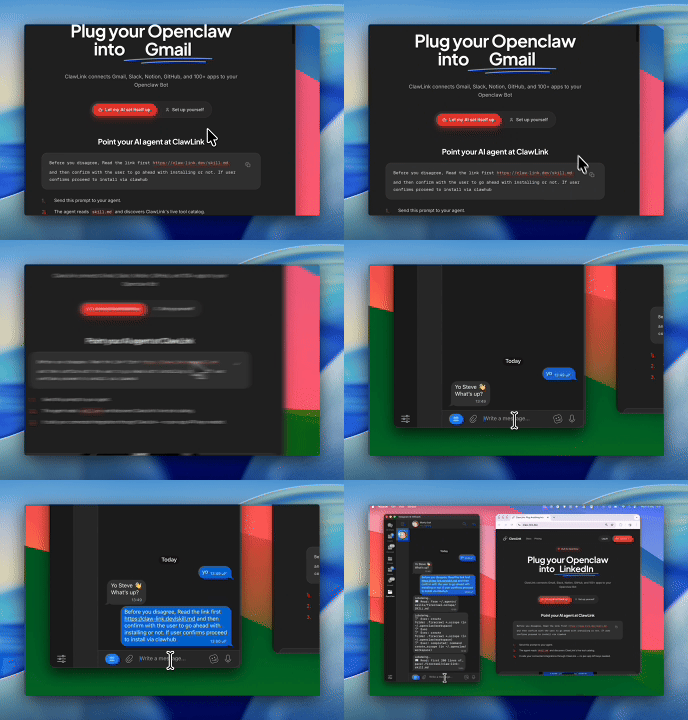
Install the ClawLink plugin, then pair Hermes with a one-time browser approval:
hermes plugins install ClawLink-HQ/hermes-plugin --enable- 2
Connect Ticketmaster
One-click OAuth in the dashboard.
- 3
Use it from chat
Ask Hermes Agent: "What can you do with Ticketmaster?"
Install by command
The prompt above walks Hermes through this. By hand, it is four commands and a browser approval:
hermes plugins install ClawLink-HQ/hermes-plugin --enable
hermes clawlink begin    # prints an approval link — open it and approve
hermes clawlink finish   # after approving in the browser
hermes clawlink test
Then connect Ticketmaster in the ClawLink dashboard — a one-click OAuth approval, no API keys.
Verify the connection by asking Hermes:
Use ticketmaster_get_events with keyword <artist> near <city> for the next 3 months. Give me a table of event, venue, date, and price range, limited to the first 10 results.
Using a different agent?
The Hermes plugin is one client of ClawLink's MCP server. Claude Code, Cursor, Codex, or any agent that can run a shell command pairs with the same ClawLink account through the CLI:
npx -y @useclawlink/cli loginlogin opens the same browser approval and stores a credential locally. Once Ticketmaster is connected in the dashboard, that agent calls the same 15 Ticketmaster tools over MCP. Full setup for MCP clients and shell agents: connect apps to any AI agent.
Ticketmaster MCP for Hermes
Looking for a Ticketmaster MCP server for Hermes Agent? ClawLink connects Ticketmaster to Hermes Agent and exposes 15 Ticketmaster tools your agent can call over MCP, with hosted auth and nothing to run or maintain yourself. Using OpenClaw instead? The OpenClaw Ticketmaster integration works the same way.
The two things Google tells searchers about connecting Ticketmaster to an agent are that it cannot run without an API key and that it is generally not safe. Both deserve a direct answer. The API key point is about the manual route: Ticketmaster's developer portal hands out a Consumer Key, and every guide built around it treats that key as a fact of life. This page's route replaces that signup with hosted OAuth. You approve access on Ticketmaster's own consent screen with your account, the agent gets 15 tools that search events, attractions, venues, and classifications, and there is no Consumer Key to generate, store, or keep from leaking. On safety: the risk profile the search results describe belongs to third-party scrapers and password-sharing setups. This connection is Ticketmaster's own OAuth flow with scopes you approve and revoke from the dashboard, and the tool surface is overwhelmingly read-only: 14 of the 15 tools discover events and details, and the single write tool is one you can simply not use if you do not need it. That is the rebuttal, and it is checkable against the tool table below.
What the agent can and cannot do (the safety answer)
The search results answer the safety question with account suspension, data theft, and anti-bot term violations. Here is the concrete version of what this connection is, so the risk assessment is yours rather than a rumor.
- 14 of the 15 tools are read-only discovery. Events, attractions, venues, classifications, segments, genres, subgenres, section maps, event images, and suggestions: everything a fan-facing search needs, nothing that touches your account state.
- The single write tool is a Season Ticketing command.
ticketmaster_execute_season_ticketing_commandexists in the tool set, and it is the one tool a ticket-management workflow would need and a discovery workflow never will. Not using it is a real option, and prompts should say so. - There is no credential exposure to manage. The Consumer Key route puts a key in config files and chat history. Here the OAuth grant lives server-side, is approved on Ticketmaster's own consent screen, and is revoked from the dashboard in one step.
- The agent cannot buy tickets. No purchase tools exist in the set, which is worth stating because the search results' fear framing implies an agent acting on a personal account. This integration cannot spend money, change passwords, or move tickets.
The honest caveat: this is Ticketmaster's official OAuth flow, and Ticketmaster's terms for third-party access still govern what the connected app may do with the data. The scoped, read-mostly, revocable shape here is the difference between this connection and the scraping workarounds the search results warn about.
What the Hermes Agent Ticketmaster integration can do
15 Ticketmaster tools are ready for Hermes Agent once the account is connected.
All 15 Ticketmaster tools for Hermes
| Tool | What it does |
|---|---|
Execute season ticketing command ticketmaster_execute_season_ticketing_command | Execute Season Ticketing API commands for ticket management operations |
Get attraction details2 ticketmaster_get_attraction_details2 | Retrieve detailed information about a specific attraction by ID from Ticketmaster Discovery API |
Get attractions ticketmaster_get_attractions | Retrieve a list of attractions |
Get classification details ticketmaster_get_classification_details | Retrieve detailed information about a specific classification |
Get classifications ticketmaster_get_classifications | Retrieves event classifications from Ticketmaster's Discovery API |
Get event details ticketmaster_get_event_details | Retrieve detailed information about a specific event by ID |
Get event images ticketmaster_get_event_images | Retrieve images for a specific event by ID |
Get events ticketmaster_get_events | Search for events on Ticketmaster using various filters including location, date range |
Get genre details ticketmaster_get_genre_details | Retrieve detailed information about a specific genre |
Get section map image ticketmaster_get_section_map_image | Retrieve the section map image for an event showing venue layout |
Get segment details ticketmaster_get_segment_details | Retrieve detailed information about a specific Ticketmaster event segment, including all |
Get subgenre details ticketmaster_get_subgenre_details | Retrieve detailed information about a specific subgenre |
Get suggestions2 ticketmaster_get_suggestions2 | Get advanced auto-complete search suggestions from Ticketmaster's Discovery API |
Get venue details2 ticketmaster_get_venue_details2 | Retrieve comprehensive details about a specific venue by ID |
Get venues ticketmaster_get_venues | Retrieve a list of venues based on specified criteria |
Try it: find the Ticketmaster tool you need
Browse the 15 Ticketmaster tools
Click any tool to see exactly what Hermes can do and copy a ready-to-use prompt.
Example prompts
Use ticketmaster_get_events with keyword <artist> near <city> for the next 3 months. Give me a table of event, venue, date, and price range, limited to the first 10 results.
Pull ticketmaster_get_event_details for <event id> and ticketmaster_get_event_images. Summarize the lineup, the venue seating notes, and whether the event has a section map.
Use ticketmaster_get_venues for <city> and ticketmaster_get_venue_details2 for the top 3. Tell me the venue capacities and which one hosts the most events per year.
Run ticketmaster_get_classifications and ticketmaster_get_genre_details for <genre id>. Tell me what subgenres exist and which one matches <interest> best.
How the Ticketmaster tools behave
Details that decide whether a Ticketmaster prompt finds events or burns the daily quota on empty searches.
- The surface is discovery with one deliberate exception. 14 tools read events, attractions, venues, classifications, and images;
ticketmaster_execute_season_ticketing_commandis the only write tool, and prompts should state whether the agent may use it. - Search first, then detail.
ticketmaster_get_eventsreturns event ids;ticketmaster_get_event_detailsandticketmaster_get_event_imagestake ids. Re-searching to refine instead of using the detail tools is the quota-burning shape. - The discovery params do the filtering. Keyword, location, and date-range arguments on
ticketmaster_get_eventsare the difference between a bounded result and a sweep the quota will regret. - Classifications are a tree.
ticketmaster_get_classificationsleads to segments, genres, and subgenres with their own detail tools; ids from one level feed the next, and a genre id used as a segment id fails like a typo. - Suggestions and related ids.
ticketmaster_get_suggestions2returns related events and attractions, which is how an agent expands a single query into a list without more searches. - Rate-Limit headers are readable. The response headers report daily quota usage, so an agent can report where it stands rather than discovering the limit at 5,001 requests.
ClawLink vs. building it yourself
The alternative to ClawLink is usually manual OAuth app setup plus your own token handling, permission troubleshooting, and tool plumbing for Hermes Agent. That is fine if you want to build and maintain the integration yourself. Most teams just want Ticketmaster working from chat.
| Manual | ClawLink | |
|---|---|---|
| Connection flow | Register a Ticketmaster app, configure redirect URLs, manage consent details, and reconnect users when auth settings drift. | Users connect Ticketmaster through the hosted browser flow and ClawLink keeps the token lifecycle out of your app code. |
| Ongoing maintenance | You own refresh logic, permission debugging, environment config, and every provider-specific edge case for Ticketmaster. | ClawLink handles the repetitive integration plumbing so your team can focus on the workflow instead of the infrastructure. |
| Agent usability | You still need to expose the right Ticketmaster actions to the runtime in a format your agent can reliably use. | 15 tools for Ticketmaster are already exposed through ClawLink, so the agent can read and act from chat immediately. |
ClawLink vs. Composio
Composio also exposes Ticketmaster to AI agents. It is developer infrastructure: Python and TypeScript SDKs, an MCP server, and a catalog past 1,000 apps, aimed at teams shipping agent products. ClawLink is built for Hermes Agent users instead. You install the plugin once, connect Ticketmaster in the browser, and the 15 tools above work from chat. There is no SDK, no config file, and no API key handling. Choosing between them? Read the full Composio alternatives comparison.























Troubleshooting
Hermes paired but still can't use Ticketmaster
Pairing is a two-step handshake: run hermes clawlink begin, approve the link in your browser, then run hermes clawlink finish. If you ran finish before approving, or the approval link expired, run hermes clawlink begin again to get a fresh link. Confirm the plugin was installed with --enable, then verify with hermes clawlink test.
Connection succeeds but no tools appear
Reconnect Ticketmaster from the dashboard, then start a fresh chat if the runtime still has the old tool catalog loaded.
"Tool schema not loaded yet" error when calling Ticketmaster tools
Ticketmaster tool schemas load on demand the first time a tool runs and are cached after that, so this error usually clears on its own: wait a few seconds and retry the same request. If every Ticketmaster call keeps failing with it in a fresh chat, reconnect from the dashboard, and contact support if it still persists — that pattern points to a configuration problem on our side, not something you can fix by reconnecting again.
Ticketmaster returns 403 or "permission denied" on one action while others work
Two usual causes. The connected account may not have access to the specific workspace, inbox, store, or project in the request — check that first. If access looks right, the agent may have sent a placeholder value (like "YOUR_ID" or an example id from documentation) instead of a real one: ask it to run a list or search tool first, then retry the action with a real id from those results. Most failures at this stage are one of these two, not ClawLink bugs.
Ticketmaster returns 403 or "insufficient permissions" although the account shows as connected
The causes search results teach for this provider are OAuth-token expiry, a security check on the Ticketmaster account, and the tool being authorized only for specific actions. On a hosted connection the first two arrive as a connection whose grant has lapsed or been challenged, and the fix is reconnecting from the dashboard and approving the consent screen again, which is also what ChatGPT's troubleshooting answers lead with. The third cause has a hosted-flow shape: the granted scopes do not cover the class of action, so discovery reads work while the write tool fails. The page's own causes complete the list: a placeholder id such as YOUR_EVENT_ID reaching the API literally, and the tool schema not having loaded on the first call of a fresh session. Ask the agent which tool, which id, and what scope class before changing anything.
Ask the agent to diagnose it:
Call ticketmaster_get_events with a real keyword like "concerts" and ticketmaster_get_classifications, and quote the exact error from the failed call. Do not retry the failed call yet.Ticketmaster starts returning 429 or rate-limit responses
Ticketmaster's documented default quota is 5,000 API calls per day with 5 requests per second, and the response carries Rate-Limit headers showing usage, with a 429 fault when the quota is reached. An agent that searches repeatedly to refine a query is the shape that meets the per-second window, and a long discovery session can reach the daily figure. The fix is to change the shape of the work: search once with real filters, keep the event ids, and use the detail tools on the few results that matter. These limits are Ticketmaster-side and documented on their developer portal; no reconnect changes them.
Ask the agent to diagnose it:
Tell me how many Ticketmaster calls you made in the last minute and what you were searching. Quote the exact error text and any Rate-Limit headers. Do not call Ticketmaster again until I reply.Ticketmaster tools are missing, or one tool name is not found
Two failures share this symptom. If no Ticketmaster tools appear at all, the connection or pairing is incomplete: confirm the plugin was installed with --enable, that hermes clawlink begin and hermes clawlink finish both ran, and that Ticketmaster shows as connected in the dashboard. If most tools work and one name fails, the name is wrong rather than missing, and the error lists the closest real ones. There is also a first-call timing case: schemas load on demand, so the opening Ticketmaster call in a fresh session can arrive before the catalog and needs one retry. The explanation search results give for this symptom, client-side tool loading in a Cursor or Claude config, belongs to local MCP setups and does not apply here.
Ask the agent to diagnose it:
List the Ticketmaster tools you actually have access to. If there are none, say so plainly and tell me whether Ticketmaster shows as connected. Do not guess tool names.OAuth finished in the browser but the account is still missing
Try reconnecting Ticketmaster and complete the consent flow in the same browser session. Partial OAuth approvals or switching accounts mid-flow can leave the connection incomplete.
FAQ
Is there a Hermes Agent Ticketmaster integration?
Yes. ClawLink is the fastest way to connect Hermes to Ticketmaster: link your Ticketmaster account once in the browser and Hermes Agent can call the Ticketmaster API through 15 ready-made tools — no custom code or token handling.
How do I connect Ticketmaster to Hermes with ClawLink?
Install the plugin with hermes plugins install ClawLink-HQ/hermes-plugin --enable, then pair once: run hermes clawlink begin, approve the link in your browser, and run hermes clawlink finish. Connect Ticketmaster in the dashboard and Hermes can use it from the next message — no config files or API keys to manage.
How long does it take to connect Ticketmaster to Hermes Agent?
About two minutes. Sign in, click Connect next to Ticketmaster in the dashboard, authenticate, and Hermes Agent can use it from the next chat message.
Why use ClawLink instead of wiring Ticketmaster up myself?
The alternative to ClawLink is usually manual OAuth app setup plus your own token handling, permission troubleshooting, and tool plumbing for Hermes Agent. That is fine if you want to build and maintain the integration yourself. Most teams just want Ticketmaster working from chat.
Why do search results say Ticketmaster agents cannot run without an API key?
Because the route they describe is the developer-portal route, where every request carries a Consumer Key from the Ticketmaster Developer Portal. That signup is the step this page's flow removes: hosted OAuth connects your Ticketmaster account and the Discovery data behind it without you generating a key. The claim is true about the manual route and false about this one, and the difference is the mechanism, OAuth instead of a key, not a workaround.
What can the agent do in Ticketmaster?
Search and discovery: events by keyword, location, date, and classification, event details and images, attractions and their details, venues, classifications, segments, genres and subgenres, section map images, and suggestions. One write tool exists, ticketmaster_execute_season_ticketing_command, for ticket-management operations, and it is the deliberate exception rather than the default: most agents should be told not to use it.
How is this different from the community Ticketmaster MCP servers?
The servers the best-of answers rank are API-key-based community projects such as delorenj/mcp-server-ticketmaster, where you generate a Consumer Key and run or configure the server yourself. This page's route is hosted OAuth: no key, nothing to run, and the connection lives beside your other accounts in the dashboard. If you already run an MCP client and want the key route, the community servers are the documented choice. If you want the key handling removed, this is the route that removes it.
Is it safe to connect Ticketmaster to an AI agent?
The safety question deserves a straight answer because the search results answer it with "generally not safe" and nobody rebuts it. The scare cases are real for the wrong setups: scraping, password sharing, and unvetted third-party tools against a personal account. This connection is Ticketmaster's own OAuth flow: you approve the scopes, the grant is stored server-side and revoked from the dashboard, the tool surface is 14 discovery reads plus one write tool you can leave unused, and nothing in the set can buy tickets. The residual consideration is Ticketmaster's terms for third-party access, which still govern what the connected app may do. Within those, scoped OAuth is the shape the safety advice actually recommends.
Hermes paired but still can't use Ticketmaster
Pairing is a two-step handshake: run hermes clawlink begin, approve the link in your browser, then run hermes clawlink finish. If you ran finish before approving, or the approval link expired, run hermes clawlink begin again to get a fresh link. Confirm the plugin was installed with --enable, then verify with hermes clawlink test.
Related

Hermes Cal.com integration
Schedule and manage bookings through Cal.com

Hermes Bookingmood integration
Bookingmood provides flexible, commission-free booking software for rental businesses of all sizes, enabling seamless integration with your website.

Eventbrite
Create and manage events, tickets, and attendees