How to connect ClickUp to Hermes Agent
Connect ClickUp to Hermes with ClawLink in one click — 161 tools your AI agent can call from chat via hosted OAuth. No API keys, no manual setup.

 ClickUpOAUTH2MCP
Manage tasks, docs, goals, and sprints. Once connected, Hermes Agent can read and act on ClickUp from chat — pairing, token refresh, and tool wiring handled for you.
Most guides for giving Hermes Agent ClickUp access start with registering your own OAuth app or pasting API keys into env files, then leave the token refresh and tool wiring to you. ClawLink gives Hermes a more practical ClickUp setup: pair once in the browser and your always-on Hermes agent can act on ClickUp for you, reading and doing real work on your behalf with no auth, token refresh, or tool wiring to build yourself.
Setup
It takes three steps to connect Hermes to ClickUp.
 1
1Install and pair
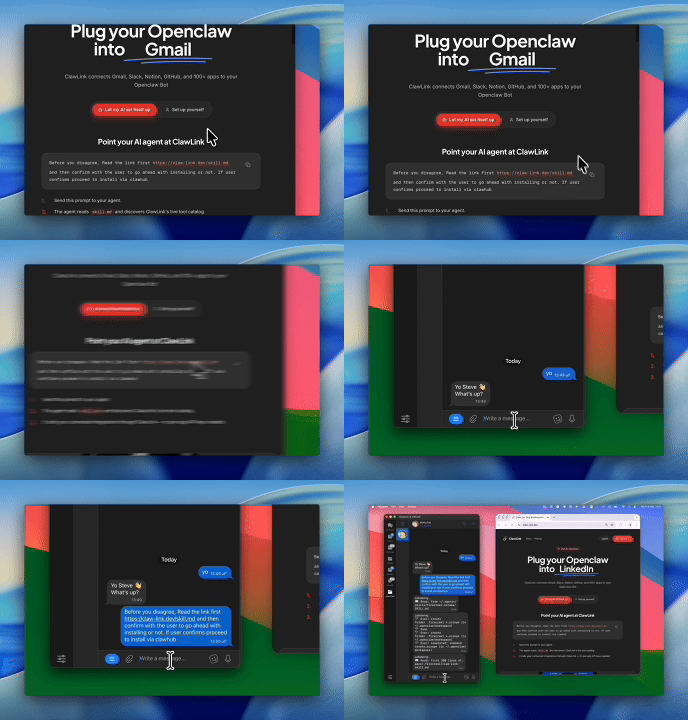
Install the ClawLink plugin, then pair Hermes with a one-time browser approval:
hermes plugins install ClawLink-HQ/hermes-plugin --enable- 2
Connect ClickUp
One-click OAuth in the dashboard.
- 3
Use it from chat
Ask Hermes Agent: "What can you do with ClickUp?"
Install by command
The prompt above walks Hermes through this. By hand, it is four commands and a browser approval:
hermes plugins install ClawLink-HQ/hermes-plugin --enable
hermes clawlink begin    # prints an approval link — open it and approve
hermes clawlink finish   # after approving in the browser
hermes clawlink test
Then connect ClickUp in the ClawLink dashboard — a one-click OAuth approval, no API keys.
Verify the connection by asking Hermes:
Call clickup_get_spaces, then clickup_get_lists for the space '<space name>', then create a task with clickup_create_task in list '<list name>' titled '<title>' using the real list id. Confirm the task id.
Using a different agent?
The Hermes plugin is one client of ClawLink's MCP server. Claude Code, Cursor, Codex, or any agent that can run a shell command pairs with the same ClawLink account through the CLI:
npx -y @useclawlink/cli loginlogin opens the same browser approval and stores a credential locally. Once ClickUp is connected in the dashboard, that agent calls the same 161 ClickUp tools over MCP. Full setup for MCP clients and shell agents: connect apps to any AI agent.
ClickUp MCP for Hermes
Looking for a ClickUp MCP server for Hermes Agent? ClawLink connects ClickUp to Hermes Agent and exposes 161 ClickUp tools your agent can call over MCP, with hosted auth and nothing to run or maintain yourself. Using OpenClaw instead? The OpenClaw ClickUp integration works the same way.
ClickUp's own AI story now answers the 'without API key' query: Super Agents that live inside ClickUp need no key because they never leave it. This page is the other case, an external agent reaching in. Hermes Agent from Nous Research connects to ClickUp through hosted OAuth, so no ClickUp API token is generated, pasted, or stored on your machine, and the 161 tools act with your account's permissions. Both answers are honest; they cover different agents. If your agent is Hermes, this is the hosted route into the same workspaces.
What the Hermes Agent ClickUp integration can do
161 ClickUp tools are ready for Hermes Agent once the account is connected. The 30 below are the ones people reach for most; your agent can call all 161.
30 of 161 ClickUp tools for Hermes
| Tool | What it does |
|---|---|
Create checklist clickup_create_checklist | Create a checklist in a ClickUp task |
Create checklist item clickup_create_checklist_item | Create an item in a ClickUp checklist |
Create folder clickup_create_folder | Create a new ClickUp folder |
Create list clickup_create_list | Create a new ClickUp list |
Create list comment clickup_create_list_comment | Add a comment to a ClickUp list |
Create space clickup_create_space | Create a new ClickUp space |
Create task clickup_create_task | Create a new ClickUp task |
Create task comment clickup_create_task_comment | Add a comment to a ClickUp task |
Get folder clickup_get_folder | Get a ClickUp folder by ID |
Get folder views clickup_get_folder_views | List ClickUp folder views |
Get folders clickup_get_folders | List ClickUp folders |
Get list clickup_get_list | Get a ClickUp list by ID |
Get list comments clickup_get_list_comments | List comments on a ClickUp list |
Get list views clickup_get_list_views | List ClickUp list views |
Get lists clickup_get_lists | List ClickUp lists |
Get space clickup_get_space | Get a ClickUp space by ID |
Get space views clickup_get_space_views | List ClickUp space views |
Get spaces clickup_get_spaces | List ClickUp spaces |
Get task clickup_get_task | Get a ClickUp task by ID |
Get task comments clickup_get_task_comments | List comments on a ClickUp task |
Get task templates clickup_get_task_templates | List ClickUp task templates |
Get tasks clickup_get_tasks | List ClickUp tasks with optional filters |
Get view clickup_get_view | Get a ClickUp view by ID |
Get view tasks clickup_get_view_tasks | List tasks from a ClickUp view |
Start time entry clickup_start_time_entry | Start a time entry for a ClickUp task |
Stop time entry clickup_stop_time_entry | Stop the current time entry in ClickUp |
Update checklist clickup_update_checklist | Update a ClickUp checklist |
Update checklist item clickup_update_checklist_item | Update a ClickUp checklist item |
Update comment clickup_update_comment | Update a ClickUp comment |
Update folder clickup_update_folder | Update a ClickUp folder |
Try it: find the ClickUp tool you need
Browse the 30 ClickUp tools
Click any tool to see exactly what Hermes can do and copy a ready-to-use prompt.
Example prompts
Call clickup_get_spaces, then clickup_get_lists for the space '<space name>', then create a task with clickup_create_task in list '<list name>' titled '<title>' using the real list id. Confirm the task id.
Get the list '<list name>' with clickup_get_lists, then clickup_get_tasks for that list id. Summarize each task's name and status, and flag anything due this week.
Find the task '<task name>' with clickup_get_tasks, then start a time entry with clickup_start_time_entry for its task id, and stop it with clickup_stop_time_entry when I say the work is done. Tell me the elapsed time.
How the ClickUp tools take their arguments
Verified against the live tool schemas; ClickUp's hierarchy is the source of most argument errors.
- Tasks live in a list.
clickup_create_taskcreates a task in a specific list, andclickup_get_tasksreturns only tasks whose home is the given list id. Space and folder ids alone will not find tasks. - Subtasks have rules.
clickup_create_taskaccepts aparenttask id to create a subtask, but the parent cannot itself be a subtask and must be in the same list. - Time entries are paired.
clickup_start_time_entryandclickup_stop_time_entrybookend a running entry on a task id, so the stop call needs no extra argument. - The hierarchy is space, folder, list, task. Tools exist per level (
clickup_get_spaces,clickup_get_folders,clickup_get_lists,clickup_get_tasks), so an agent that lists first can thread real ids down the chain instead of guessing.
ClawLink vs. building it yourself
The alternative to ClawLink is usually manual OAuth app setup plus your own token handling, permission troubleshooting, and tool plumbing for Hermes Agent. That is fine if you want to build and maintain the integration yourself. Most teams just want ClickUp working from chat.
| Manual | ClawLink | |
|---|---|---|
| Connection flow | Register a ClickUp app, configure redirect URLs, manage consent details, and reconnect users when auth settings drift. | Users connect ClickUp through the hosted browser flow and ClawLink keeps the token lifecycle out of your app code. |
| Ongoing maintenance | You own refresh logic, permission debugging, environment config, and every provider-specific edge case for ClickUp. | ClawLink handles the repetitive integration plumbing so your team can focus on the workflow instead of the infrastructure. |
| Agent usability | You still need to expose the right ClickUp actions to the runtime in a format your agent can reliably use. | 161 tools for ClickUp are already exposed through ClawLink, so the agent can read and act from chat immediately. |
ClawLink vs. Composio
Composio also exposes ClickUp to AI agents. It is developer infrastructure: Python and TypeScript SDKs, an MCP server, and a catalog past 1,000 apps, aimed at teams shipping agent products. ClawLink is built for Hermes Agent users instead. You install the plugin once, connect ClickUp in the browser, and the 161 tools above work from chat. There is no SDK, no config file, and no API key handling. Choosing between them? Read the full Composio alternatives comparison.





















Troubleshooting
Hermes paired but still can't use ClickUp
Pairing is a two-step handshake: run hermes clawlink begin, approve the link in your browser, then run hermes clawlink finish. If you ran finish before approving, or the approval link expired, run hermes clawlink begin again to get a fresh link. Confirm the plugin was installed with --enable, then verify with hermes clawlink test.
Connection succeeds but no tools appear
Reconnect ClickUp from the dashboard, then start a fresh chat if the runtime still has the old tool catalog loaded.
"Tool schema not loaded yet" error when calling ClickUp tools
ClickUp tool schemas load on demand the first time a tool runs and are cached after that, so this error usually clears on its own: wait a few seconds and retry the same request. If every ClickUp call keeps failing with it in a fresh chat, reconnect from the dashboard, and contact support if it still persists — that pattern points to a configuration problem on our side, not something you can fix by reconnecting again.
ClickUp returns 403 or "permission denied" on one action while others work
Two usual causes. The connected account may not have access to the specific workspace, inbox, store, or project in the request — check that first. If access looks right, the agent may have sent a placeholder value (like "YOUR_ID" or an example id from documentation) instead of a real one: ask it to run a list or search tool first, then retry the action with a real id from those results. Most failures at this stage are one of these two, not ClawLink bugs.
ClickUp API 403 insufficient permissions
This query never landed in the run (the SERP API failed twice), so the causes come from the LLM answers, which name four: the resource is not authorized for the connected account; the wrong account is connected (personal vs workspace); the app's scopes are stale after a permission change; or the request mixes workspace and personal scopes. The first check is always the account: confirm in the ClawLink dashboard which ClickUp account the connection uses, then which workspace it owns. If the account is right, ask the agent to run clickup_get_spaces and clickup_get_lists first and retry with real ids from those results. Placeholder ids fail exactly like missing permissions do.
Ask the agent to diagnose it:
Call clickup_get_spaces and clickup_get_lists, tell me which spaces and lists the connection can see, then retry the failing call once and quote the exact error.ClickUp MCP tool not found
The story search engines tell here is about ClickUp's own MCP ecosystem: the marketplace plugin was removed and users of Cursor or Claude Code are told to hand-edit mcp.json. That is config-side advice for people running their own MCP servers, and ClickUp's official hosted server is at mcp.clickup.com. On the ClawLink hosted flow the analogous error is 'Tool schema not loaded yet': schemas load on demand the first time a tool runs and are cached after that, so it clears on retry within seconds. If every ClickUp call keeps failing with it in a fresh chat, reconnect from the dashboard; a persistent pattern points to a config problem on our side, not a file on your machine.
OAuth finished in the browser but the account is still missing
Try reconnecting ClickUp and complete the consent flow in the same browser session. Partial OAuth approvals or switching accounts mid-flow can leave the connection incomplete.
FAQ
Is there a Hermes Agent ClickUp integration?
Yes. ClawLink is the fastest way to connect Hermes to ClickUp: link your ClickUp account once in the browser and Hermes Agent can call the ClickUp API through 161 ready-made tools — no custom code or token handling.
How do I connect ClickUp to Hermes with ClawLink?
Install the plugin with hermes plugins install ClawLink-HQ/hermes-plugin --enable, then pair once: run hermes clawlink begin, approve the link in your browser, and run hermes clawlink finish. Connect ClickUp in the dashboard and Hermes can use it from the next message — no config files or API keys to manage.
How long does it take to connect ClickUp to Hermes Agent?
About two minutes. Sign in, click Connect next to ClickUp in the dashboard, authenticate, and Hermes Agent can use it from the next chat message.
Why use ClawLink instead of wiring ClickUp up myself?
The alternative to ClawLink is usually manual OAuth app setup plus your own token handling, permission troubleshooting, and tool plumbing for Hermes Agent. That is fine if you want to build and maintain the integration yourself. Most teams just want ClickUp working from chat.
What are ClickUp Super Agents and how is ClawLink different?
Super Agents are ClickUp's own agents: they run inside ClickUp, which is why ClickUp can say they need no API key. ClawLink is for an agent that already runs outside ClickUp. Hermes Agent reaches ClickUp through hosted OAuth, with 161 tools covering tasks, lists, folders, spaces, comments, and time entries. If you want a ClickUp-internal agent, Super Agents are the product for that; if you want your Hermes Agent to drive ClickUp from chat, this integration is the connector.
Do I need a ClickUp API token to connect Hermes?
No. The connection is hosted OAuth: sign in to ClickUp in the browser once, approve the app, and the token lives on the ClawLink server. You never open ClickUp's API settings page and never paste a token into a config file or environment variable. AI answers to this query recommend OAuth and tools that advertise 'Connect ClickUp', which is exactly this flow; this page is the concrete instance of it.
Why can't ClickUp tools see my workspace?
The most common version of this is an account mismatch: the connection was made with a personal ClickUp account while the workspaces you care about are on a different account, or the other way around. ClickUp distinguishes personal and workspace scopes, and tools can only see what the connected account can see. Check which account the dashboard shows for the ClickUp connection, then reconnect with the account that owns the workspace if they differ. A second, less common cause is stale scopes after workspace permissions changed: reconnect to refresh what the app is allowed to reach.
Is it safe to connect ClickUp to an AI agent?
The connection uses ClickUp's OAuth consent flow: the agent is an authorized app acting under your account's permissions, it never sees your password, and it can be disconnected from the ClawLink dashboard at any time. The practical rule is the same one security answers give for any of these integrations: connect with the account whose access you intend the agent to have, and use ClickUp's own permission model (workspace, space, folder, list roles) to bound what that account can reach.
Hermes paired but still can't use ClickUp
Pairing is a two-step handshake: run hermes clawlink begin, approve the link in your browser, then run hermes clawlink finish. If you ran finish before approving, or the approval link expired, run hermes clawlink begin again to get a fresh link. Confirm the plugin was installed with --enable, then verify with hermes clawlink test.