How to connect HighLevel to Hermes Agent
Connect HighLevel to Hermes with ClawLink: paste your HighLevel key once and 36 tools work from chat. No MCP server to run, nothing stored on your machine.

 HighLevelAPI KEYMCP
All-in-one sales, marketing, and CRM platform. Once connected, Hermes Agent can read and act on HighLevel from chat — pairing, token refresh, and tool wiring handled for you.
Most guides for giving Hermes Agent HighLevel access start with registering your own OAuth app or pasting API keys into env files, then leave the token refresh and tool wiring to you. ClawLink gives Hermes a more practical HighLevel setup: pair once in the browser and your always-on Hermes agent can act on HighLevel for you, reading and doing real work on your behalf with no auth, token refresh, or tool wiring to build yourself.
Setup
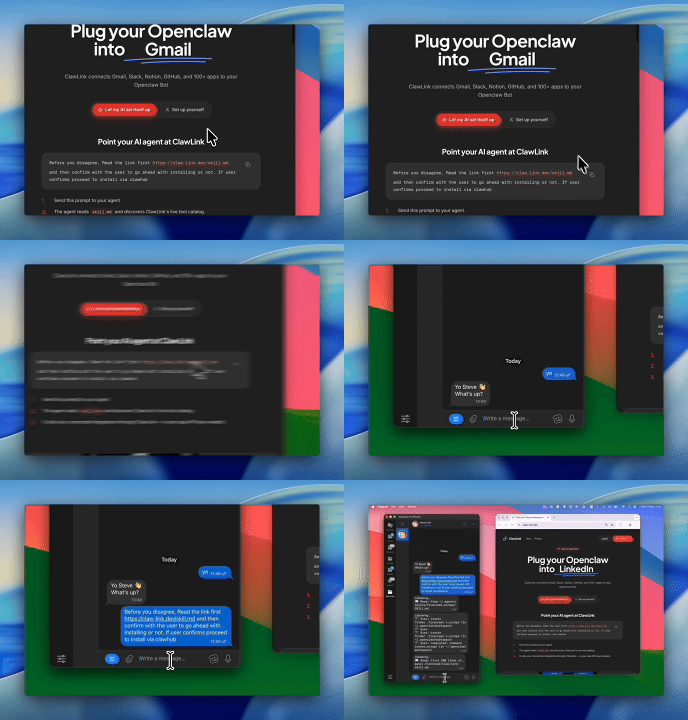
It takes three steps to connect Hermes to HighLevel.
 1
1Install and pair
Install the ClawLink plugin, then pair Hermes with a one-time browser approval:
hermes plugins install ClawLink-HQ/hermes-plugin --enable- 2
Connect HighLevel
Paste your API key in the dashboard.
- 3
Use it from chat
Ask Hermes Agent: "What can you do with HighLevel?"
Install by command
The prompt above walks Hermes through this. By hand, it is four commands and a browser approval:
hermes plugins install ClawLink-HQ/hermes-plugin --enable
hermes clawlink begin    # prints an approval link — open it and approve
hermes clawlink finish   # after approving in the browser
hermes clawlink test
Then connect HighLevel in the ClawLink dashboard — paste your HighLevel API key once.
Verify the connection by asking Hermes:
Run highlevel_get_conversations and highlevel_get_pipelines, then highlevel_get_calendars_events_appointments for today, and give me one summary with counts per channel and stage.
Using a different agent?
The Hermes plugin is one client of ClawLink's MCP server. Claude Code, Cursor, Codex, or any agent that can run a shell command pairs with the same ClawLink account through the CLI:
npx -y @useclawlink/cli loginlogin opens the same browser approval and stores a credential locally. Once HighLevel is connected in the dashboard, that agent calls the same 36 HighLevel tools over MCP. Full setup for MCP clients and shell agents: connect apps to any AI agent.
HighLevel MCP for Hermes
Looking for a HighLevel MCP server for Hermes Agent? ClawLink connects HighLevel to Hermes Agent and exposes 36 HighLevel tools your agent can call over MCP, with hosted auth and nothing to run or maintain yourself. Using OpenClaw instead? The OpenClaw HighLevel integration works the same way.
The route every search result teaches is a Private Integration Token: generate one with the right scopes, paste it with a sub-account ID into a JSON mcpServers block, and point Hermes at it. This page is the hosted version: you sign in to HighLevel once in a browser, approve the connection, and the 94 tools below work from chat. No token is generated, no config file is edited, and the scopes come from the OAuth grant rather than from a token you maintain. Least privilege here is by construction: the connection carries exactly the access you approve, it is revocable from the dashboard, and there is no key to leak.
What the Hermes Agent HighLevel integration can do
36 HighLevel tools are ready for Hermes Agent once the account is connected. The 30 below are the ones people reach for most; your agent can call all 36.
30 of 36 HighLevel tools for Hermes
| Tool | What it does |
|---|---|
Mcp blogs check URL slug exists highlevel_mcp_blogs_check_url_slug_exists | Validates whether a URL slug is available for a blog post before publishing |
Mcp blogs get all blog authors by location highlevel_mcp_blogs_get_all_blog_authors_by_location | Retrieves all blog authors for a specific location with pagination support |
Mcp blogs get all categories by location highlevel_mcp_blogs_get_all_categories_by_location | Retrieves all blog categories for a specific location with pagination support |
Mcp blogs get blog post highlevel_mcp_blogs_get_blog_post | Retrieves blog posts for a specific blog site using blog ID with filtering and pagination |
Mcp blogs get blogs highlevel_mcp_blogs_get_blogs | Retrieves a list of blog sites for a location with pagination and search support |
Mcp calendars get appointment notes highlevel_mcp_calendars_get_appointment_notes | Retrieves notes associated with a specific appointment |
Mcp calendars get calendar events highlevel_mcp_calendars_get_calendar_events | Retrieves calendar events and appointments within a specified time range |
Mcp contacts get all tasks highlevel_mcp_contacts_get_all_tasks | Retrieves all tasks associated with a specific contact |
Mcp contacts get contact highlevel_mcp_contacts_get_contact | Retrieves detailed contact information by contact ID |
Mcp contacts get contacts highlevel_mcp_contacts_get_contacts | Retrieves a list of contacts with pagination support |
Mcp conversations get messages highlevel_mcp_conversations_get_messages | Retrieves messages from a specific conversation with optional filtering by message type |
Mcp conversations search conversation highlevel_mcp_conversations_search_conversation | Searches conversations using multiple filters including contact, assigned user, followers |
Mcp emails fetch template highlevel_mcp_emails_fetch_template | Retrieves email templates for a location with advanced filtering and pagination |
Mcp locations get custom fields highlevel_mcp_locations_get_custom_fields | Retrieves custom fields for a location with optional filtering by model type |
Mcp locations get location highlevel_mcp_locations_get_location | Retrieves detailed information for a sub-account (formerly location) by location ID |
Mcp opportunities get opportunity highlevel_mcp_opportunities_get_opportunity | Retrieves detailed information for a specific opportunity by opportunity ID |
Mcp opportunities get pipelines highlevel_mcp_opportunities_get_pipelines | Retrieves all sales pipelines for a location |
Mcp opportunities search opportunity highlevel_mcp_opportunities_search_opportunity | Searches and filters opportunities in the sales pipeline using multiple criteria |
Mcp payments get order by ID highlevel_mcp_payments_get_order_by_id | Retrieves detailed information for a specific order using its unique order ID |
Mcp payments list transactions highlevel_mcp_payments_list_transactions | Retrieves a paginated list of transactions with comprehensive filtering options |
Mcp social media posting get account highlevel_mcp_social_media_posting_get_account | Retrieves a list of connected social media accounts and groups for a location |
Mcp social media posting get post highlevel_mcp_social_media_posting_get_post | Retrieves detailed information for a specific social media post by post ID |
Mcp social media posting get posts highlevel_mcp_social_media_posting_get_posts | Retrieves social media posts with advanced filtering and pagination |
Mcp social media posting get social media statistics highlevel_mcp_social_media_posting_get_social_media_statistics | Retrieve analytics data for multiple social media accounts |
Mcp blogs create blog post highlevel_mcp_blogs_create_blog_post | Creates a new blog post for a blog site with comprehensive content and metadata |
Mcp blogs update blog post highlevel_mcp_blogs_update_blog_post | Modifies an existing blog post including content, metadata, categories, tags, and publication |
Mcp contacts add tags highlevel_mcp_contacts_add_tags | Adds one or more tags to an existing contact record |
Mcp contacts create contact highlevel_mcp_contacts_create_contact | Creates a new contact record in the CRM with personal and business information |
Mcp contacts update contact highlevel_mcp_contacts_update_contact | Modifies existing contact information in the CRM |
Mcp contacts upsert contact highlevel_mcp_contacts_upsert_contact | Creates a new contact or updates an existing contact based on duplicate detection settings |
Try it: find the HighLevel tool you need
Browse the 30 HighLevel tools
Click any tool to see exactly what Hermes can do and copy a ready-to-use prompt.
Example prompts
Run highlevel_get_conversations and highlevel_get_pipelines, then highlevel_get_calendars_events_appointments for today, and give me one summary with counts per channel and stage.
Take the conversation <id> with highlevel_get_conversations_messages2 and summarise the thread, who last replied, and whether anything needs an action.
Run highlevel_get_emails_templates and highlevel_get_emails_campaigns_emails and tell me which templates are in use and which campaigns have sent recently.
Run highlevel_generate_estimate_number and tell me the number, and note that I will use it in an invoice.
How the HighLevel tools behave
Facts that keep HighLevel prompts inside the location the connection owns.
- HighLevel is location-scoped. Conversations, calendars, and pipeline data belong to a location, and the connection acts as the account approved at setup. Location-restricted 403s come back before any data does.
- Calendars split across three tools. Events and appointments, schedules, and services and bookings are separate reads; "what is on the calendar" needs two of them.
- Conversations and messages are two calls.
highlevel_get_conversationslists the threads andhighlevel_get_conversations_messages2reads one thread's messages. Name the conversation id from the first call before asking for messages. - Email surfaces are separate. Templates, campaign emails, and campaign bulk actions each have their own tool; "what did we send" usually means the campaigns tool.
- Funnel pages are read-only here.
highlevel_get_funnels_pageandhighlevel_get_funnels_page_countreport the pages; there is no funnel builder in the tool set. - Agent Studio agents are readable.
highlevel_get_agent_studio_public_api_agentslists the published agents for a location, which is how the agent checks what HighLevel's own automation is already doing.
ClawLink vs. building it yourself
The alternative to ClawLink is usually manual API key setup plus your own token handling, permission troubleshooting, and tool plumbing for Hermes Agent. That is fine if you want to build and maintain the integration yourself. Most teams just want HighLevel working from chat.
| Manual | ClawLink | |
|---|---|---|
| Credential handling | Collect, validate, store, and rotate the HighLevel API key yourself, then make sure every tool call uses the right account. | Users complete the hosted ClawLink setup once and the connected HighLevel account becomes available to the agent without you building credential management. |
| Ongoing maintenance | You own refresh logic, permission debugging, environment config, and every provider-specific edge case for HighLevel. | ClawLink handles the repetitive integration plumbing so your team can focus on the workflow instead of the infrastructure. |
| Agent usability | You still need to expose the right HighLevel actions to the runtime in a format your agent can reliably use. | 36 tools for HighLevel are already exposed through ClawLink, so the agent can read and act from chat immediately. |
ClawLink vs. Composio
Composio also exposes HighLevel to AI agents. It is developer infrastructure: Python and TypeScript SDKs, an MCP server, and a catalog past 1,000 apps, aimed at teams shipping agent products. ClawLink is built for Hermes Agent users instead. You install the plugin once, connect HighLevel in the browser, and the 36 tools above work from chat. There is no SDK and no config file, and the HighLevel key you paste at setup is stored server-side rather than kept in your environment. Choosing between them? Read the full Composio alternatives comparison.























Troubleshooting
Hermes paired but still can't use HighLevel
Pairing is a two-step handshake: run hermes clawlink begin, approve the link in your browser, then run hermes clawlink finish. If you ran finish before approving, or the approval link expired, run hermes clawlink begin again to get a fresh link. Confirm the plugin was installed with --enable, then verify with hermes clawlink test.
Connection succeeds but no tools appear
Reconnect HighLevel from the dashboard, then start a fresh chat if the runtime still has the old tool catalog loaded.
"Tool schema not loaded yet" error when calling HighLevel tools
HighLevel tool schemas load on demand the first time a tool runs and are cached after that, so this error usually clears on its own: wait a few seconds and retry the same request. If every HighLevel call keeps failing with it in a fresh chat, reconnect from the dashboard, and contact support if it still persists — that pattern points to a configuration problem on our side, not something you can fix by reconnecting again.
HighLevel returns 403 or "permission denied" on one action while others work
Two usual causes. The connected account may not have access to the specific workspace, inbox, store, or project in the request — check that first. If access looks right, the agent may have sent a placeholder value (like "YOUR_ID" or an example id from documentation) instead of a real one: ask it to run a list or search tool first, then retry the action with a real id from those results. Most failures at this stage are one of these two, not ClawLink bugs.
HighLevel returns 403 "insufficient permissions" while the account shows as connected
The engines teach three causes, all token-shape: a valid token restricted to the wrong location, which shows up as mismatched location IDs; a company-level token used against location-level endpoints; and missing OAuth scopes. Their fix is "regenerate your PIT scopes", which has no equivalent in a hosted flow, because the permission comes from the OAuth grant, not from a token you maintain. The hosted equivalents: confirm the HighLevel account and location the connection was approved with, and reconnect from the dashboard to re-approve the grant. If some tools work and others fail, the failing family is where the scope gap is.
Ask the agent to diagnose it:
List the HighLevel tools you actually have and tell me which location the account shows. Run highlevel_get_conversations once, quote the exact error, and do not retry it.HighLevel tools are missing, or one tool name is not found
In the manual world the taught cause is un-checked scopes in the Private Integration: Settings, then Private Integrations, then selecting the required scopes, then updating the local configuration file. In the hosted world scopes ride the OAuth grant: if a whole tool family is absent, the connection lacks that scope, and reconnecting after re-approving is the fix. If one name fails, it is wrong rather than missing, and the error lists the nearest real tools. Schemas load on demand, so the first HighLevel call in a fresh session can arrive before the catalog and needs one retry. The taught "update your local configuration file" step does not apply, because there is no local configuration file.
Ask the agent to diagnose it:
List the HighLevel tools you have available and tell me whether the missing one is part of a family, for example calendars or emails. Then use the exact name from the list.API key setup works but results look incomplete
Double-check that the API key for HighLevel has the right scopes or account access. A valid key can still be too limited for some reads or writes.
FAQ
Is there a Hermes Agent HighLevel integration?
Yes. ClawLink is the fastest way to connect Hermes to HighLevel: link your HighLevel account once in the browser and Hermes Agent can call the HighLevel API through 36 ready-made tools — no custom code or token handling.
How do I connect HighLevel to Hermes with ClawLink?
Install the plugin with hermes plugins install ClawLink-HQ/hermes-plugin --enable, then pair once: run hermes clawlink begin, approve the link in your browser, and run hermes clawlink finish. Connect HighLevel in the dashboard and Hermes can use it from the next message — no config files, and the HighLevel key you paste is stored server-side instead of in your environment.
How long does it take to connect HighLevel to Hermes Agent?
About two minutes. Sign in, click Connect next to HighLevel in the dashboard, authenticate, and Hermes Agent can use it from the next chat message.
Why use ClawLink instead of wiring HighLevel up myself?
The alternative to ClawLink is usually manual API key setup plus your own token handling, permission troubleshooting, and tool plumbing for Hermes Agent. That is fine if you want to build and maintain the integration yourself. Most teams just want HighLevel working from chat.
How does this connect without API keys?
HighLevel connects through hosted OAuth: you sign in to HighLevel on their screen, approve the access, and ClawLink holds the token server-side. The manual route exists because the engines only know it: generate a Private Integration Token, choose scopes, write an mcpServers entry pointing at services.leadconnectorhq.com, and restart the agent. The hosted flow removes the token generation and the config file. Revoking the connection in the dashboard ends the agent's access.
What can the agent do in HighLevel?
The 94 tools cover the platform's surface: conversations and messages, calendars with appointments, schedules, services, and bookings, pipelines, funnel pages, email templates and campaigns, invoices and schedules, tasks, notes, tags, blogs, custom values, media files, brand boards and brand voice, marketplace rebilling configuration, and the Agent Studio agents published for a location. Reads dominate. The writes to be deliberate about are creating a tag or generating an estimate number, both of which land in real account data.
Company account or location: what does the connection see?
HighLevel structures everything by location, and the permission errors the engines teach are location-shaped: mismatched location IDs, a company-level token used against location-level endpoints, and missing OAuth scopes. The hosted connection sees what the HighLevel account you signed in with can reach. If tools return location errors, the first check is which account and location the connection was approved with.
Is it safe to connect HighLevel to an agent?
The safety advice the engines repeat is generic: use API keys wisely, limit permissions, monitor activity. This connection is the concrete version of that advice: no key exists to leak, the OAuth grant sets the permissions, the connection is revocable from the dashboard, and nothing is written to any machine you use.
Hermes paired but still can't use HighLevel
Pairing is a two-step handshake: run hermes clawlink begin, approve the link in your browser, then run hermes clawlink finish. If you ran finish before approving, or the approval link expired, run hermes clawlink begin again to get a fresh link. Confirm the plugin was installed with --enable, then verify with hermes clawlink test.
Related

Connect CentralStationCRM
CentralStationCRM is an easy-to-use CRM software focusing on collaboration and long-term customer relationships.
Salesforce tools
Manage CRM data and workflows

RepairShopr
RepairShopr is a comprehensive repair shop management software designed to streamline operations, manage customer relationships, and enhance business efficiency.