How to connect Webex to Hermes Agent
Connect Webex to Hermes with ClawLink in one click — 26 tools your AI agent can call from chat via hosted OAuth. No API keys, no manual setup.


 WebexOAUTH2MCP
Schedule and manage meetings, calls, and team messaging. Once connected, Hermes Agent can read and act on Webex from chat — pairing, token refresh, and tool wiring handled for you.
Most guides for giving Hermes Agent Webex access start with registering your own OAuth app or pasting API keys into env files, then leave the token refresh and tool wiring to you. ClawLink gives Hermes a more practical Webex setup: pair once in the browser and your always-on Hermes agent can act on Webex for you, reading and doing real work on your behalf with no auth, token refresh, or tool wiring to build yourself.
Setup
It takes three steps to connect Hermes to Webex.
 1
1Install and pair
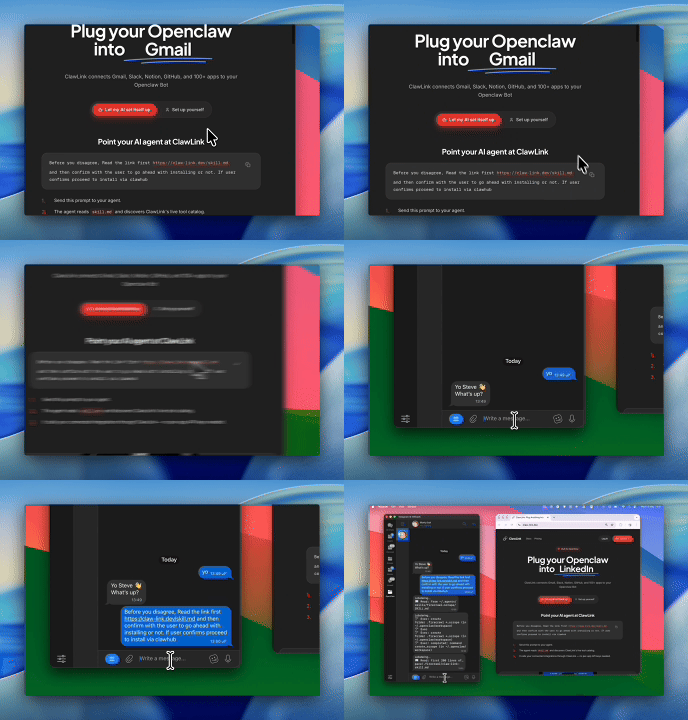
Install the ClawLink plugin, then pair Hermes with a one-time browser approval:
hermes plugins install ClawLink-HQ/hermes-plugin --enable- 2
Connect Webex
One-click OAuth in the dashboard.
- 3
Use it from chat
Ask Hermes Agent: "What can you do with Webex?"
Install by command
The prompt above walks Hermes through this. By hand, it is four commands and a browser approval:
hermes plugins install ClawLink-HQ/hermes-plugin --enable
hermes clawlink begin    # prints an approval link — open it and approve
hermes clawlink finish   # after approving in the browser
hermes clawlink test
Then connect Webex in the ClawLink dashboard — a one-click OAuth approval, no API keys.
Verify the connection by asking Hermes:
List my rooms with webex_list_rooms, then webex_messaging_list_messages for <room id> limited to the last 25. Summarize the thread and who is waiting on whom. Do not post anything.
Using a different agent?
The Hermes plugin is one client of ClawLink's MCP server. Claude Code, Cursor, Codex, or any agent that can run a shell command pairs with the same ClawLink account through the CLI:
npx -y @useclawlink/cli loginlogin opens the same browser approval and stores a credential locally. Once Webex is connected in the dashboard, that agent calls the same 26 Webex tools over MCP. Full setup for MCP clients and shell agents: connect apps to any AI agent.
Webex MCP for Hermes
Looking for a Webex MCP server for Hermes Agent? ClawLink connects Webex to Hermes Agent and exposes 26 Webex tools your agent can call over MCP, with hosted auth and nothing to run or maintain yourself. Using OpenClaw instead? The OpenClaw Webex integration works the same way.
Google's own answer to the Webex-plus-Hermes query already describes this page's route: authenticate through the browser via hosted OAuth to give Hermes one-click access to Webex tools without manually managing API keys or token refreshes. That is the arrangement, and the job of this pass is to make sure the error pages searchers hit next agree. The routes the search results otherwise teach are a Composio Connect config file and a custom Webex bot: register a bot in the Developer Portal, hold a bearer token, and keep a webhook running. Both are real, and both assume you want to run infrastructure. This page's route is the third option: approve Webex access in the browser, and the 26 tools below, messaging, rooms, teams, people, and webhooks, are callable from chat with the token lifecycle handled server-side. The one Webex fact worth repeating from the search results: Cisco's own MCP servers are Meetings, Messaging, and Vidcast surfaces that need Control Hub admin provisioning. No admin step is required here; your own Webex login is the whole authorization.
What the Hermes Agent Webex integration can do
26 Webex tools are ready for Hermes Agent once the account is connected. The 22 below are the ones people reach for most; your agent can call all 26.
22 of 26 Webex tools for Hermes
| Tool | What it does |
|---|---|
Get team details webex_get_team_details | Retrieve details for a specific team by teamId |
List teams webex_list_teams | Lists all teams the authenticated user belongs to |
List webhooks webex_list_webhooks | Lists all webhooks registered for the authenticated user or organization |
Messaging get membership details webex_messaging_get_membership_details | Retrieve details for a specific membership |
Messaging get message details webex_messaging_get_message_details | Retrieve details for a specific message |
Messaging get team membership details webex_messaging_get_team_membership_details | Retrieve details for a specific team membership |
Messaging list memberships webex_messaging_list_memberships | List memberships in Webex rooms |
Messaging list messages webex_messaging_list_messages | List messages in a room |
Messaging list rooms webex_messaging_list_rooms | List rooms the authenticated user belongs to |
Messaging list team memberships webex_messaging_list_team_memberships | List all memberships for a specific team |
People get person webex_people_get_person | Retrieves detailed profile information for a specific person by their ID |
People list people webex_people_list_people | List people in your organization |
Rooms get room details webex_rooms_get_room_details | Retrieve details for a specific room |
Webhooks get webhook webex_webhooks_get_webhook | Retrieves detailed information about a specific Webex webhook by its ID |
Create team webex_create_team | Creates a new Webex team and automatically adds the authenticated user as a member |
Messaging create message webex_messaging_create_message | Post a message to a Webex room or person |
Messaging create room webex_messaging_create_room | Creates a new Webex room for team collaboration |
Messaging create team membership webex_messaging_create_team_membership | Add a person to a Webex team by personId or personEmail |
Update membership webex_update_membership | Updates a Webex room membership by ID to change moderator or monitor status |
Update room webex_update_room | Update a room's title, lock status, or team association |
Update team webex_update_team | Update a team's name by teamId |
Webhooks create webhook webex_webhooks_create_webhook | Creates a Webex webhook to receive real-time event notifications via HTTP POST requests to your |
Try it: find the Webex tool you need
Browse the 22 Webex tools
Click any tool to see exactly what Hermes can do and copy a ready-to-use prompt.
Example prompts
List my rooms with webex_list_rooms, then webex_messaging_list_messages for <room id> limited to the last 25. Summarize the thread and who is waiting on whom. Do not post anything.
Draft a message to <room id> about <topic> using webex_messaging_create_message, and show me the exact text before sending. Do not send until I approve.
Run webex_list_teams and webex_messaging_list_team_memberships for each team. Tell me which teams I belong to and who is on them.
List my webhooks with webex_list_webhooks and tell me what events they watch and where they point. Flag any that target a URL I have not approved.
How the Webex tools behave
Details that decide whether a Webex prompt is a quick answer or a visible post in a room full of people.
- Messaging is a room-or-person shape.
webex_messaging_create_messageposts to a room or a person, and the id for either comes fromwebex_list_roomsorwebex_people_list_people. An id from memory fails like a typo, and a message to the wrong room is worse than an error. - Rooms and teams are separate trees.
webex_rooms_get_room_detailsandwebex_get_team_detailsread different objects; a room id passed as a team id fails, andwebex_messaging_list_team_membershipsversuswebex_messaging_list_membershipsis the same distinction at membership level. - Webhooks keep running.
webex_webhooks_create_webhookregisters a standing subscription with a target URL, so creating one is account state that persists beyond the chat, which makes it a confirmation-step tool. - People tools are the lookup surface.
webex_people_list_peopleandwebex_people_get_personresolve names to ids, which is the correct prelude to sending someone a message or adding a membership. - Visibility follows the user. The connected account's own memberships and roles decide what the tools can see; permission-shaped errors on rooms are Webex enforcing that, not a connection fault.
- The write surface is genuinely visible. Messages, rooms, and team memberships are shared objects other people are looking at, which is why the toolNotes and prompts keep putting a confirmation step between the agent and the send.
ClawLink vs. building it yourself
The alternative to ClawLink is usually manual OAuth app setup plus your own token handling, permission troubleshooting, and tool plumbing for Hermes Agent. That is fine if you want to build and maintain the integration yourself. Most teams just want Webex working from chat.
| Manual | ClawLink | |
|---|---|---|
| Connection flow | Register a Webex app, configure redirect URLs, manage consent details, and reconnect users when auth settings drift. | Users connect Webex through the hosted browser flow and ClawLink keeps the token lifecycle out of your app code. |
| Ongoing maintenance | You own refresh logic, permission debugging, environment config, and every provider-specific edge case for Webex. | ClawLink handles the repetitive integration plumbing so your team can focus on the workflow instead of the infrastructure. |
| Agent usability | You still need to expose the right Webex actions to the runtime in a format your agent can reliably use. | 26 tools for Webex are already exposed through ClawLink, so the agent can read and act from chat immediately. |
ClawLink vs. Composio
Composio also exposes Webex to AI agents. It is developer infrastructure: Python and TypeScript SDKs, an MCP server, and a catalog past 1,000 apps, aimed at teams shipping agent products. ClawLink is built for Hermes Agent users instead. You install the plugin once, connect Webex in the browser, and the 26 tools above work from chat. There is no SDK, no config file, and no API key handling. Choosing between them? Read the full Composio alternatives comparison.
























Troubleshooting
Hermes paired but still can't use Webex
Pairing is a two-step handshake: run hermes clawlink begin, approve the link in your browser, then run hermes clawlink finish. If you ran finish before approving, or the approval link expired, run hermes clawlink begin again to get a fresh link. Confirm the plugin was installed with --enable, then verify with hermes clawlink test.
Connection succeeds but no tools appear
Reconnect Webex from the dashboard, then start a fresh chat if the runtime still has the old tool catalog loaded.
"Tool schema not loaded yet" error when calling Webex tools
Webex tool schemas load on demand the first time a tool runs and are cached after that, so this error usually clears on its own: wait a few seconds and retry the same request. If every Webex call keeps failing with it in a fresh chat, reconnect from the dashboard, and contact support if it still persists — that pattern points to a configuration problem on our side, not something you can fix by reconnecting again.
Webex returns 403 or "permission denied" on one action while others work
Two usual causes. The connected account may not have access to the specific workspace, inbox, store, or project in the request — check that first. If access looks right, the agent may have sent a placeholder value (like "YOUR_ID" or an example id from documentation) instead of a real one: ask it to run a list or search tool first, then retry the action with a real id from those results. Most failures at this stage are one of these two, not ClawLink bugs.
Webex returns 403 or "insufficient permissions" although the account shows as connected
Webex 403s are about what the credential can reach, and the taught causes are missing OAuth scopes, the user lacking an administrative role, and the license type not covering the endpoint. On a hosted connection the first cause is the one that bites: a partial approval on Webex's consent screen leaves the connection active but unable to do a class of action, so reads work and writes fail. The token-refresh advice the search results give, re-running the OAuth flow because there is no token file to edit, translates here to reconnecting from the dashboard. The page's own causes complete the list: a placeholder id such as YOUR_ROOM_ID reaching the API literally, and visibility, since Webex returns permission errors for rooms the connected user cannot see.
Ask the agent to diagnose it:
Call webex_list_rooms and tell me how many rooms are visible, then webex_people_get_person for yourself and say which account this is. Quote the exact error from the failed call. Do not retry it yet.Webex starts returning 429 or rate-limit responses
Webex REST APIs enforce a default rate limit of around 300 requests per minute, dynamic per resource, with a 429 Too Many Requests response carrying a Retry-After header telling you the pause in seconds. An agent that lists rooms, then messages, then memberships across a large workspace is the shape that meets the window. The fix is to change the shape of the work and honour the header: ask for the rooms you actually need, use the membership and message list tools once instead of in loops, and have the agent read and report the Retry-After value rather than retry blind. The limits are Webex-side and documented on developer.webex.com; no reconnect changes them.
Ask the agent to diagnose it:
Tell me how many Webex calls you made in the last minute and what you were listing. Quote the exact error text and any Retry-After header. Do not call Webex again until I reply.Webex tools are missing, or one tool name is not found
Two failures share this symptom. If no Webex tools appear at all, the connection or pairing is incomplete: confirm the plugin was installed with --enable, that hermes clawlink begin and hermes clawlink finish both ran, and that Webex shows as connected in the dashboard. If most tools work and one name fails, the name is wrong rather than missing, and the error lists the closest real ones. There is also a first-call timing case: schemas load on demand, so the opening Webex call in a fresh session can arrive before the catalog and needs one retry. The checklist search results teach for this symptom, a malformed MCP URL or a key inside an mcpServers path, belongs to the manual setup and does not apply here.
Ask the agent to diagnose it:
List the Webex tools you actually have access to. If there are none, say so plainly and tell me whether Webex shows as connected. Do not guess tool names.OAuth finished in the browser but the account is still missing
Try reconnecting Webex and complete the consent flow in the same browser session. Partial OAuth approvals or switching accounts mid-flow can leave the connection incomplete.
FAQ
Is there a Hermes Agent Webex integration?
Yes. ClawLink is the fastest way to connect Hermes to Webex: link your Webex account once in the browser and Hermes Agent can call the Webex API through 26 ready-made tools — no custom code or token handling.
How do I connect Webex to Hermes with ClawLink?
Install the plugin with hermes plugins install ClawLink-HQ/hermes-plugin --enable, then pair once: run hermes clawlink begin, approve the link in your browser, and run hermes clawlink finish. Connect Webex in the dashboard and Hermes can use it from the next message — no config files or API keys to manage.
How long does it take to connect Webex to Hermes Agent?
About two minutes. Sign in, click Connect next to Webex in the dashboard, authenticate, and Hermes Agent can use it from the next chat message.
Why use ClawLink instead of wiring Webex up myself?
The alternative to ClawLink is usually manual OAuth app setup plus your own token handling, permission troubleshooting, and tool plumbing for Hermes Agent. That is fine if you want to build and maintain the integration yourself. Most teams just want Webex working from chat.
Which token does the agent use, and where does it live?
The connection uses an OAuth token granted through Webex's own consent screen, stored server-side and refreshed for you. That is the difference between this route and the bot route the search results teach, where you register a bot in the Developer Portal and keep its bearer token in config: a bot token is a long-lived credential on your machine, while this grant is revocable from the dashboard and carries your own user's permissions. If search results tell you a Webex token expired and needs a re-run of the OAuth flow, that advice applies to manual setups; here the refresh is the hosted part.
How is this different from Cisco's official Webex MCP servers?
Cisco ships official MCP servers for Meetings, Messaging, and Vidcast, and they win the best-of answers. They are administered through Control Hub: an admin provisions the integration, which is a non-starter for a user who just wants their agent in their own spaces. This page's route needs no admin: your Webex login authorizes the connection, and the 26 tools cover messaging, rooms, teams, people, and webhooks under your own permissions. If you have Control Hub admin rights and want Cisco's own servers, they are the native choice. If you want the agent to work in the spaces you already belong to, this is the route that works without asking anyone.
What can the agent do in Webex?
Messaging: list rooms, read and create messages, manage memberships and team memberships. Spaces and teams: create and update rooms and teams. People: list and read people. Webhooks: list, read, and create webhooks, which is how an agent subscribes to events rather than polling. The write surface is real and visible: creating a message posts into a room other people are in, so message prompts deserve a confirmation step, and creating a webhook is account state that keeps running.
Why does the agent only see some rooms?
Because Webex visibility follows the connected user. The agent sees the rooms, teams, and memberships your account can see, and a room outside that visibility returns a permission error rather than a not-found. That is Webex enforcing its model, not a broken connection. If a room the user should see is missing, the usual cause is a partial or changed grant, and the fix is reconnecting from the dashboard and approving the full scope set on the consent screen.
Hermes paired but still can't use Webex
Pairing is a two-step handshake: run hermes clawlink begin, approve the link in your browser, then run hermes clawlink finish. If you ran finish before approving, or the approval link expired, run hermes clawlink begin again to get a fresh link. Confirm the plugin was installed with --enable, then verify with hermes clawlink test.