How to connect Vercel to Hermes Agent
Connect Vercel to Hermes Agent with ClawLink: paste your Vercel access token once and 131 tools work from chat, covering deployments, projects, domains, environment variables, and teams. Optional team scope for team projects.


 VercelAPI KEYMCP
Manage projects, deployments, domains, and environment variables. Once connected, Hermes Agent can read and act on Vercel from chat — pairing, token refresh, and tool wiring handled for you.
Most guides for giving Hermes Agent Vercel access start with registering your own OAuth app or pasting API keys into env files, then leave the token refresh and tool wiring to you. ClawLink gives Hermes a more practical Vercel setup: pair once in the browser and your always-on Hermes agent can act on Vercel for you, reading and doing real work on your behalf with no auth, token refresh, or tool wiring to build yourself.
Setup
It takes three steps to connect Hermes to Vercel.
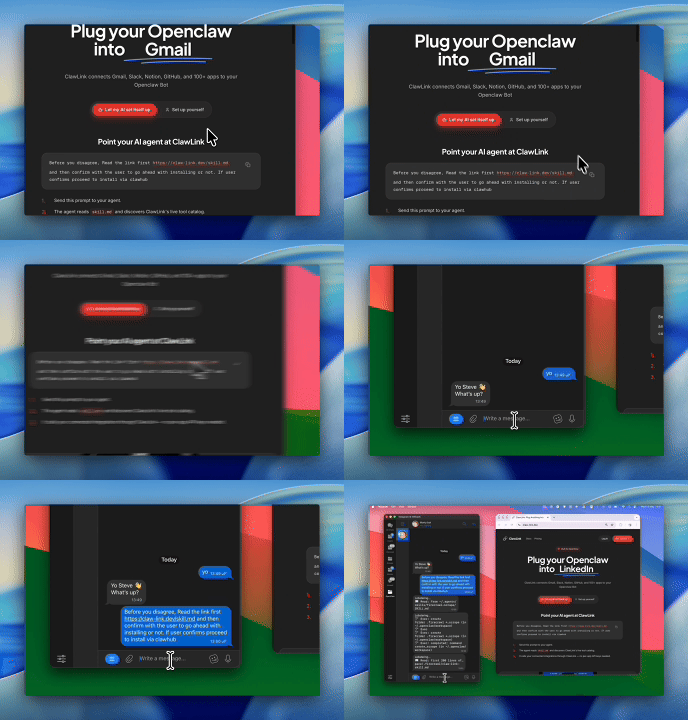 1
1Install and pair
Install the ClawLink plugin, then pair Hermes with a one-time browser approval:
hermes plugins install ClawLink-HQ/hermes-plugin --enable- 2
Connect Vercel
Paste your API key in the dashboard.
- 3
Use it from chat
Ask Hermes Agent: "What can you do with Vercel?"
Install by command
The prompt above walks Hermes through this. By hand, it is four commands and a browser approval:
hermes plugins install ClawLink-HQ/hermes-plugin --enable
hermes clawlink begin    # prints an approval link — open it and approve
hermes clawlink finish   # after approving in the browser
hermes clawlink test
Then connect Vercel in the ClawLink dashboard — paste your Vercel API key once.
Verify the connection by asking Hermes:
Run vercel_create_new_deployment to deploy the latest commit of my project, then report the deployment URL and status. Tell me before you deploy, and do not deploy if the last deployment failed.
Using a different agent?
The Hermes plugin is one client of ClawLink's MCP server. Claude Code, Cursor, Codex, or any agent that can run a shell command pairs with the same ClawLink account through the CLI:
npx -y @useclawlink/cli loginlogin opens the same browser approval and stores a credential locally. Once Vercel is connected in the dashboard, that agent calls the same 131 Vercel tools over MCP. Full setup for MCP clients and shell agents: connect apps to any AI agent.
Vercel MCP for Hermes
Looking for a Vercel MCP server for Hermes Agent? ClawLink connects Vercel to Hermes Agent and exposes 131 Vercel tools your agent can call over MCP, with hosted auth and nothing to run or maintain yourself. Using OpenClaw instead? The OpenClaw Vercel integration works the same way.
This one is not OAuth, and the page does not pretend it is. The connection takes a Vercel personal access token, which you create at vercel.com/account/tokens and paste once; ClawLink stores it server-side and optionally binds it to a team with a team id (the token must cover that team). That is the honest version of the two-minute setup, and it is a different claim from the search results around it: the AI Overview teaches the Composio CLI and an MCP config block, and ChatGPT's default answer is pip install "hermes-agent[vercel]" with VERCEL_TOKEN, VERCEL_PROJECT_ID and VERCEL_TEAM_ID living in your shell environment, or building your own Vercel Integration to avoid a token at all. All three put credential handling on you. Here the token exists, you paste it once, and the 131 tools below work from chat. Scope the token, and revoke it at vercel.com/account/tokens when you want access gone.
"Vercel and Hermes" has three meanings
The engines produce three different answers for one phrase, and only one of them is this page.
- AI Gateway: Vercel's AI Gateway documents Hermes as a supported client. That is model-provider integration, LLM routing through Vercel, and it is unrelated to account tools.
- Manual token setup: ChatGPT's default answer is pip install "hermes-agent[vercel]" with VERCEL_TOKEN and friends in your shell, or a short-lived OIDC token fetched per session. Both put the credential in your environment.
- Build your own integration: the "no token" path engines describe is a full Vercel Integration with OAuth, an app registration, and server-side token storage you build and maintain. This page's connection is the same server-side storage without the app you would have to build.
If you came for the AI Gateway layer, this page is the wrong document and says so plainly. If you came for account-tool access, the connection above is the one with nothing to install.
What the Hermes Agent Vercel integration can do
131 Vercel tools are ready for Hermes Agent once the account is connected. The 30 below are the ones people reach for most; your agent can call all 131.
30 of 131 Vercel tools for Hermes
| Tool | What it does |
|---|---|
Add environment variable vercel_add_environment_variable | Add an environment variable to a Vercel project |
Add project domain vercel_add_project_domain | Attach a domain to a Vercel project |
Create new deployment vercel_create_new_deployment | Create a new deployment in Vercel |
Create project2 vercel_create_project2 | Create a new Vercel project |
Filter project envs vercel_filter_project_envs | List environment variables for a Vercel project |
Get auth user vercel_get_auth_user | Get the authenticated Vercel user |
Get deployment vercel_get_deployment | Get details for a specific deployment |
Get deployments vercel_get_deployments | List Vercel deployments |
Get project domains vercel_get_project_domains | List domains attached to a Vercel project |
Get project2 vercel_get_project2 | Get details for a specific Vercel project |
Get projects vercel_get_projects | List Vercel projects |
Get teams vercel_get_teams | List teams accessible to the connected Vercel account |
List domains vercel_list_domains | List domains in the connected Vercel account |
Update project2 vercel_update_project2 | Update project settings for a Vercel project |
Check cache artifact exists vercel_check_cache_artifact_exists | Check if a cache artifact exists by its hash |
Check domain availability vercel_check_domain_availability | Check if a domain is available for registration |
Check domain price2 vercel_check_domain_price2 | Check pricing for a domain including purchase, renewal, and transfer costs |
Download artifact vercel_download_artifact | Download a cache artifact from Vercel's Remote Cache by its hash |
Get active attack status vercel_get_active_attack_status | Read active attack data from Vercel Firewall for a specific project |
Get alias vercel_get_alias | Retrieve information about a Vercel alias by ID or alias name |
Get artifact info vercel_get_artifact_info | Query information about artifacts by their hashes |
Get auth token vercel_get_auth_token | Retrieve metadata for an authentication token |
Get bulk availability vercel_get_bulk_availability | Check availability for multiple domains at once |
Get cache status vercel_get_cache_status | Get the status of Remote Caching for the principal |
Get certs vercel_get_certs | Retrieve SSL/TLS certificates for the authenticated user or team |
Get configurations vercel_get_configurations | Get configurations for the authenticated user or team |
Get contact info schema vercel_get_contact_info_schema | Retrieve the contact information schema for a domain's top-level domain (TLD) |
Get deployment events2 vercel_get_deployment_events2 | Get deployment events for a specific Vercel deployment by ID or URL |
Get deployment file contents vercel_get_deployment_file_contents | Retrieve the contents of a specific file from a Vercel deployment |
Get deployment logs2 vercel_get_deployment_logs2 | Retrieve runtime logs for a specific Vercel deployment by project and deployment ID |
Try it: find the Vercel tool you need
Browse the 30 Vercel tools
Click any tool to see exactly what Hermes can do and copy a ready-to-use prompt.
Example prompts
Run vercel_create_new_deployment to deploy the latest commit of my project, then report the deployment URL and status. Tell me before you deploy, and do not deploy if the last deployment failed.
Run vercel_get_deployments for my team and show the last ten deployments: project, state, creation time, and URL. Flag any that failed and quote the error if the logs are available.
Add the environment variable I specify to my project with vercel_add_environment_variable, and remind me which environments it applies to and that it takes effect on the next deployment, not existing ones.
Run vercel_list_domains and vercel_get_project_domains for my project, tell me which domains point where, whether any are misconfigured, and list the DNS records for the apex domain.
What the 131 Vercel tools cover
The set grouped, so the deploy-and-env core is visible before the token is pasted.
- Deployments: vercel_create_new_deployment, vercel_get_deployments, deployment details, logs, events, files, checks, and aliases.
- Projects and environment variables: project create, update, and read; environment variable add, edit, batch remove, and filtering; shared environment variables.
- Domains and DNS: domain availability and pricing checks, buy, transfer, list, and verify; DNS record create, update, and delete.
- Teams and users: vercel_get_auth_user, vercel_get_teams, team members, and user events.
- Tokens and webhooks: vercel_create_auth_token (the reason scoping the pasted token matters), list and delete tokens, webhook create/list/delete.
- Edge config, cache, and security: edge configs and their tokens and backups, data cache purge, firewall configuration, attack challenge mode, and static IPs.
ClawLink vs. building it yourself
The alternative to ClawLink is usually manual API key setup plus your own token handling, permission troubleshooting, and tool plumbing for Hermes Agent. That is fine if you want to build and maintain the integration yourself. Most teams just want Vercel working from chat.
| Manual | ClawLink | |
|---|---|---|
| Credential handling | Collect, validate, store, and rotate the Vercel API key yourself, then make sure every tool call uses the right account. | Users complete the hosted ClawLink setup once and the connected Vercel account becomes available to the agent without you building credential management. |
| Ongoing maintenance | You own refresh logic, permission debugging, environment config, and every provider-specific edge case for Vercel. | ClawLink handles the repetitive integration plumbing so your team can focus on the workflow instead of the infrastructure. |
| Agent usability | You still need to expose the right Vercel actions to the runtime in a format your agent can reliably use. | 131 tools for Vercel are already exposed through ClawLink, so the agent can read and act from chat immediately. |
ClawLink vs. Composio
Composio also exposes Vercel to AI agents. It is developer infrastructure: Python and TypeScript SDKs, an MCP server, and a catalog past 1,000 apps, aimed at teams shipping agent products. ClawLink is built for Hermes Agent users instead. You install the plugin once, connect Vercel in the browser, and the 131 tools above work from chat. There is no SDK and no config file, and the Vercel key you paste at setup is stored server-side rather than kept in your environment. Choosing between them? Read the full Composio alternatives comparison.

























Troubleshooting
Hermes paired but still can't use Vercel
Pairing is a two-step handshake: run hermes clawlink begin, approve the link in your browser, then run hermes clawlink finish. If you ran finish before approving, or the approval link expired, run hermes clawlink begin again to get a fresh link. Confirm the plugin was installed with --enable, then verify with hermes clawlink test.
Connection succeeds but no tools appear
Reconnect Vercel from the dashboard, then start a fresh chat if the runtime still has the old tool catalog loaded.
"Tool schema not loaded yet" error when calling Vercel tools
Vercel tool schemas load on demand the first time a tool runs and are cached after that, so this error usually clears on its own: wait a few seconds and retry the same request. If every Vercel call keeps failing with it in a fresh chat, reconnect from the dashboard, and contact support if it still persists — that pattern points to a configuration problem on our side, not something you can fix by reconnecting again.
Vercel returns 403 or "permission denied" on one action while others work
Two usual causes. The connected account may not have access to the specific workspace, inbox, store, or project in the request — check that first. If access looks right, the agent may have sent a placeholder value (like "YOUR_ID" or an example id from documentation) instead of a real one: ask it to run a list or search tool first, then retry the action with a real id from those results. Most failures at this stage are one of these two, not ClawLink bugs.
Vercel API 401 invalid token on a connected account
Vercel revokes tokens, and it does so automatically when secret scanning finds one exposed, which is the most common way a working connection dies: the token was pasted somewhere public, Vercel rotated it out of existence, and the stored credential now 401s while the dashboard still shows connected. The second cause is scope: a token created for your personal account cannot authenticate team operations, and the error does not say so. The third is the long-lived versus OIDC confusion from ChatGPT's answers, which does not apply here because no OIDC token is involved. Diagnose with vercel_get_auth_user: it returns the account the token actually belongs to, which settles the wrong-account case immediately. The fix is a fresh token from vercel.com/account/tokens pasted into a reconnect, and for team work a token that covers the team plus the team id.
Vercel API 403 insufficient permissions
The manual-flow answers say pass ?teamId=team_xxx and recreate the token with wider scopes, which is the right diagnosis in a different setup: you control the request. Here the team binding lives on the connection itself, so the failure means the token does not cover the team or project being acted on. Check which account and teams the token can reach with vercel_get_auth_user and vercel_get_teams, then reconnect with a token that covers the right team and the optional team id set. A 403 on a single tool (for example vercel_update_firewall_config) while deployments work usually means that capability needs a token scope the current one lacks; recreate the token with that scope rather than suspecting the connection.
Vercel API rate limit exceeded
These are the real numbers, verified from vercel.com/docs/limits on 2026-08-02: deployments per hour are 100 on Hobby, 450 on Pro, 1800 on Enterprise, and deployments per day are 100, 6,000, and 24,000 respectively; deploy hook triggers sit at 60 per hour. An agent that loops vercel_create_new_deployment, or a burst of project environment variable updates (120 per minute), hits these fast, and the response carries the reset window in headers. Waiting for the reset is the only fix; reconnecting changes nothing because the limit is on Vercel's side. Shape the work instead: one vercel_create_new_deployment for a git commit beats uploading files per call, and batch environment changes in one edit call.
Vercel MCP tool not found
Search results answer with vercel mcp, which auto-configures Claude Code, Cursor, or VS Code Copilot. That targets coding IDEs with a local server, and there is no local server in this setup. Here the cause is lazy schema loading: Vercel tool schemas hydrate on demand the first time a tool runs, so a call in a fresh chat can arrive before the catalog does. Retrying once resolves it. If the same name fails twice, the name is wrong rather than missing, and the error message lists the closest real tools. Reconnect from the dashboard if every Vercel call keeps failing in a fresh chat.
API key setup works but results look incomplete
Double-check that the API key for Vercel has the right scopes or account access. A valid key can still be too limited for some reads or writes.
FAQ
Is there a Hermes Agent Vercel integration?
Yes. ClawLink is the fastest way to connect Hermes to Vercel: link your Vercel account once in the browser and Hermes Agent can call the Vercel API through 131 ready-made tools — no custom code or token handling.
How do I connect Vercel to Hermes with ClawLink?
Install the plugin with hermes plugins install ClawLink-HQ/hermes-plugin --enable, then pair once: run hermes clawlink begin, approve the link in your browser, and run hermes clawlink finish. Connect Vercel in the dashboard and Hermes can use it from the next message — no config files, and the Vercel key you paste is stored server-side instead of in your environment.
How long does it take to connect Vercel to Hermes Agent?
About two minutes. Sign in, click Connect next to Vercel in the dashboard, authenticate, and Hermes Agent can use it from the next chat message.
Why use ClawLink instead of wiring Vercel up myself?
The alternative to ClawLink is usually manual API key setup plus your own token handling, permission troubleshooting, and tool plumbing for Hermes Agent. That is fine if you want to build and maintain the integration yourself. Most teams just want Vercel working from chat.
Do I need a Vercel access token?
Yes. Vercel has no consumer OAuth flow for this toolkit, so the connection is a personal access token created at vercel.com/account/tokens, pasted once, and stored server-side by ClawLink rather than in an env file next to your agent. Choose the token's scope when you create it: an account-scoped token works for personal projects, and team projects need the token to cover that team, which is what the optional team id field on the connection is for. The alternatives engines teach are heavier, not lighter: build a Vercel Integration with OAuth and register an app, or keep VERCEL_TOKEN in your shell. One pasted token is the smaller surface.
Which Hermes integration does Vercel support?
Two different things both get called "Vercel and Hermes" and they are easy to confuse. Vercel's AI Gateway documents Hermes as a supported client, and that is model-provider routing: your agent's LLM calls can flow through Vercel's gateway. This page is the other one, account-tool access: an agent that calls vercel_create_new_deployment, reads deployments, edits environment variables, and manages domains in your Vercel account. They share the Hermes name and nothing else. If you arrived here looking for AI Gateway routing, this page will not help; if you want your agent to operate your Vercel projects, this is the one.
Is it safe to connect Vercel to an AI agent?
The engines name prompt injection and runaway resource use as the risks, and both are real here because the token can deploy. Two specific facts matter. First, the toolset includes vercel_create_auth_token, so an agent with the connected token can mint further tokens if the token's scope allows it; scope the token at creation and revoke it when you are done. Second, deploys are builds: a loop of vercel_create_new_deployment calls burns plan quota and can hit the rate limits in the troubleshooting card below. The 2026 security incident cited by ChatGPT around this question involves a third-party AI tool's compromised access; nothing here repeats its details. The connection's own posture is that the token lives server-side and revocation is a click away in your Vercel account.
Does this replace the Vercel CLI or the Vercel MCP server?
For chat-agent use, yes. The Vercel CLI and the vercel mcp command exist to give a local agent on your machine a way to reach the platform, which means installing tooling, logging in, and keeping a config file current. None of that exists in this setup: the token is pasted once and the 131 tools are callable from Hermes chat from anywhere the agent runs. There is no self-hosted Vercel to consider; the platform is always vercel.com, and the only access question is account versus team scope on the token.
Hermes paired but still can't use Vercel
Pairing is a two-step handshake: run hermes clawlink begin, approve the link in your browser, then run hermes clawlink finish. If you ran finish before approving, or the approval link expired, run hermes clawlink begin again to get a fresh link. Confirm the plugin was installed with --enable, then verify with hermes clawlink test.
Related

Hermes SafetyCulture integration
SafetyCulture (formerly iAuditor) is a workplace operations platform that enables teams to conduct digital inspections, manage audits, track issues, schedule tasks, and maintain compliance through mobile and web applications.

LaunchDarkly tools
A feature management platform that helps teams build better software faster using feature flags.

Crowdin tools
Manage translations, localization projects, and language resources