How to connect Sentry to Hermes Agent
Connect Sentry to Hermes Agent with ClawLink via hosted OAuth: 205 tools your agent can call from chat, covering issue triage, alerts, releases, monitors, and replay. No API keys, no manual setup.


 SentryOAUTH2MCP
Monitor errors and application performance. Once connected, Hermes Agent can read and act on Sentry from chat — pairing, token refresh, and tool wiring handled for you.
Most guides for giving Hermes Agent Sentry access start with registering your own OAuth app or pasting API keys into env files, then leave the token refresh and tool wiring to you. ClawLink gives Hermes a more practical Sentry setup: pair once in the browser and your always-on Hermes agent can act on Sentry for you, reading and doing real work on your behalf with no auth, token refresh, or tool wiring to build yourself.
Setup
It takes three steps to connect Hermes to Sentry.
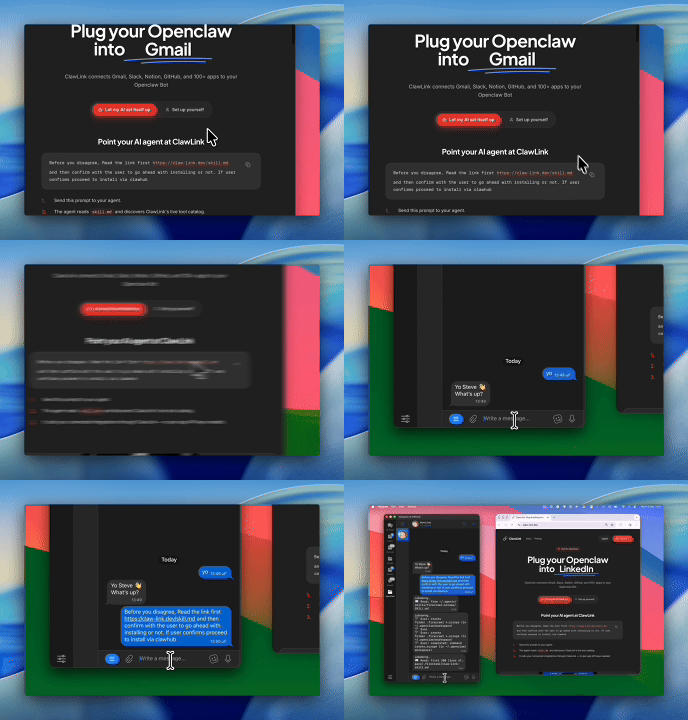 1
1Install and pair
Install the ClawLink plugin, then pair Hermes with a one-time browser approval:
hermes plugins install ClawLink-HQ/hermes-plugin --enable- 2
Connect Sentry
One-click OAuth in the dashboard.
- 3
Use it from chat
Ask Hermes Agent: "What can you do with Sentry?"
Install by command
The prompt above walks Hermes through this. By hand, it is four commands and a browser approval:
hermes plugins install ClawLink-HQ/hermes-plugin --enable
hermes clawlink begin    # prints an approval link — open it and approve
hermes clawlink finish   # after approving in the browser
hermes clawlink test
Then connect Sentry in the ClawLink dashboard — a one-click OAuth approval, no API keys.
Verify the connection by asking Hermes:
Run sentry_list_an_organizations_issues and show me the unresolved high and medium priority issues in my org, grouped by project. Tell me which three look most urgent, what the error is, and how many events each has. Do not change anything yet.
Using a different agent?
The Hermes plugin is one client of ClawLink's MCP server. Claude Code, Cursor, Codex, or any agent that can run a shell command pairs with the same ClawLink account through the CLI:
npx -y @useclawlink/cli loginlogin opens the same browser approval and stores a credential locally. Once Sentry is connected in the dashboard, that agent calls the same 205 Sentry tools over MCP. Full setup for MCP clients and shell agents: connect apps to any AI agent.
Sentry MCP for Hermes
Looking for a Sentry MCP server for Hermes Agent? ClawLink connects Sentry to Hermes Agent and exposes 205 Sentry tools your agent can call over MCP, with hosted auth and nothing to run or maintain yourself. Using OpenClaw instead? The OpenClaw Sentry integration works the same way.
Hermes here is the Nous Research hermes-agent runtime, not React Native's Hermes JavaScript engine. The other Hermes is an embedded JS engine whose Sentry integration means source maps and .hermes bundles, which is what most search results for "Sentry and Hermes" are actually about; this page is about the agent. And on the agent side, every setup guide starts from a SENTRY_AUTH_TOKEN: unquote it, fix the region with SENTRY_URL, switch token types, check [auth] token=. A hosted OAuth flow has none of those failure modes, because the token never exists in a file you manage. Connect Sentry once in the browser and the 205 tools below work from chat, with issue triage the most useful of them: list unresolved issues, pull details and events, and update status, all against your real org.
What the Hermes Agent Sentry integration can do
205 Sentry tools are ready for Hermes Agent once the account is connected. The 30 below are the ones people reach for most; your agent can call all 205.
30 of 205 Sentry tools for Hermes
| Tool | What it does |
|---|---|
Access project information sentry_access_project_information | Retrieve detailed information for a Sentry project |
Add a symbol source to a project sentry_add_a_symbol_source_to_a_project | Add a custom symbol source to a Sentry project |
Add organization member via email sentry_add_organization_member_via_email | Invite a new member to a Sentry organization |
Add team member in organization sentry_add_team_member_in_organization | Add an existing member to a Sentry team |
Fetch alerts sentry_fetch_alerts | Retrieve a list of alerts for a Sentry organization |
Fetch an organizations monitors sentry_fetch_an_organizations_monitors | Retrieve monitors for a Sentry organization |
Fetch issue event by ID sentry_fetch_issue_event_by_id | Retrieve the latest or recommended event for a Sentry issue |
Fetch organization alert rules sentry_fetch_organization_alert_rules | Retrieve active metric alert rules for an organization |
Fetch a monitor sentry_fetch_a_monitor | Fetches detailed information for a specific monitor (detector) within an organization |
Fetch an alert sentry_fetch_an_alert | Retrieves detailed information for a specific alert workflow |
Fetch organization release threshold statuses sentry_fetch_organization_release_threshold_statuses | Retrieves derived health statuses for release thresholds in a Sentry organization for a given |
Fetch organization replay count sentry_fetch_organization_replay_count | Retrieves the total count of session replays for a specified Sentry organization, filterable by |
Fetch organization replay details sentry_fetch_organization_replay_details | Retrieves detailed information for a specific replay session by ID within a Sentry |
Fetch organization replay selectors sentry_fetch_organization_replay_selectors | Retrieves replay selectors (CSS/DOM selectors from session replays) for a Sentry organization |
Fetch project environment details sentry_fetch_project_environment_details | Retrieves detailed information for a specific environment within a Sentry project |
Fetch project ownership details sentry_fetch_project_ownership_details | Retrieves the ownership configuration, like CODEOWNERS rules or Issue Owner settings, for a |
Fetch project release files sentry_fetch_project_release_files | Retrieves artifact files (e.g., source maps, debug information files) for a specific release |
Fetch project replay clicks sentry_fetch_project_replay_clicks | Fetches a list of user click interactions for a specific Sentry session replay, including the |
Fetch replay recording segment sentry_fetch_replay_recording_segment | Retrieves a specific recording segment for a Sentry replay, requiring valid organization |
Fetch tag values for issue sentry_fetch_tag_values_for_issue | Retrieves a list of distinct values for a specified tag key associated with an existing Sentry |
Get alerts sentry_get_alerts | Retrieve all combined alert rules and monitors for a Sentry organization |
Get integration details by org sentry_get_integration_details_by_org | Retrieves details for a specific integration, identified by integration_id, installed within |
Get organization by ID or slug sentry_get_organization_by_id_or_slug | Retrieves a Sentry organization by its ID or slug; use the detailed parameter to optionally |
Get organization details sentry_get_organization_details | Retrieves Sentry organizations accessible via the current authentication, with scope varying |
Get organization environments sentry_get_organization_environments | Lists deployment environments for a Sentry organization, optionally filtered by visibility |
Get organization issue details sentry_get_organization_issue_details | Retrieves detailed information for a specific issue within a Sentry organization |
Get organization release version sentry_get_organization_release_version | Retrieves detailed information, including optional health data and statistics, for a specific |
Get organization sessions sentry_get_organization_sessions | Retrieves time series data for an organization's Sentry project release health sessions; note |
Get organization stats summary sentry_get_organization_stats_summary | Retrieves summarized event statistics for a Sentry organization, aggregated by project |
Get project event stats sentry_get_project_event_stats | Retrieves time-series event statistics for a Sentry project |
Try it: find the Sentry tool you need
Browse the 30 Sentry tools
Click any tool to see exactly what Hermes can do and copy a ready-to-use prompt.
Example prompts
Run sentry_list_an_organizations_issues and show me the unresolved high and medium priority issues in my org, grouped by project. Tell me which three look most urgent, what the error is, and how many events each has. Do not change anything yet.
Open issue 7159174717 with sentry_get_organization_issue_details and pull its recent events with sentry_get_project_events. Summarize the stack trace, the affected release, and what changed in the latest events. Suggest where to start looking.
Call sentry_fetch_alerts and tell me which alerts are in a firing or errored state, which projects they belong to, and how long each has been active.
Run sentry_list_organization_releases, open the latest release with sentry_get_organization_release_version, and tell me its commits, deploy status, and how many unresolved issues are associated with it.
What the 205 Sentry tools cover
The full set grouped, with the triage core first because that is what the queries actually demand.
- Issue triage and events: sentry_list_an_organizations_issues, sentry_get_organization_issue_details, sentry_bulk_mutate_an_organizations_issues (up to 1,000 issues), issue events, hashes, tags, and event-level detail.
- Alerts and monitors: fetch, create, and delete alert rules, fetch alerts and monitors, monitor check-ins, and spike protection controls.
- Releases and deploys: create releases and deploy records, upload release files and debug symbol files, and retrieve commits and files per release.
- Projects, teams, and members: project keys and rules, team and member management, roles, SCIM v2 user and group operations, and SSO/SAML user creation.
- Replay and sessions: replay sessions, recording segments, clicks, and who-viewed data, plus org sessions and stats summaries.
- Seer AI: sentry_list_seer_ai_models, sentry_start_seer_issue_fix, and sentry_retrieve_seer_issue_fix_state bring Sentry's Seer feature into the toolset.
ClawLink vs. building it yourself
The alternative to ClawLink is usually manual OAuth app setup plus your own token handling, permission troubleshooting, and tool plumbing for Hermes Agent. That is fine if you want to build and maintain the integration yourself. Most teams just want Sentry working from chat.
| Manual | ClawLink | |
|---|---|---|
| Connection flow | Register a Sentry app, configure redirect URLs, manage consent details, and reconnect users when auth settings drift. | Users connect Sentry through the hosted browser flow and ClawLink keeps the token lifecycle out of your app code. |
| Ongoing maintenance | You own refresh logic, permission debugging, environment config, and every provider-specific edge case for Sentry. | ClawLink handles the repetitive integration plumbing so your team can focus on the workflow instead of the infrastructure. |
| Agent usability | You still need to expose the right Sentry actions to the runtime in a format your agent can reliably use. | 205 tools for Sentry are already exposed through ClawLink, so the agent can read and act from chat immediately. |
ClawLink vs. Composio
Composio also exposes Sentry to AI agents. It is developer infrastructure: Python and TypeScript SDKs, an MCP server, and a catalog past 1,000 apps, aimed at teams shipping agent products. ClawLink is built for Hermes Agent users instead. You install the plugin once, connect Sentry in the browser, and the 205 tools above work from chat. There is no SDK, no config file, and no API key handling. Choosing between them? Read the full Composio alternatives comparison.

























Troubleshooting
Hermes paired but still can't use Sentry
Pairing is a two-step handshake: run hermes clawlink begin, approve the link in your browser, then run hermes clawlink finish. If you ran finish before approving, or the approval link expired, run hermes clawlink begin again to get a fresh link. Confirm the plugin was installed with --enable, then verify with hermes clawlink test.
Connection succeeds but no tools appear
Reconnect Sentry from the dashboard, then start a fresh chat if the runtime still has the old tool catalog loaded.
"Tool schema not loaded yet" error when calling Sentry tools
Sentry tool schemas load on demand the first time a tool runs and are cached after that, so this error usually clears on its own: wait a few seconds and retry the same request. If every Sentry call keeps failing with it in a fresh chat, reconnect from the dashboard, and contact support if it still persists — that pattern points to a configuration problem on our side, not something you can fix by reconnecting again.
Sentry returns 403 or "permission denied" on one action while others work
Two usual causes. The connected account may not have access to the specific workspace, inbox, store, or project in the request — check that first. If access looks right, the agent may have sent a placeholder value (like "YOUR_ID" or an example id from documentation) instead of a real one: ask it to run a list or search tool first, then retry the action with a real id from those results. Most failures at this stage are one of these two, not ClawLink bugs.
Sentry API 401 invalid token on an account that shows connected
The standard answers assume a token you created: unquote SENTRY_AUTH_TOKEN, match the region with SENTRY_URL, switch from an auth token to an API key, refresh a stale cache. In a hosted flow there is no token file to unquote and no env to check, which rules out most of that advice. What is left is the grant itself: an expired or revoked OAuth grant produces a 401 on calls while the dashboard still lists the connection as connected, because the connection row and the token's validity are separate facts. The recovery is to reconnect Sentry from the ClawLink dashboard, which re-authorizes and replaces the stored grant. Check your Sentry account's authorized applications first; if the grant was revoked there, the dashboard connection is already stale.
Sentry API 403 insufficient permissions
Two causes cover most cases, and neither is a ClawLink bug. The first is scope: the OAuth grant carries the scopes approved at consent, and a tool that needs event:read or project:write will 403 if the grant does not have it; reconnect from the dashboard to approve the full scope set again. The second is org context: the grant is bound to the Sentry org you approved, so a project in a different org returns permission errors rather than an obvious wrong-org message. Sentry's own advice that personal tokens cannot be edited after creation does not apply here, because there is no personal token; when scopes change on your side, the whole grant is re-approved rather than patched.
Sentry MCP tool not found
The answers engines give target coding IDEs: an OAuth handshake in Cursor settings, deleting a cached mcp.json, claude mcp add against https://mcp.sentry.dev/mcp. None of that exists in this setup, which has no local MCP server. Here the cause is lazy schema loading: Sentry tool schemas hydrate on demand the first time a tool runs, so a call in a fresh chat can arrive before the catalog does, and retrying once resolves it. If the same name fails twice, the name is wrong rather than missing, and the error message lists the closest real tools. Reconnect from the dashboard if every Sentry call keeps failing in a fresh chat.
OAuth finished in the browser but the account is still missing
Try reconnecting Sentry and complete the consent flow in the same browser session. Partial OAuth approvals or switching accounts mid-flow can leave the connection incomplete.
FAQ
Is there a Hermes Agent Sentry integration?
Yes. ClawLink is the fastest way to connect Hermes to Sentry: link your Sentry account once in the browser and Hermes Agent can call the Sentry API through 205 ready-made tools — no custom code or token handling.
How do I connect Sentry to Hermes with ClawLink?
Install the plugin with hermes plugins install ClawLink-HQ/hermes-plugin --enable, then pair once: run hermes clawlink begin, approve the link in your browser, and run hermes clawlink finish. Connect Sentry in the dashboard and Hermes can use it from the next message — no config files or API keys to manage.
How long does it take to connect Sentry to Hermes Agent?
About two minutes. Sign in, click Connect next to Sentry in the dashboard, authenticate, and Hermes Agent can use it from the next chat message.
Why use ClawLink instead of wiring Sentry up myself?
The alternative to ClawLink is usually manual OAuth app setup plus your own token handling, permission troubleshooting, and tool plumbing for Hermes Agent. That is fine if you want to build and maintain the integration yourself. Most teams just want Sentry working from chat.
Do I need a Sentry auth token?
No. This connection is a hosted OAuth grant, so there is no SENTRY_AUTH_TOKEN to create in your account settings, export into an env file, or unquote when a guide says so. The manual flow's entire failure surface, which is most of what the search results for "sentry api 401 invalid token" teach, comes from token handling: wrong token type, region mismatch, stale cache, tokens that cannot be edited after creation. None of that exists here. The grant is stored server-side and refreshed for you, and reconnecting from the dashboard is the recovery path when something does break.
What can the agent actually do with Sentry?
The canonical use case is issue triage: sentry_list_an_organizations_issues returns error groups with a default query of unresolved issues at high or medium priority, sentry_get_organization_issue_details accepts both numeric and short IDs, and sentry_bulk_mutate_an_organizations_issues updates status, priority, and assignment across up to 1,000 issues in one call. Around that core sit alerts and monitors, releases and deploys, projects, teams and members, replay sessions, and three Seer tools (sentry_list_seer_ai_models, sentry_start_seer_issue_fix, sentry_retrieve_seer_issue_fix_state) that work on the same issues from chat.
Is it safe to connect Sentry to an AI agent?
The June 2026 Agentjacking research, which the AI Overview surfaces on this exact question, showed public Sentry DSNs being used to inject prompts into coding agents that ingest error payloads. That attack is about unauthenticated ingestion endpoints, not about an agent holding a scoped grant. This connection is a user OAuth grant, not a public DSN, and the grant's scopes are the visible list from consent: org:read, project:read, event:read, team:read, member:read and the write counterparts, with the 11 total scopes checked against the Composio toolkit on 2026-08-02. The behavioral risk remains real and is not solved by the connection model: an agent reading issue descriptions is reading text written by other people. Keep write actions (status changes, member invites, releases) as things it drafts first and you approve.
Does this work with a self-hosted Sentry instance?
No. The connection targets sentry.io. A self-hosted Sentry instance needs its own instance URL, an internal token you manage, and a network path to it, none of which this flow provides.
Hermes paired but still can't use Sentry
Pairing is a two-step handshake: run hermes clawlink begin, approve the link in your browser, then run hermes clawlink finish. If you ran finish before approving, or the approval link expired, run hermes clawlink begin again to get a fresh link. Confirm the plugin was installed with --enable, then verify with hermes clawlink test.
Related

Connect SafetyCulture
SafetyCulture (formerly iAuditor) is a workplace operations platform that enables teams to conduct digital inspections, manage audits, track issues, schedule tasks, and maintain compliance through mobile and web applications.

LaunchDarkly tools
A feature management platform that helps teams build better software faster using feature flags.

Crowdin tools
Manage translations, localization projects, and language resources