How to connect Tavily to Hermes Agent
Connect Tavily to Hermes Agent with ClawLink: paste your Tavily API key once and 5 tools work from chat. No .env file, no config.yaml, no MCP server to keep running.


 TavilyAPI KEYMCP
Search the web and retrieve structured AI research data. Once connected, Hermes Agent can read and act on Tavily from chat — pairing, token refresh, and tool wiring handled for you.
Most guides for giving Hermes Agent Tavily access start with registering your own OAuth app or pasting API keys into env files, then leave the token refresh and tool wiring to you. ClawLink gives Hermes a more practical Tavily setup: pair once in the browser and your always-on Hermes agent can act on Tavily for you, reading and doing real work on your behalf with no auth, token refresh, or tool wiring to build yourself.
Setup
It takes three steps to connect Hermes to Tavily.
 1
1Install and pair
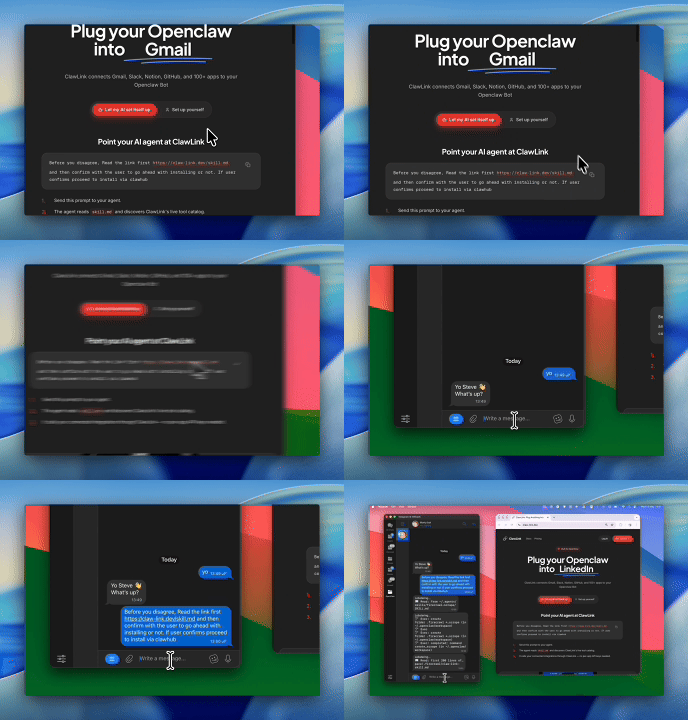
Install the ClawLink plugin, then pair Hermes with a one-time browser approval:
hermes plugins install ClawLink-HQ/hermes-plugin --enable- 2
Connect Tavily
Paste your API key in the dashboard.
- 3
Use it from chat
Ask Hermes Agent: "What can you do with Tavily?"
Install by command
The prompt above walks Hermes through this. By hand, it is four commands and a browser approval:
hermes plugins install ClawLink-HQ/hermes-plugin --enable
hermes clawlink begin    # prints an approval link — open it and approve
hermes clawlink finish   # after approving in the browser
hermes clawlink test
Then connect Tavily in the ClawLink dashboard — paste your Tavily API key once.
Verify the connection by asking Hermes:
Use tavily_search for the latest developments in AI agent tooling with max_results 12, search_depth advanced, and include_answer true. Give me Tavily's summary first, then the sources with their URLs.
Using a different agent?
The Hermes plugin is one client of ClawLink's MCP server. Claude Code, Cursor, Codex, or any agent that can run a shell command pairs with the same ClawLink account through the CLI:
npx -y @useclawlink/cli loginlogin opens the same browser approval and stores a credential locally. Once Tavily is connected in the dashboard, that agent calls the same 5 Tavily tools over MCP. Full setup for MCP clients and shell agents: connect apps to any AI agent.
Tavily MCP for Hermes
Looking for a Tavily MCP server for Hermes Agent? ClawLink connects Tavily to Hermes Agent and exposes 5 Tavily tools your agent can call over MCP, with hosted auth and nothing to run or maintain yourself. Using OpenClaw instead? The OpenClaw Tavily integration works the same way.
Tavily has no OAuth, so every route to it starts with a tvly- key from app.tavily.com, including this one. What differs is where that key ends up and what you have to run. Tavily's own walkthrough puts it in ~/.hermes/.env and has you set the search backend in config.yaml. The official MCP route has you run a server and point Hermes at it. ClawLink stores the key server-side after one paste, and the five tools below work from chat with nothing running on your machine and no file to edit. The key stays yours: it is your Tavily account, your credit balance, and your plan limits that the agent spends.
The other ways Hermes Agent gets Tavily search
All of them need a Tavily key except keyless mode. What differs is what you run and which tools the agent gets.
- Tavily's keyless mode: no account, no key, free, and limited to search and extract with a rate limit you cannot see. Good for a quick script, and it cannot serve the crawl, map, or usage tools.
- Hermes Agent's own setup wizard:
hermes setup, putTAVILY_API_KEYin~/.hermes/.env, and set the web backend inconfig.yaml. This is the route Tavily's blog teaches and the one the AI Overview leads with. It gives Hermes web search rather than Tavily's individual tools. - Tavily's official MCP server: search, extract, map, and crawl over MCP, run locally with npx or pointed at their remote endpoint with the key in the URL. You configure it and keep it running.
- ClawLink (this page): all five tools including
tavily_get_usage, key stored server-side, nothing running on your machine.
Using OpenClaw as well? The OpenClaw Tavily integration is the same key-based setup and the same five tools, with OpenClaw's skill flow instead of Hermes pairing.
What the Hermes Agent Tavily integration can do
5 Tavily tools are ready for Hermes Agent once the account is connected.
All 5 Tavily tools for Hermes
| Tool | What it does |
|---|---|
Crawl tavily_crawl | Tool to perform intelligent graph-based website crawling with parallel path exploration and content extraction. |
Extract tavily_extract | Tool to extract and parse web page content from specified URLs using Tavily's extract endpoint. |
Get usage tavily_get_usage | Tool to retrieve API key and account usage statistics from Tavily. |
Map tavily_map | Tool to map a website and discover its pages. Use when you need to scan a website and get a structured list of URLs/pages it contains without extracting full content. |
Search tavily_search | Use this to perform a web search via the Tavily API; offers controls for search depth, content types, result count, and domain filtering. Requires an active Tavily connection (401 = auth failure). |
Try it: find the Tavily tool you need
Browse the 5 Tavily tools
Click any tool to see exactly what Hermes can do and copy a ready-to-use prompt.
Example prompts
Use tavily_search for the latest developments in AI agent tooling with max_results 12, search_depth advanced, and include_answer true. Give me Tavily's summary first, then the sources with their URLs.
Search Tavily for changes to the EU AI Act, but only include results from europa.eu and official government domains, and exclude aggregator blogs. Set include_answer true.
Use tavily_extract on the URL I paste and summarize it as markdown with the key claims and any numbers. If the page comes back mostly empty because it is JavaScript-heavy, retry with extract_depth advanced.
Run tavily_map on my site with max_depth 2 and show me the structure. Then crawl only the /docs section with tavily_crawl using select_paths, and tell me which pages have not been updated this year. Check tavily_get_usage first and stop if I have under 100 credits.
How the Tavily tools behave
Five tools, and their defaults decide what a search costs and how much it returns.
tavily_searchreturns 5 results by default.max_resultsis the argument to raise, and a plain search request comes back with exactly five links unless it is set.include_answerdefaults to false. There is no Tavily-generated summary unless you ask for one. Combined with the defaultsearch_depthofbasic, a bare search is the thinnest possible response.- Search depth is a credit decision.
basiccosts one credit,advancedcosts two and returns better relevance. On the free tier's 1,000 monthly credits, running everything at advanced halves the number of searches you get. - Results nest under
response_data.results. An agent that reads the top level of the response sees nothing and may report a failed search that actually succeeded. tavily_crawlandtavily_mapdefault to shallow and broad. Depth 1, breadth 20, and external links allowed, so a bare crawl request can wander off-site. Setmax_depth,select_paths, andselect_domainsfor anything controlled.tavily_extracttakes an array of URLs and has anextract_depthargument;advancedis the setting for JavaScript-rendered pages that come back empty on the first attempt.tavily_get_usagetakes no arguments and reports the credits left on your key. It is the only tool that reads Tavily's usage endpoint, and the fastest way to tell a metering problem from a broken connection.
ClawLink vs. building it yourself
The alternative to ClawLink is usually manual API key setup plus your own token handling, permission troubleshooting, and tool plumbing for Hermes Agent. That is fine if you want to build and maintain the integration yourself. Most teams just want Tavily working from chat.
| Manual | ClawLink | |
|---|---|---|
| Credential handling | Collect, validate, store, and rotate the Tavily API key yourself, then make sure every tool call uses the right account. | Users complete the hosted ClawLink setup once and the connected Tavily account becomes available to the agent without you building credential management. |
| Ongoing maintenance | You own refresh logic, permission debugging, environment config, and every provider-specific edge case for Tavily. | ClawLink handles the repetitive integration plumbing so your team can focus on the workflow instead of the infrastructure. |
| Agent usability | You still need to expose the right Tavily actions to the runtime in a format your agent can reliably use. | 5 tools for Tavily are already exposed through ClawLink, so the agent can read and act from chat immediately. |
ClawLink vs. Composio
Composio also exposes Tavily to AI agents. It is developer infrastructure: Python and TypeScript SDKs, an MCP server, and a catalog past 1,000 apps, aimed at teams shipping agent products. ClawLink is built for Hermes Agent users instead. You install the plugin once, connect Tavily in the browser, and the 5 tools above work from chat. There is no SDK and no config file, and the Tavily key you paste at setup is stored server-side rather than kept in your environment. Choosing between them? Read the full Composio alternatives comparison.
























Troubleshooting
Hermes paired but still can't use Tavily
Pairing is a two-step handshake: run hermes clawlink begin, approve the link in your browser, then run hermes clawlink finish. If you ran finish before approving, or the approval link expired, run hermes clawlink begin again to get a fresh link. Confirm the plugin was installed with --enable, then verify with hermes clawlink test.
Connection succeeds but no tools appear
Reconnect Tavily from the dashboard, then start a fresh chat if the runtime still has the old tool catalog loaded.
"Tool schema not loaded yet" error when calling Tavily tools
Tavily tool schemas load on demand the first time a tool runs and are cached after that, so this error usually clears on its own: wait a few seconds and retry the same request. If every Tavily call keeps failing with it in a fresh chat, reconnect from the dashboard, and contact support if it still persists — that pattern points to a configuration problem on our side, not something you can fix by reconnecting again.
Tavily returns 403 or "permission denied" on one action while others work
Two usual causes. The connected account may not have access to the specific workspace, inbox, store, or project in the request — check that first. If access looks right, the agent may have sent a placeholder value (like "YOUR_ID" or an example id from documentation) instead of a real one: ask it to run a list or search tool first, then retry the action with a real id from those results. Most failures at this stage are one of these two, not ClawLink bugs.
Tavily returns 401 Unauthorized or an invalid API key error
Advice for this phrase assumes a local .env file: check for a stray space, confirm the variable name, verify the file is being loaded. None of that applies here, because the key is stored server-side rather than in a file you edit. Three things cause it instead. The key was regenerated or revoked at app.tavily.com, in which case reconnect from the dashboard with the current key. The key was pasted incompletely, which is worth ruling out because a truncated tvly- string fails exactly like a revoked one. Or the Tavily account itself is inactive. One cause that search results attribute to 401 does belong to a different error here: an exhausted monthly credit allowance is a metering problem on your Tavily account, and calling tavily_get_usage tells you whether that is what you are looking at. Tavily keys carry no scopes, so there is nothing to widen.
Ask the agent to diagnose it:
Call tavily_get_usage and report exactly what it returns, including any error body. Do not retry the search.Tavily returns 429 "Too many requests"
This is Tavily's rate limit and reconnecting does nothing for it. Development keys allow a lower requests-per-minute ceiling than production keys, so a burst of searches from one prompt can trip it while the same volume spread out succeeds. The response carries a retry-after value, which is the interval to respect. If it keeps happening, the shape of the work is the problem rather than the key: ask for one search with a higher max_results instead of several narrow searches in sequence.
Ask the agent to diagnose it:
Report the exact status code and any retry-after value from the failed Tavily call, then call tavily_get_usage and tell me the remaining credits. Do not retry the search.Tavily search results look thin or come back with only five links
Usually not a fault. tavily_search returns five results by default, and include_answer defaults to false, so a plain request for a search comes back as the smallest possible response with no summary attached. Ask for a specific max_results, set search_depth to advanced when relevance matters more than credits, and set include_answer true if you want Tavily's own summary rather than the agent writing one from titles. The other common cause is response shape: results nest under response_data.results, so an agent reading only the top level of the response can report an empty search when there were results.
Ask the agent to diagnose it:
Run tavily_search again for the same query with max_results 15, search_depth advanced, and include_answer true, then tell me how many results came back.Tavily tool returns "tool not found" or a doubled name such as tavily_tavily_search
There are exactly five Tavily tools: tavily_search, tavily_extract, tavily_crawl, tavily_map, and tavily_get_usage. A doubled prefix means the agent concatenated the integration name onto a tool name that already carries it, and the error message names the nearest real tools, so retrying with one of those works. If the name looks correct, the catalog had not loaded when the first call went out and one retry clears it.
Ask the agent to diagnose it:
List the Tavily tools you actually have access to and use the exact name for what I asked.API key setup works but results look incomplete
Double-check that the API key for Tavily has the right scopes or account access. A valid key can still be too limited for some reads or writes.
FAQ
Is there a Hermes Agent Tavily integration?
Yes. ClawLink is the fastest way to connect Hermes to Tavily: link your Tavily account once in the browser and Hermes Agent can call the Tavily API through 5 ready-made tools — no custom code or token handling.
How do I connect Tavily to Hermes with ClawLink?
Install the plugin with hermes plugins install ClawLink-HQ/hermes-plugin --enable, then pair once: run hermes clawlink begin, approve the link in your browser, and run hermes clawlink finish. Connect Tavily in the dashboard and Hermes can use it from the next message — no config files, and the Tavily key you paste is stored server-side instead of in your environment.
How long does it take to connect Tavily to Hermes Agent?
About two minutes. Sign in, click Connect next to Tavily in the dashboard, authenticate, and Hermes Agent can use it from the next chat message.
Why use ClawLink instead of wiring Tavily up myself?
The alternative to ClawLink is usually manual API key setup plus your own token handling, permission troubleshooting, and tool plumbing for Hermes Agent. That is fine if you want to build and maintain the integration yourself. Most teams just want Tavily working from chat.
Do I need a Tavily API key to connect Tavily to Hermes Agent?
Yes. Tavily does not offer OAuth, so there is no version of this that skips the key, and any page telling you otherwise is describing something else. The key is free to get: app.tavily.com issues one with 1,000 credits a month and no card. Tavily also runs a keyless mode, which sends an X-Tavily-Access-Mode header instead of a key and needs no account at all, but it covers only search and extract and is rate-limited without a visible budget. The crawl, map, and usage tools on this page have no keyless equivalent, which is why this connection takes a key.
How do I test the Tavily integration in Hermes Agent?
Run hermes clawlink test to confirm the plugin is paired, then ask Hermes for a live search, for example "Use Tavily to search for today's top AI news". A ranked result list back in chat means the connection works. If you want to check the key itself rather than the pairing, ask the agent to call tavily_get_usage, which reads your remaining credits and takes no arguments.
Who pays for the searches?
You do, from your own Tavily balance, because it is your key. Tavily meters in credits: a basic search costs one and an advanced search costs two, so search depth directly halves how far a month's allowance goes. The free tier is 1,000 credits a month. This is worth stating plainly because the hosted setup can give the impression that usage is pooled or absorbed somewhere; it is not. tavily_get_usage is the tool that tells you where you stand before a heavy research session rather than after.
What happens if I regenerate my Tavily key?
The connection breaks immediately and the agent starts returning 401s. Unlike OAuth there is no refresh step to recover it, so the fix is to reconnect Tavily from the ClawLink dashboard and paste the new key. The same applies if you revoke the key at app.tavily.com.
Hermes paired but still can't use Tavily
Pairing is a two-step handshake: run hermes clawlink begin, approve the link in your browser, then run hermes clawlink finish. If you ran finish before approving, or the approval link expired, run hermes clawlink begin again to get a fresh link. Confirm the plugin was installed with --enable, then verify with hermes clawlink test.
Related

Hermes Metabase integration
Metabase is an open-source business intelligence tool that lets you ask questions about your data and visualize answers as charts, graphs, and dashboards.

Longbridge tools
Longbridge MCP lets agents access authorized market data, account information, portfolio data, trading operations, and investment workflows through Longbridge OpenAPI.

Vantage tools
Vantage MCP lets agents analyze authorized cloud costs, reports, resources, tags, budgets, anomalies, and optimization recommendations, and perform supported FinOps management actions.