How to connect Google Analytics to OpenClaw
Connect Google Analytics to OpenClaw with no Google Cloud project, no OAuth client, and no service account JSON. Hosted OAuth, 67 GA4 tools, and fixes for the GA4 errors agents actually hit.


 Google AnalyticsOAUTH2MCP
Connect Google Analytics properties through hosted Google OAuth. Once connected, OpenClaw can read and act on Google Analytics from chat — pairing, token refresh, and tool wiring handled for you.
The usual route to Google Analytics access for OpenClaw is an MCP server you configure and keep running, plus your own OAuth app or API keys. ClawLink gives OpenClaw a more practical Google Analytics setup: install one ClawHub skill, connect Google Analytics in the browser, and OpenClaw can call real Google Analytics actions from any chat surface with no auth, token refresh, or tool wiring to build yourself.
Setup
It takes three steps to connect OpenClaw to Google Analytics.
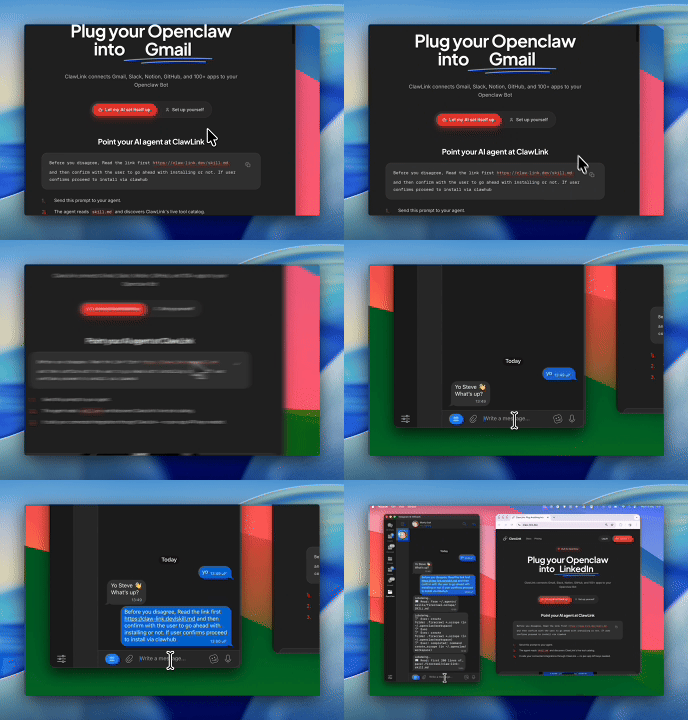 1
1Install the plugin
Paste the setup prompt into OpenClaw, or install from the terminal and ask OpenClaw to pair:
openclaw plugins install clawhub:clawlink-plugin- 2
Connect Google Analytics
One-click OAuth in the dashboard.
- 3
Use it from chat
Ask OpenClaw: "What can you do with Google Analytics?"
The install, start to finish. Run these once, then connect Google Analytics in the dashboard:
openclaw plugins install clawhub:clawlink-plugin
openclaw skills install @hith3sh/google-analytics-reporting
There is a separate community google-analytics skill on ClawHub that is not ours and expects a Google Cloud service account. The skill above is the one that uses your ClawLink connection. Start a fresh chat after installing so OpenClaw reloads its tool catalog.
Using a different agent?
The OpenClaw plugin is one client of ClawLink's MCP server. Claude Code, Cursor, Codex, or any agent that can run a shell command pairs with the same ClawLink account through the CLI:
npx -y @useclawlink/cli loginlogin opens the same browser approval and stores a credential locally. Once Google Analytics is connected in the dashboard, that agent calls the same 67 Google Analytics tools over MCP. Full setup for MCP clients and shell agents: connect apps to any AI agent.
Google Analytics MCP for OpenClaw
Looking for a Google Analytics MCP server for OpenClaw? ClawLink connects Google Analytics to OpenClaw and exposes 67 Google Analytics tools your agent can call over MCP, with hosted auth and nothing to run or maintain yourself. Using Hermes instead? The Hermes Google Analytics integration works the same way.
Every other route to GA4 asks you to become a Google Cloud administrator first: create a project, enable the Analytics Data and Admin APIs, create an OAuth client or a service account, download a JSON key, then add that service account's email as a Viewer inside GA4 itself. ClawLink asks for none of it. ClawLink owns the verified Google OAuth app, so you click Connect, approve on Google's own consent screen, and the tools below work against the properties your Google account can already see.
What the OpenClaw Google Analytics integration can do
67 Google Analytics tools are ready for OpenClaw once the account is connected. The 30 below are the ones people reach for most; your agent can call all 67.
30 of 67 Google Analytics tools for OpenClaw
| Tool | What it does |
|---|---|
Batch run reports google_analytics_batch_run_reports | Run multiple GA4 reports in a batch |
Check compatibility google_analytics_check_compatibility | Check dimension and metric compatibility |
Get metadata google_analytics_get_metadata | Get GA4 metadata (dimensions and metrics) |
Get property google_analytics_get_property | Get a GA4 property |
List account summaries google_analytics_list_account_summaries | List GA account summaries |
List audiences google_analytics_list_audiences | List audiences in a GA4 property |
List data streams google_analytics_list_data_streams | List data streams for a GA4 property |
List key events google_analytics_list_key_events | List key events in a GA4 property |
List properties filtered google_analytics_list_properties_filtered | List GA4 properties |
Run funnel report google_analytics_run_funnel_report | Run a funnel exploration report |
Run pivot report google_analytics_run_pivot_report | Run a pivot report in GA4 |
Run realtime report google_analytics_run_realtime_report | Run a real-time GA4 report |
Run report google_analytics_run_report | Run a GA4 report with dimensions and metrics |
Update property google_analytics_update_property | Update a GA4 property |
Batch run pivot reports google_analytics_batch_run_pivot_reports | Return multiple pivot reports in a batch for a GA4 property |
Get account google_analytics_get_account | Retrieve a single Account by its resource name |
Get attribution settings google_analytics_get_attribution_settings | Retrieve attribution configuration for a Google Analytics property |
Get audience google_analytics_get_audience | Retrieve a single Audience configuration from a Google Analytics property |
Get audience export google_analytics_get_audience_export | Get configuration metadata about a specific audience export |
Get audience list google_analytics_get_audience_list | Get configuration metadata about a specific audience list |
Get custom dimension google_analytics_get_custom_dimension | Retrieve a single CustomDimension by its resource name |
Get data retention settings google_analytics_get_data_retention_settings | Retrieve data retention configuration for a Google Analytics property |
Get data sharing settings google_analytics_get_data_sharing_settings | Retrieve data sharing configuration for a Google Analytics account |
Get google signals settings google_analytics_get_google_signals_settings | Retrieve Google Signals configuration settings for a GA4 property |
Get key event google_analytics_get_key_event | Retrieve a Key Event |
Get property quotas snapshot google_analytics_get_property_quotas_snapshot | Retrieve all property quotas organized by category (corePropertyQuota, funnelPropertyQuota |
Get recurring audience list google_analytics_get_recurring_audience_list | Get configuration metadata about a specific recurring audience list |
Get report task google_analytics_get_report_task | Get report metadata about a specific report task |
List accounts v1 beta google_analytics_list_accounts_v1_beta | List all Google Analytics accounts accessible by the caller using v1beta API |
List adsense links google_analytics_list_adsense_links | List all AdSenseLinks on a property |
Try it: find the Google Analytics tool you need
Browse the 30 Google Analytics tools
Click any tool to see exactly what OpenClaw can do and copy a ready-to-use prompt.
Example prompts
List my Google Analytics account summaries, then run a report on the property for claw-link.dev for the last 28 days with dimensions date and sessionDefaultChannelGroup and metrics sessions and activeUsers. Show it as a table.
Before you build the report, call get_metadata on properties/0/metadata and use it to pick the exact apiNames for the fields I described. Do not guess field names from the GA4 interface labels.
Run a realtime Google Analytics report on my main property with the dimension country and the metric activeUsers, and tell me how many people are on the site right now.
Compare the last 7 days to the previous 7 days on my main property, broken down by sessionSource, and call out any source whose sessions fell more than 20 percent. If the API rejects a dimension and metric pair, drop the field it names and retry rather than asking me.
What the Google Analytics tools actually expect
These are the argument-level rules the GA4 APIs enforce. They are the difference between a report that returns and a 400 your agent cannot explain.
- The property argument has four different names across the 67 tools, and the reporting tools use the odd one out. The report tools, including
google_analytics_run_report, wantproperty. The list and create tools wantparent. The get tools wantname.google_analytics_get_audiencealone wantspropertyId. All four take the sameproperties/123456789shape, so an agent that carries one call's arguments into the next getsarguments.parent is requiredrather than a hint about the rename. propertyis a numeric property id, never a measurement ID. It must look likeproperties/544060035. AG-XXXXXXXXXXmeasurement ID is a tagging identifier and the Data API does not accept it. ClawLink rejects that shape before the request reaches Google, so you get a clear message instead of a misleading 403.dimensionsandmetricsare arrays of objects, not arrays of strings.[\{"name": "country"\}]works;["country"]fails witharguments.dimensions[0] must be an object. This one catches models that have read Google's own MCP server, which accepts a looser form, so it is worth saying in the prompt.- Ask for the field list instead of guessing it.
get_metadataacceptsproperties/0/metadata, which returns Google's universal dimension and metric list with bothapiNameanduiName, without touching a real property. GA4 interface labels are not API names, and this is what stops your agent inventingaverageEngagementTimewhen the field isengagementRate. - One report takes at most 9 dimensions and 10 metrics. Exceed either and the Data API returns 400 before running anything. Split the request and join the results on a shared dimension.
dateRangesis required for a standard report and must be omitted for a cohort report. Passing both alongsidecohortSpecfails. Dates acceptYYYY-MM-DDor relative values like7daysAgoandtoday.dimensionFilterandmetricFilterare not interchangeable. Filtering oncountryorpagePathbelongs indimensionFilter; filtering onsessionsorpurchaseRevenuebelongs inmetricFilter. Putting a dimension in the metric filter is rejected as invalid rather than silently ignored.- Realtime reports accept only four metrics:
activeUsers,eventCount,keyEventsandscreenPageViews, with a fixed 14-dimension list and a default window of the last 30 minutes. The realtime tool's own description points at alist_propertiestool that does not exist in this toolkit; uselist_account_summariesto get property ids. list_account_summariesreturns 50 properties by default and 200 at most. If you manage more than 50, an agent that does not page will quietly work from a partial list. Ask it to page until the response has nopageToken.- Quota is measured in tokens, not requests. Google allows a standard property 200,000 Core tokens per day and 10 concurrent Core requests; most requests cost 10 tokens or fewer, and complex ones cost more. Set
returnPropertyQuota: trueon a report to have the remaining quota come back in the same response. - Seven of the 67 tools cannot run on this connection.
google_analytics_update_property,google_analytics_create_custom_dimension,google_analytics_create_custom_metric,google_analytics_archive_custom_dimension,google_analytics_create_expanded_data_set,google_analytics_create_rollup_propertyandgoogle_analytics_provision_account_ticketrequire Google'sanalytics.editscope, which ClawLink does not request. They return 403. Everything else, including every report, is available. - Two more tools do not use your Google connection at all.
google_analytics_send_eventsandgoogle_analytics_validate_eventsare Measurement Protocol calls. They need ameasurement_idand anapi_secretyou create yourself under Admin, Data Streams, Measurement Protocol API secrets, plus aclient_idand aneventsarray. Connecting Google Analytics in ClawLink does not supply those, so hand them over explicitly if you want the agent sending events.
ClawLink vs. building it yourself
The alternative to ClawLink is usually manual OAuth app setup plus your own token handling, permission troubleshooting, and tool plumbing for OpenClaw. That is fine if you want to build and maintain the integration yourself. Most teams just want Google Analytics working from chat.
| Manual | ClawLink | |
|---|---|---|
| Connection flow | Register a Google Analytics app, configure redirect URLs, manage consent details, and reconnect users when auth settings drift. | Users connect Google Analytics through the hosted browser flow and ClawLink keeps the token lifecycle out of your app code. |
| Ongoing maintenance | You own refresh logic, permission debugging, environment config, and every provider-specific edge case for Google Analytics. | ClawLink handles the repetitive integration plumbing so your team can focus on the workflow instead of the infrastructure. |
| Agent usability | You still need to expose the right Google Analytics actions to the runtime in a format your agent can reliably use. | 67 tools for Google Analytics are already exposed through ClawLink, so the agent can read and act from chat immediately. |
ClawLink vs. Composio
Composio also exposes Google Analytics to AI agents. It is developer infrastructure: Python and TypeScript SDKs, an MCP server, and a catalog past 1,000 apps, aimed at teams shipping agent products. ClawLink is built for OpenClaw users instead. You install the plugin once, connect Google Analytics in the browser, and the 67 tools above work from chat. There is no SDK, no config file, and no API key handling. Choosing between them? Read the full Composio alternatives comparison.

























Troubleshooting
OpenClaw installed the Google Analytics skill but can't call the tools
The ClawHub skill teaches OpenClaw about Google Analytics, but the calls run through the ClawLink plugin and your connected account. Make sure Google Analytics is connected in the dashboard, then start a fresh chat so OpenClaw reloads the tool catalog. If OpenClaw runs as a persistent gateway, restart it so the new tools register.
Connection succeeds but no tools appear
Reconnect Google Analytics from the dashboard, then start a fresh chat if the runtime still has the old tool catalog loaded.
"Tool schema not loaded yet" error when calling Google Analytics tools
Google Analytics tool schemas load on demand the first time a tool runs and are cached after that, so this error usually clears on its own: wait a few seconds and retry the same request. If every Google Analytics call keeps failing with it in a fresh chat, reconnect from the dashboard, and contact support if it still persists — that pattern points to a configuration problem on our side, not something you can fix by reconnecting again.
Google Analytics returns 403 or "permission denied" on one action while others work
Two usual causes. The connected account may not have access to the specific workspace, inbox, store, or project in the request — check that first. If access looks right, the agent may have sent a placeholder value (like "YOUR_ID" or an example id from documentation) instead of a real one: ask it to run a list or search tool first, then retry the action with a real id from those results. Most failures at this stage are one of these two, not ClawLink bugs.
"The request's dimensions & metrics are incompatible" when running a Google Analytics report
This is the single most common Google Analytics failure in ClawLink, 21 of the 48 real tool errors we logged. GA4 stores some dimension and metric combinations separately and refuses to query them together, so the pairing is rejected rather than returned empty. The useful part is that Google names the exact field to drop: the message reads "Please remove eventCount to make the request compatible for example", or occasionally "Please add sessionCampaignName". Tell your agent to remove the single field the error names and retry, rather than rebuilding the request. If it needs to check before spending a call, google_analytics_check_compatibility takes the same dimensions and metrics and returns COMPATIBLE or INCOMPATIBLE per field. Note that it fails outright on an incompatible pair rather than always answering politely, so treat the failure itself as the verdict.
"Did you mean engagementRate? Field averageEngagementTime is not a valid metric" from Google Analytics
The agent used a GA4 interface label instead of an API name. They differ, and the reporting UI never shows the API name. We have logged this with averageEngagementTime, averageUserEngagementDuration, sessionCampaign, sessionGoogleAdsKeywordText and exits, all of which look correct in the GA4 interface and none of which exist in the Data API. Google's suggestion in the error is usually right, so retry with the field it names. To stop it recurring, have the agent call google_analytics_get_metadata with properties/0/metadata first and pick apiName values from that response.
"User does not have sufficient permissions for this property" from Google Analytics
Despite the wording, this is almost never a permissions problem. It is a property id the connected Google account cannot see, usually one the agent invented or carried over from an example. Ask it to call google_analytics_list_account_summaries and reuse a property value from that response verbatim. Reconnecting will not help and is the wrong first move here.
"Request had insufficient authentication scopes" (ACCESS_TOKEN_SCOPE_INSUFFICIENT) from Google Analytics
Two distinct causes, and they need opposite responses. First, the tool may need Google's analytics.edit scope, which ClawLink does not request. Seven of the 67 tools are in that group, all of them account and property administration rather than reporting, and no amount of reconnecting will change it. Second, if a report or list tool fails this way, the grant itself is incomplete: ClawLink requests three Google scopes, which is the condition under which Google shows the consent screen with a separate checkbox per permission, and unchecking the Analytics box produces exactly this error. Reconnect from the dashboard and leave every box on Google's consent screen ticked.
"Requests are limited to 10 metrics within a nested request" or "limited to 9 dimensions"
A hard Data API limit, not a ClawLink one, and batch reports count each nested request separately. Split the request into several calls of at most 9 dimensions and 10 metrics each and join the results on a dimension both share, usually date. Asking for everything in one report is the usual cause.
"A dateRange is required for non-cohort reports" from Google Analytics
The report went out with no date range. Standard reports require at least one, for example dateRanges=[\{"startDate": "30daysAgo", "endDate": "today"\}]. The exception runs the other way: a cohort report supplies its own window through cohortSpec and fails if you also pass dateRanges.
"Connected account is in EXPIRED state" when OpenClaw calls Google Analytics
Google's refresh token for this connection is no longer valid, usually because the grant was revoked in the Google account, the password changed, or the account sat unused long enough for Google to expire it. This is the one case where reconnecting is the right answer: open the ClawLink dashboard, reconnect Google Analytics, and leave every box ticked on Google's consent screen. It is rare, 2 of the 48 real Google Analytics failures we have logged.
OAuth finished in the browser but the account is still missing
Try reconnecting Google Analytics and complete the consent flow in the same browser session. Partial OAuth approvals or switching accounts mid-flow can leave the connection incomplete.
FAQ
Is there a OpenClaw Google Analytics integration?
Yes. ClawLink is the fastest way to connect OpenClaw to Google Analytics: link your Google Analytics account once in the browser and OpenClaw can call the Google Analytics API through 67 ready-made tools — no custom code or token handling.
How do I add Google Analytics to OpenClaw with ClawLink?
Paste the setup prompt from this page into OpenClaw. It installs the ClawLink Google Analytics skill from ClawHub, then you click Connect in the dashboard to authorize Google Analytics. OpenClaw calls the tools from the next message — no config files or API keys to manage.
How long does it take to connect Google Analytics to OpenClaw?
About two minutes. Sign in, click Connect next to Google Analytics in the dashboard, authenticate, and OpenClaw can use it from the next chat message.
Why use ClawLink instead of wiring Google Analytics up myself?
The alternative to ClawLink is usually manual OAuth app setup plus your own token handling, permission troubleshooting, and tool plumbing for OpenClaw. That is fine if you want to build and maintain the integration yourself. Most teams just want Google Analytics working from chat.
Do I need a Google Cloud project or a service account to connect Google Analytics to OpenClaw?
No. That is the requirement every other route imposes, including Google's own MCP server, which asks you to enable the Analytics Data and Admin APIs in a Cloud project, create an OAuth client or an impersonable service account, run a gcloud login, and point a config file at the credentials JSON on disk. ClawLink owns the verified OAuth app instead. You click Connect, approve on Google's consent screen, and ClawLink holds and refreshes the token. There is no Cloud project, no OAuth client, no JSON key on your machine, and no Property Access Management step to grant a robot account access.
Which Google Analytics permissions does ClawLink ask for?
Three scopes: https://www.googleapis.com/auth/analytics.readonly, https://www.googleapis.com/auth/analytics and https://www.googleapis.com/auth/userinfo.profile. Because that is more than one non-sign-in scope, Google shows its granular consent screen with a checkbox per permission, and the connection only works if you leave them ticked. ClawLink does not request analytics.edit, so it cannot create, rename or archive properties, custom dimensions or custom metrics. You can review or revoke the grant at any time under Third-party apps and services in your Google account.
Can OpenClaw change my Google Analytics configuration?
Not through ClawLink today. The 67 tools include GA4 Admin API endpoints that would edit a property, but they need the analytics.edit scope ClawLink does not request, so they return 403. In practice the integration is reporting and inspection: run standard, pivot, funnel and realtime reports, read property, audience, data stream, key event and link configuration, and check field compatibility. If you need GA4 configuration writes, that is a genuine limit of this integration rather than something a reconnect will fix.
How is this different from the official Google Analytics MCP server?
Google's server is open source, still labelled experimental, read-only by Google's own description, and runs locally over stdio, which means it cannot be used from a hosted or phone-based agent at all. Getting to a first query needs pipx, Python 3.10 or newer, the gcloud CLI, a Google Cloud project, two manually enabled APIs and an OAuth client you create. It registers nine tools, seven of which its README documents. ClawLink exposes 67 through a hosted connection with no local runtime and nothing to keep running, at the cost of routing calls through our infrastructure rather than your machine. If you want a local, self-owned setup and are comfortable with Google Cloud, the official server is a reasonable choice.
OpenClaw installed the Google Analytics skill but can't call the tools
The ClawHub skill teaches OpenClaw about Google Analytics, but the calls run through the ClawLink plugin and your connected account. Make sure Google Analytics is connected in the dashboard, then start a fresh chat so OpenClaw reloads the tool catalog. If OpenClaw runs as a persistent gateway, restart it so the new tools register.

