How to connect Google Slides to OpenClaw
Connect Google Slides to OpenClaw with ClawLink in one click — 7 tools your AI agent can call from chat via hosted OAuth. No API keys, no manual setup.

 Google SlidesOAUTH2MCP
Create and share presentations. Once connected, OpenClaw can read and act on Google Slides from chat — pairing, token refresh, and tool wiring handled for you.
The usual route to Google Slides access for OpenClaw is an MCP server you configure and keep running, plus your own OAuth app or API keys. ClawLink gives OpenClaw a more practical Google Slides setup: install one ClawHub skill, connect Google Slides in the browser, and OpenClaw can call real Google Slides actions from any chat surface with no auth, token refresh, or tool wiring to build yourself.
Setup
It takes three steps to connect OpenClaw to Google Slides.
 1
1Install the plugin
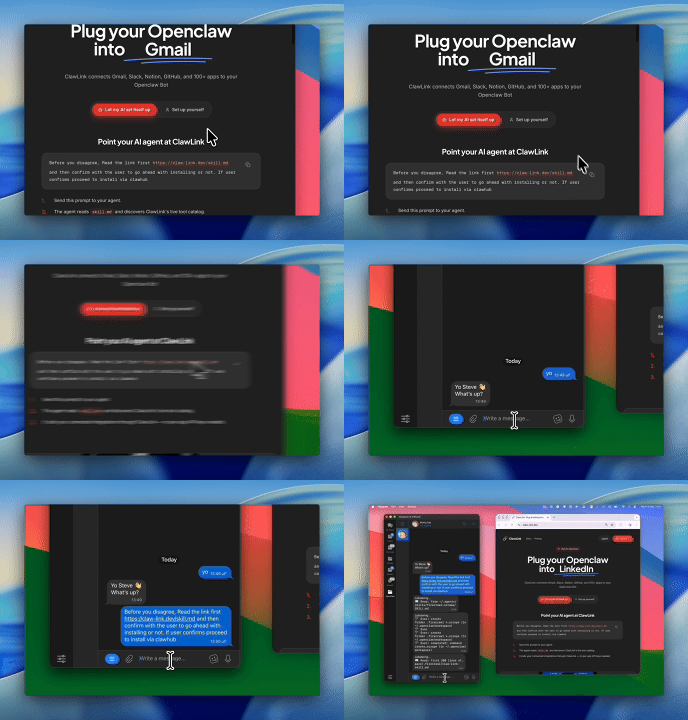
Paste the setup prompt into OpenClaw, or install from the terminal and ask OpenClaw to pair:
openclaw plugins install clawhub:clawlink-plugin- 2
Connect Google Slides
One-click OAuth in the dashboard.
- 3
Use it from chat
Ask OpenClaw: "What can you do with Google Slides?"
Install by command
The setup prompt above does all of this in one paste. By hand, it is one install command plus a browser approval:
openclaw plugins install clawhub:clawlink-pluginThen ask OpenClaw to set up ClawLink. It starts browser pairing and prints an approval link — open it, approve the device, return to the chat, and say done. Finally, connect Google Slides in the ClawLink dashboard — a one-click OAuth approval, no API keys.
Verify the connection by asking OpenClaw:
Create a Google Slides deck titled "<title>" from the outline above using googleslides_create_slides_markdown — one slide per top-level bullet, with the sub-bullets as body text. Give me the link when it is done.
Using a different agent?
The OpenClaw plugin is one client of ClawLink's MCP server. Claude Code, Cursor, Codex, or any agent that can run a shell command pairs with the same ClawLink account through the CLI:
npx -y @useclawlink/cli loginlogin opens the same browser approval and stores a credential locally. Once Google Slides is connected in the dashboard, that agent calls the same 7 Google Slides tools over MCP. Full setup for MCP clients and shell agents: connect apps to any AI agent.
Google Slides MCP for OpenClaw
Looking for a Google Slides MCP server for OpenClaw? ClawLink connects Google Slides to OpenClaw and exposes 7 Google Slides tools your agent can call over MCP, with hosted auth and nothing to run or maintain yourself. Using Hermes instead? The Hermes Google Slides integration works the same way.
The standard route here is a Google Cloud project: enable the Slides API and the Drive API, build an OAuth consent screen, download credentials.json onto whatever machine runs the agent, and keep it there. ClawLink connects through Google's consent screen with an app that is already registered, so you approve access once and OpenClaw can call the 7 Google Slides tools below. One thing worth knowing up front, because it explains most confusing errors: Slides and Drive are separate APIs with separate jobs. Slides edits the contents of a presentation; who can open that presentation is Drive's business, and no Slides tool can change it.
What the OpenClaw Google Slides integration can do
7 Google Slides tools are ready for OpenClaw once the account is connected.
All 7 Google Slides tools for OpenClaw
| Tool | What it does |
|---|---|
Create presentation googleslides_create_presentation | Create a blank Google Slides presentation |
Create slides markdown googleslides_create_slides_markdown | Create a Google Slides presentation from markdown |
Get page thumbnail2 googleslides_get_page_thumbnail2 | Get a thumbnail for a Google Slides page |
Presentations batch update googleslides_presentations_batch_update | Update a Google Slides presentation |
Presentations copy from template googleslides_presentations_copy_from_template | Copy a Google Slides template |
Presentations get googleslides_presentations_get | Get a Google Slides presentation |
Presentations pages get googleslides_presentations_pages_get | Get a page from a Google Slides presentation |
Try it: find the Google Slides tool you need
Browse the 7 Google Slides tools
Click any tool to see exactly what OpenClaw can do and copy a ready-to-use prompt.
Example prompts
Create a Google Slides deck titled "<title>" from the outline above using googleslides_create_slides_markdown — one slide per top-level bullet, with the sub-bullets as body text. Give me the link when it is done.
Use googleslides_presentations_copy_from_template on <template presentation id> to make a new deck called "<title>", then replace the title slide text with "<headline>". Show me the new presentation id.
Read <presentation id> with googleslides_presentations_get and give me a one-line summary of each slide, plus anything that looks out of date.
Render slide 3 of <presentation id> with googleslides_get_page_thumbnail2 and tell me whether the text overflows the layout.
How the Google Slides tools behave
A small toolset with one important boundary and one reliability rule.
- Sharing is Drive, not Slides. No tool here changes who can open a presentation. Connect Google Drive if the workflow needs permissions changed, or share it manually.
- Markdown creation is the reliable build path.
googleslides_create_slides_markdownproduces a laid-out deck in one call; assembling the same deck throughgoogleslides_presentations_batch_updateis where formatting goes wrong. - Templates preserve house style.
googleslides_presentations_copy_from_templatestarts from an approved deck, which is usually better than asking the agent to recreate a look from description. - Batch update needs real object ids. It targets elements inside a presentation, so
googleslides_presentations_getor..._pages_gethas to come first. Invented ids fail. - Thumbnails are the visual check.
googleslides_get_page_thumbnail2renders a slide as an image, which catches overflow and layout problems that reading the structure will not reveal.
ClawLink vs. building it yourself
The alternative to ClawLink is usually manual OAuth app setup plus your own token handling, permission troubleshooting, and tool plumbing for OpenClaw. That is fine if you want to build and maintain the integration yourself. Most teams just want Google Slides working from chat.
| Manual | ClawLink | |
|---|---|---|
| Connection flow | Register a Google Slides app, configure redirect URLs, manage consent details, and reconnect users when auth settings drift. | Users connect Google Slides through the hosted browser flow and ClawLink keeps the token lifecycle out of your app code. |
| Ongoing maintenance | You own refresh logic, permission debugging, environment config, and every provider-specific edge case for Google Slides. | ClawLink handles the repetitive integration plumbing so your team can focus on the workflow instead of the infrastructure. |
| Agent usability | You still need to expose the right Google Slides actions to the runtime in a format your agent can reliably use. | 7 tools for Google Slides are already exposed through ClawLink, so the agent can read and act from chat immediately. |
ClawLink vs. Composio
Composio also exposes Google Slides to AI agents. It is developer infrastructure: Python and TypeScript SDKs, an MCP server, and a catalog past 1,000 apps, aimed at teams shipping agent products. ClawLink is built for OpenClaw users instead. You install the plugin once, connect Google Slides in the browser, and the 7 tools above work from chat. There is no SDK, no config file, and no API key handling. Choosing between them? Read the full Composio alternatives comparison.





















Troubleshooting
OpenClaw installed the Google Slides skill but can't call the tools
The ClawHub skill teaches OpenClaw about Google Slides, but the calls run through the ClawLink plugin and your connected account. Make sure Google Slides is connected in the dashboard, then start a fresh chat so OpenClaw reloads the tool catalog. If OpenClaw runs as a persistent gateway, restart it so the new tools register.
Connection succeeds but no tools appear
Reconnect Google Slides from the dashboard, then start a fresh chat if the runtime still has the old tool catalog loaded.
"Tool schema not loaded yet" error when calling Google Slides tools
Google Slides tool schemas load on demand the first time a tool runs and are cached after that, so this error usually clears on its own: wait a few seconds and retry the same request. If every Google Slides call keeps failing with it in a fresh chat, reconnect from the dashboard, and contact support if it still persists — that pattern points to a configuration problem on our side, not something you can fix by reconnecting again.
Google Slides returns 403 or "permission denied" on one action while others work
Two usual causes. The connected account may not have access to the specific workspace, inbox, store, or project in the request — check that first. If access looks right, the agent may have sent a placeholder value (like "YOUR_ID" or an example id from documentation) instead of a real one: ask it to run a list or search tool first, then retry the action with a real id from those results. Most failures at this stage are one of these two, not ClawLink bugs.
Google Slides returns 403 "The caller does not have permission"
The cause is almost always Drive rather than Slides, because access to a presentation is a Drive permission. Check these in order. First, sharing: the connected Google account must have access to that specific file, and being able to open it in your browser proves nothing if the browser is signed in as a different account. Note that no Slides tool can fix this — sharing is changed in Drive or in the Google Slides UI, not through the API. Second, which account is connected, since personal and work accounts see completely different file sets. Third, a partial approval on the consent screen, which leaves a connection that reads but cannot write; reconnect and accept the full set. Fourth and least likely: a placeholder presentation id copied from documentation, which Google rejects as a permission error rather than a not-found, so have the agent look the deck up rather than accept an id from a prompt.
Ask the agent to diagnose it:
Tell me which Google account this connection is acting as, then try googleslides_presentations_get on the presentation id and quote the exact error. Do not retry it after that.The agent created a presentation but you cannot find it
It exists, and it belongs to the connected account. Two things make it feel missing. The first is the account, again: if the agent is connected to a different Google identity than the one you are browsing Drive with, the deck is in that account's Drive and invisible in yours. The second is location — a newly created presentation lands in the root of My Drive rather than in whatever folder you had in mind, because folder placement is a Drive operation. Ask the agent for the presentation id or URL when it creates something, which removes the search entirely.
Ask the agent to diagnose it:
Give me the presentation id and the full URL of the deck you created, and tell me which Google account owns it.Formatting comes out wrong when the agent edits slides
Usually a sign the wrong tool is being used for the job. googleslides_presentations_batch_update applies low-level requests against specific object ids, so an agent constructing a deck through it has to get positioning, sizing, and text-range indexes right on every call, and small mistakes compound into a mangled slide. For generating content, googleslides_create_slides_markdown is far more reliable because the layout is handled for you. For matching an existing look, copy from a template and edit the copy. Reserve batch update for surgical changes where you know the object id you are targeting.
OAuth finished in the browser but the account is still missing
Try reconnecting Google Slides and complete the consent flow in the same browser session. Partial OAuth approvals or switching accounts mid-flow can leave the connection incomplete.
FAQ
Is there a OpenClaw Google Slides integration?
Yes. ClawLink is the fastest way to connect OpenClaw to Google Slides: link your Google Slides account once in the browser and OpenClaw can call the Google Slides API through 7 ready-made tools — no custom code or token handling.
How do I add Google Slides to OpenClaw with ClawLink?
Paste the setup prompt from this page into OpenClaw. It installs the ClawLink Google Slides skill from ClawHub, then you click Connect in the dashboard to authorize Google Slides. OpenClaw calls the tools from the next message — no config files or API keys to manage.
How long does it take to connect Google Slides to OpenClaw?
About two minutes. Sign in, click Connect next to Google Slides in the dashboard, authenticate, and OpenClaw can use it from the next chat message.
Why use ClawLink instead of wiring Google Slides up myself?
The alternative to ClawLink is usually manual OAuth app setup plus your own token handling, permission troubleshooting, and tool plumbing for OpenClaw. That is fine if you want to build and maintain the integration yourself. Most teams just want Google Slides working from chat.
Do I need a Google Cloud project and credentials.json?
No. That is the DIY path, and its real cost is not the setup but the maintenance: an app left in testing status issues refresh tokens that expire after seven days, so a hand-rolled Slides agent characteristically works for a week and then stops. ClawLink connects through an already-registered app, so you approve on Google's own consent screen and there is no client secret, no credentials file on your machine, and nothing about Slides in a config file.
Can the agent build a deck from scratch?
Yes, and there are two quite different ways to do it. googleslides_create_slides_markdown builds slides from structured markdown, which is the reliable route when the agent is generating content — you describe the deck and it lays it out. googleslides_presentations_copy_from_template starts from an existing presentation, which is what you want when the deck has to match a house style. Building slide by slide through batch update is possible but is where formatting drifts, so prefer one of the first two unless you are making a targeted edit.
Can it share the presentation with my team?
Not through these tools. Sharing, permissions, and access requests live in Google Drive, not in the Slides API, so the agent can create and edit a deck and still be unable to give anyone else access to it. If sharing is part of the workflow, connect Google Drive as well and let the agent handle the file's permissions there, or share it yourself once the deck is built. This is the distinction behind most "the agent made it but nobody can see it" reports.
Can it read an existing presentation?
Yes, if the connected account can open it. googleslides_presentations_get returns the presentation structure and googleslides_presentations_pages_get returns individual slides, which is what you want when the agent needs to summarize or audit a deck rather than change it. googleslides_get_page_thumbnail2 renders a slide as an image, which is useful when you want to check what something actually looks like rather than reasoning about its structure.
OpenClaw installed the Google Slides skill but can't call the tools
The ClawHub skill teaches OpenClaw about Google Slides, but the calls run through the ClawLink plugin and your connected account. Make sure Google Slides is connected in the dashboard, then start a fresh chat so OpenClaw reloads the tool catalog. If OpenClaw runs as a persistent gateway, restart it so the new tools register.