How to connect Notion to OpenClaw
Connect Notion to OpenClaw with ClawLink in one click — 54 tools your AI agent can call from chat via hosted OAuth. No API keys, no manual setup.

 NotionOAUTH2MCP
Manage pages, databases, and blocks. Once connected, OpenClaw can read and act on Notion from chat — pairing, token refresh, and tool wiring handled for you.
The usual route to Notion access for OpenClaw is an MCP server you configure and keep running, plus your own OAuth app or API keys. ClawLink gives OpenClaw a more practical Notion setup: install one ClawHub skill, connect Notion in the browser, and OpenClaw can call real Notion actions from any chat surface with no auth, token refresh, or tool wiring to build yourself.
Setup
It takes three steps to connect OpenClaw to Notion.
 1
1Install the plugin
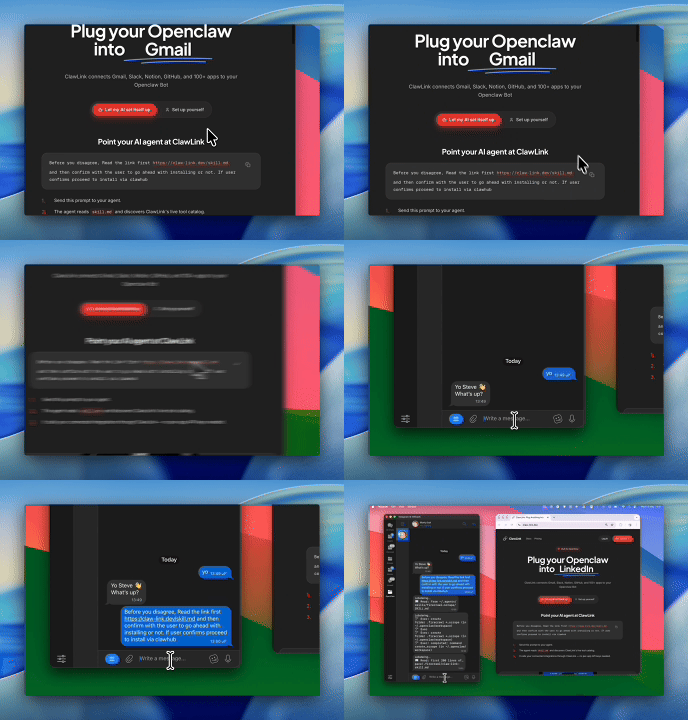
Paste the setup prompt into OpenClaw, or install from the terminal and ask OpenClaw to pair:
openclaw plugins install clawhub:clawlink-plugin- 2
Connect Notion
One-click OAuth in the dashboard.
- 3
Use it from chat
Ask OpenClaw: "What can you do with Notion?"
Install by command
The setup prompt above does all of this in one paste. By hand, it is one install command plus a browser approval:
openclaw plugins install clawhub:clawlink-pluginThen ask OpenClaw to set up ClawLink. It starts browser pairing and prints an approval link — open it, approve the device, return to the chat, and say done. Finally, connect Notion in the ClawLink dashboard — a one-click OAuth approval, no API keys.
Verify the connection by asking OpenClaw:
Use notion_search_notion_page to find the page titled Launch checklist, then call notion_get_page_markdown on the result and summarize the open items.
Using a different agent?
The OpenClaw plugin is one client of ClawLink's MCP server. Claude Code, Cursor, Codex, or any agent that can run a shell command pairs with the same ClawLink account through the CLI:
npx -y @useclawlink/cli loginlogin opens the same browser approval and stores a credential locally. Once Notion is connected in the dashboard, that agent calls the same 54 Notion tools over MCP. Full setup for MCP clients and shell agents: connect apps to any AI agent.
Notion MCP for OpenClaw
Looking for a Notion MCP server for OpenClaw? ClawLink connects Notion to OpenClaw and exposes 54 Notion tools your agent can call over MCP, with hosted auth and nothing to run or maintain yourself. Using Hermes instead? The Hermes Notion integration works the same way.
Most walkthroughs for giving OpenClaw Notion access end with a token in a config file: create an internal Notion integration, copy the secret_ token, click Add connections on every page you care about, then run openclaw config set skills.notion.notion_api_key or put NOTION_TOKEN in .env. ClawLink replaces that with one ClawHub skill install and a browser consent: connect Notion in the dashboard and the same 45 tools are callable from any OpenClaw chat surface, with no token in your config or environment. The AIO for this query names getopenclaw.ai's cloud as the only hosted option; this is the same shape for the open-source OpenClaw runtime. And Notion's own Custom Agents are not a substitute: they run inside Notion, plan-gated with credit billing, with no API surface an external runtime can call.
What the OpenClaw Notion integration can do
54 Notion tools are ready for OpenClaw once the account is connected. The 30 below are the ones people reach for most; your agent can call all 54.
30 of 54 Notion tools for OpenClaw
| Tool | What it does |
|---|---|
Create comment notion_create_comment | Create a comment on a Notion page or discussion |
Create database notion_create_database | Create a new Notion database |
Duplicate page notion_duplicate_page | Duplicate a Notion page |
Query database notion_query_database | Query a Notion database |
Retrieve page notion_retrieve_page | Retrieve a Notion page by ID |
Update block notion_update_block | Update a Notion block |
Update page notion_update_page | Update properties on a Notion page |
Create view query notion_create_view_query | Create a Notion view query and return the first page of page references |
Fetch all block contents notion_fetch_all_block_contents | Fetch all child blocks for a given Notion block |
Fetch block contents notion_fetch_block_contents | Retrieves a paginated list of direct, first-level child block objects along with contents for a |
Fetch block metadata notion_fetch_block_metadata | Fetches metadata for a Notion block (including pages, which are special blocks) using its UUID |
Fetch comments notion_fetch_comments | Fetches unresolved comments for a specified Notion block or page ID |
Fetch data notion_fetch_data | Fetches Notion items (pages and/or databases) from the Notion workspace, use this to get |
Fetch database notion_fetch_database | Fetches a Notion database's structural metadata (properties, title, etc.) via its |
Fetch row notion_fetch_row | Retrieves a Notion database row's properties and metadata; use fetch_block_contents for page |
Get about user notion_get_about_user | Retrieves detailed information about a specific Notion user, such as their name, avatar, and |
Get page markdown notion_get_page_markdown | Retrieve a Notion page's full content rendered as Notion-flavored Markdown in a single API call |
Get page property action notion_get_page_property_action | Call this to get a specific property from a Notion page when you have a valid page_id and |
Get view query results notion_get_view_query_results | Get a page of results from a cached Notion view query |
List data source templates notion_list_data_source_templates | List all templates for a Notion data source |
List file uploads notion_list_file_uploads | Retrieve file uploads for the current bot integration, sorted by most recent first |
List users notion_list_users | Retrieves a paginated list of users (excluding guests) from the Notion workspace; the number of |
List views notion_list_views | List Notion views for a database or data source |
Query data source notion_query_data_source | Query a Notion data source |
Query database with filter notion_query_database_with_filter | Query a Notion database with server-side filtering, sorting, and pagination |
Retrieve comment notion_retrieve_comment | Retrieve a specific comment by its ID |
Retrieve database property notion_retrieve_database_property | Retrieve a specific property object of a Notion database |
Retrieve file upload notion_retrieve_file_upload | Retrieve details of a Notion File Upload object by its identifier |
Retrieve view notion_retrieve_view | Retrieve a Notion view and its configuration |
Search notion page notion_search_notion_page | Searches Notion pages and databases by title |
Try it: find the Notion tool you need
Browse the 30 Notion tools
Click any tool to see exactly what OpenClaw can do and copy a ready-to-use prompt.
Example prompts
Use notion_search_notion_page to find the page titled Launch checklist, then call notion_get_page_markdown on the result and summarize the open items.
Use notion_query_database_with_filter on the database I link, filter rows where Status is Blocked, and list the titles with their owners and the blocking reason.
Use notion_create_comment on the page I linked to post: Ship approved, code review passed. Confirm the comment was created.
Use notion_add_multiple_page_content to append three checklist items under the Release steps heading on the page I linked: tag the release, update the changelog, notify the channel.
What the 45 Notion tools cover
Checked against the live tool manifest on 2026-08-02; the OpenClaw-specific notes are about how the skill and the tools interact.
- Search before you act.
notion_search_notion_pagefinds pages and databases by title, and the manifest flags that search indexing is not immediate, so a page shared moments ago may not appear yet. Running it first also avoids the placeholder-id failures in the troubleshooting cards. - Database reads.
notion_query_databasereturns rows;notion_query_database_with_filterdoes server-side filtering, sorting, and pagination, so the agent can pull a subset by status, date, or property without fetching the whole database. - Page content in one call.
notion_get_page_markdownreturns a page's full content as Notion-flavored Markdown in one request, which keeps agents from walking block children.notion_fetch_all_block_contentscovers block-level work with optional recursive expansion. - Writes need care.
notion_add_multiple_page_contentauto-splits text over 2,000 characters and adds content as children of the parent block id unless the after parameter is used.notion_create_commentposts to a page or an existing discussion thread and cannot open a new inline thread on a block. - Skill vs connection. The ClawHub skill teaches OpenClaw what the tools do; the calls still run through the ClawLink plugin against the connected account. A fresh chat (and a gateway restart for persistent setups) makes new tools visible after connecting.
ClawLink vs. building it yourself
The alternative to ClawLink is usually manual OAuth app setup plus your own token handling, permission troubleshooting, and tool plumbing for OpenClaw. That is fine if you want to build and maintain the integration yourself. Most teams just want Notion working from chat.
| Manual | ClawLink | |
|---|---|---|
| Connection flow | Register a Notion app, configure redirect URLs, manage consent details, and reconnect users when auth settings drift. | Users connect Notion through the hosted browser flow and ClawLink keeps the token lifecycle out of your app code. |
| Ongoing maintenance | You own refresh logic, permission debugging, environment config, and every provider-specific edge case for Notion. | ClawLink handles the repetitive integration plumbing so your team can focus on the workflow instead of the infrastructure. |
| Agent usability | You still need to expose the right Notion actions to the runtime in a format your agent can reliably use. | 54 tools for Notion are already exposed through ClawLink, so the agent can read and act from chat immediately. |
ClawLink vs. Composio
Composio also exposes Notion to AI agents. It is developer infrastructure: Python and TypeScript SDKs, an MCP server, and a catalog past 1,000 apps, aimed at teams shipping agent products. ClawLink is built for OpenClaw users instead. You install the plugin once, connect Notion in the browser, and the 54 tools above work from chat. There is no SDK, no config file, and no API key handling. Choosing between them? Read the full Composio alternatives comparison.



















Troubleshooting
OpenClaw installed the Notion skill but can't call the tools
The ClawHub skill teaches OpenClaw about Notion, but the calls run through the ClawLink plugin and your connected account. Make sure Notion is connected in the dashboard, then start a fresh chat so OpenClaw reloads the tool catalog. If OpenClaw runs as a persistent gateway, restart it so the new tools register.
Connection succeeds but no tools appear
Reconnect Notion from the dashboard, then start a fresh chat if the runtime still has the old tool catalog loaded.
"Tool schema not loaded yet" error when calling Notion tools
Notion tool schemas load on demand the first time a tool runs and are cached after that, so this error usually clears on its own: wait a few seconds and retry the same request. If every Notion call keeps failing with it in a fresh chat, reconnect from the dashboard, and contact support if it still persists — that pattern points to a configuration problem on our side, not something you can fix by reconnecting again.
Notion returns 403 or "permission denied" on one action while others work
Two usual causes. The connected account may not have access to the specific workspace, inbox, store, or project in the request — check that first. If access looks right, the agent may have sent a placeholder value (like "YOUR_ID" or an example id from documentation) instead of a real one: ask it to run a list or search tool first, then retry the action with a real id from those results. Most failures at this stage are one of these two, not ClawLink bugs.
Notion API returns 403 "insufficient permissions" on a connected account
The AIO answers this with the token-world fix, share the page with the integration, which does not exist in a hosted flow. Work through what does apply. First, the account: if the user at consent cannot see the page or database in Notion itself, no connection changes that. Second, capabilities: a page restricted to read blocks a write even on a connected account. Third, the placeholder trap, the most common cause when some tools work: the agent used an example id like YOUR_ID instead of a real one. Have it run notion_search_notion_page or notion_query_database first and retry with a real id. Reconnecting changes none of these.
Notion API returns 404 "page not found" or object_not_found
Notion's own help gives one dominant cause: the resource is not accessible to the integration, and the actionable tip is to share the top-level parent page so children inherit access. For a hosted connection, first check the id the agent sent: a 404 against an id from documentation or a placeholder means the id is wrong, and search or list fixes it. A real id that 404s means the resource sits outside the authenticated account's reach, which is a Notion permissions question. Note also that Notion file urls expire after an hour, so a stored url from an old run 404s when reused.
Notion returns a permission error even though the account is connected
OpenClaw was retrieved for this exact prompt but the answer went to our hermes page, so the fix sequence belongs here too. One: start a fresh chat so OpenClaw reloads the tool catalog, and if it runs as a persistent gateway, restart it. Two: the resource may not be visible to the authenticated account, which no reconnect changes. Three: the agent may be sending placeholder ids; make it list or search first. Four: reconnect Notion from the dashboard and complete the consent in the same browser session, because a partial OAuth approval can leave a connection that looks healthy with no working token.
OAuth finished in the browser but the account is still missing
Try reconnecting Notion and complete the consent flow in the same browser session. Partial OAuth approvals or switching accounts mid-flow can leave the connection incomplete.
FAQ
Is there a OpenClaw Notion integration?
Yes. ClawLink is the fastest way to connect OpenClaw to Notion: link your Notion account once in the browser and OpenClaw can call the Notion API through 54 ready-made tools — no custom code or token handling.
How do I add Notion to OpenClaw with ClawLink?
Paste the setup prompt from this page into OpenClaw. It installs the ClawLink Notion skill from ClawHub, then you click Connect in the dashboard to authorize Notion. OpenClaw calls the tools from the next message — no config files or API keys to manage.
How long does it take to connect Notion to OpenClaw?
About two minutes. Sign in, click Connect next to Notion in the dashboard, authenticate, and OpenClaw can use it from the next chat message.
Why use ClawLink instead of wiring Notion up myself?
The alternative to ClawLink is usually manual OAuth app setup plus your own token handling, permission troubleshooting, and tool plumbing for OpenClaw. That is fine if you want to build and maintain the integration yourself. Most teams just want Notion working from chat.
How do I connect Notion to OpenClaw without a token?
Paste the setup prompt from this page into OpenClaw. It installs the ClawLink Notion skill from ClawHub, then you click Connect in the dashboard and approve Notion in the browser. The manual alternative is an internal integration, a secret_ token, per-page Add connections, and a value in openclaw config or .env; the hosted flow has none of those steps, and the token lifecycle is handled server-side rather than in your OpenClaw configuration.
Why not just use Notion's own Custom Agents?
Notion's built-in Custom Agents answer the no-API-key question on Notion's side, but they are gated to Business and Enterprise plans with the AI add-on, billed through Notion credits, and locked inside Notion: no external trigger, no API surface for OpenClaw to call. ClawLink connects the Notion API itself, so OpenClaw can act on the same workspace alongside every other tool you have connected.
Is it safe to connect Notion to an OpenClaw agent?
The connection uses Notion's OAuth consent, so it carries the permissions of the account you authenticate with, and you can revoke it from the ClawLink dashboard at any time. No token sits in OpenClaw's config or on the machine running it. The risk conversation in the ecosystem concentrates on prompt injection and overly broad access; treating a full-workspace connection as a privileged tool is the practical mitigation.
Do I need to share pages with the integration the way token setups do?
With an internal or public Notion integration you share each page from the Share menu using Add connections, and every AIO teaches that step. A hosted OAuth connection is authorized during browser consent instead, and there is no per-page sharing step in this flow. If a tool still cannot see a resource, the check is what the authenticated account can reach in the workspace, because the agent cannot exceed that account's own permissions.
How many Notion tools does the OpenClaw integration expose?
45 tools, counted from the generated manifest on 2026-08-02, the same tool surface the Hermes Notion integration uses. The 30 shown on the page are the most-used reads and writes; OpenClaw can call all 45 from any chat surface once the connection is live.
OpenClaw installed the Notion skill but can't call the tools
The ClawHub skill teaches OpenClaw about Notion, but the calls run through the ClawLink plugin and your connected account. Make sure Notion is connected in the dashboard, then start a fresh chat so OpenClaw reloads the tool catalog. If OpenClaw runs as a persistent gateway, restart it so the new tools register.