How to connect Airtable to OpenClaw
Connect Airtable to OpenClaw with ClawLink in one click — 23 tools your AI agent can call from chat via hosted OAuth. No API keys, no manual setup.

 AirtableOAUTH2MCP
Manage bases, tables, and records. Once connected, OpenClaw can read and act on Airtable from chat — pairing, token refresh, and tool wiring handled for you.
The usual route to Airtable access for OpenClaw is an MCP server you configure and keep running, plus your own OAuth app or API keys. ClawLink gives OpenClaw a more practical Airtable setup: install one ClawHub skill, connect Airtable in the browser, and OpenClaw can call real Airtable actions from any chat surface with no auth, token refresh, or tool wiring to build yourself.
Setup
It takes three steps to connect OpenClaw to Airtable.
 1
1Install the plugin
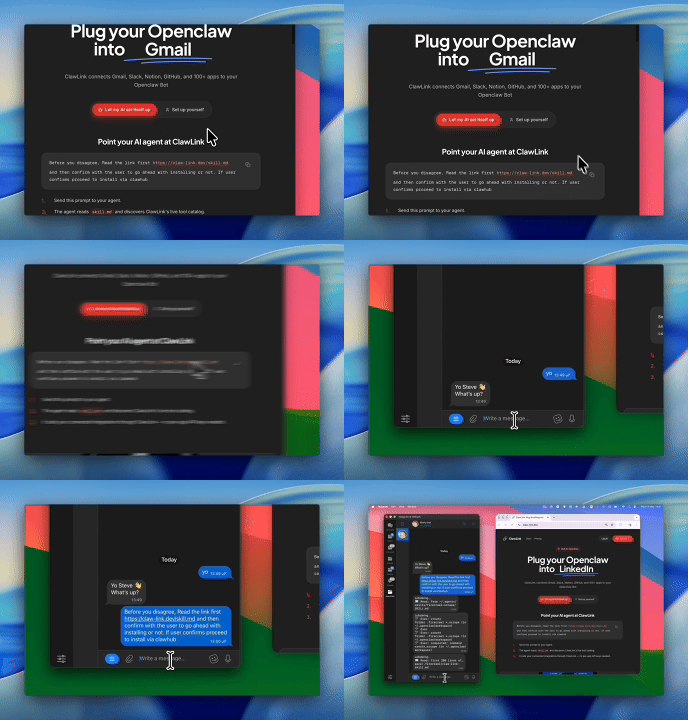
Paste the setup prompt into OpenClaw, or install from the terminal and ask OpenClaw to pair:
openclaw plugins install clawhub:clawlink-plugin- 2
Connect Airtable
One-click OAuth in the dashboard.
- 3
Use it from chat
Ask OpenClaw: "What can you do with Airtable?"
Install by command
The setup prompt above does all of this in one paste. By hand, it is one install command plus a browser approval:
openclaw plugins install clawhub:clawlink-pluginThen ask OpenClaw to set up ClawLink. It starts browser pairing and prints an approval link — open it, approve the device, return to the chat, and say done. Finally, connect Airtable in the ClawLink dashboard — a one-click OAuth approval, no API keys.
Verify the connection by asking OpenClaw:
List my bases with airtable_list_bases, pick the one I name, and show me its tables and fields with airtable_get_base_schema. Do not change anything yet.
Using a different agent?
The OpenClaw plugin is one client of ClawLink's MCP server. Claude Code, Cursor, Codex, or any agent that can run a shell command pairs with the same ClawLink account through the CLI:
npx -y @useclawlink/cli loginlogin opens the same browser approval and stores a credential locally. Once Airtable is connected in the dashboard, that agent calls the same 23 Airtable tools over MCP. Full setup for MCP clients and shell agents: connect apps to any AI agent.
Airtable MCP for OpenClaw
Looking for a Airtable MCP server for OpenClaw? ClawLink connects Airtable to OpenClaw and exposes 23 Airtable tools your agent can call over MCP, with hosted auth and nothing to run or maintain yourself. Using Hermes instead? The Hermes Airtable integration works the same way.
The walkthrough the answer engines hand out for this query is a token recipe: create a Personal Access Token in Airtable with the data.records and schema.bases scopes, put it in an environment file, restart your agent. That is the exact step this page removes, and what replaces it is named: browser OAuth consent, no secret ever copied. You install one skill, click Connect next to Airtable in the dashboard, and approve the two permissions Airtable shows on its own consent screen; the 23 tools below work from your next chat, and there is no token anywhere on your machine to copy, paste, rotate, or leak. The manual route's own docs are the best argument for this one: every scope-and-revocation warning they print is a problem the hosted connection simply does not have.
Is it safe to connect Airtable to OpenClaw?
The AI Overview answers this query with a yes-if-scoped framing, and its named risks are prompt injection, excessive permissions, and bad data loops. A hosted connection is the shape that answers the permission half directly:
- You never see or manage the token. The manual route asks you to create a Personal Access Token, paste it into an env file, and keep it safe; every leaked-PAT incident starts with a secret that existed in the first place. Here the grant lives server-side, and the only revocation step is disconnecting from the dashboard.
- The grant is account-scoped, like a least-privilege PAT. The connection acts as your Airtable account with your base access, and there is no way to over-scope it, because there is no token to grant extra scopes to.
- The behavioral risks stay yours to manage. Treat cell contents as untrusted input, because a base cell can contain instructions aimed at an agent reading it. Start with reads, require confirmation before bulk updates and schema changes, and keep a human in the loop on writes that touch shared bases.
The safety question is not "is the connection secure" but "what did you let it do". Hosted OAuth makes the first one structural and leaves the second one where it belongs: in the prompts.
What the OpenClaw Airtable integration can do
23 Airtable tools are ready for OpenClaw once the account is connected. The 20 below are the ones people reach for most; your agent can call all 23.
20 of 23 Airtable tools for OpenClaw
| Tool | What it does |
|---|---|
Create comment airtable_create_comment | Create a comment on an Airtable record |
Create field airtable_create_field | Create a field in an Airtable table |
Create table airtable_create_table | Create a new Airtable table |
Get record airtable_get_record | Get a specific Airtable record |
List bases airtable_list_bases | List Airtable bases available to the connected account |
List records airtable_list_records | List records in an Airtable table |
Update comment airtable_update_comment | Update a comment on an Airtable record |
Update field airtable_update_field | Update a field in an Airtable table |
Update table airtable_update_table | Update an Airtable table |
Get base schema airtable_get_base_schema | Retrieves the detailed schema for a specified Airtable base, including its tables, fields |
Get user info airtable_get_user_info | Retrieves information, such as ID and permission scopes, for the currently authenticated |
List comments airtable_list_comments | List comments on a specific Airtable record |
Create base airtable_create_base | Creates a new Airtable base with specified tables and fields within a workspace |
Create record from natural language airtable_create_record_from_natural_language | Creates a new record in an Airtable table from a natural language description |
Create records airtable_create_records | Create multiple records (up to 10) in a specified Airtable table |
Update multiple records airtable_update_multiple_records | Update up to 10 records in an Airtable table with selective field modifications |
Update multiple records put airtable_update_multiple_records_put | Destructively update multiple records in Airtable using PUT, clearing unspecified fields |
Update record airtable_update_record | Modifies specified fields of an existing record in an Airtable base and table; the base, table |
Update record put airtable_update_record_put | Updates an existing record in an Airtable base using PUT method |
Upload attachment airtable_upload_attachment | Uploads a file attachment to a specified field in an Airtable record |
Try it: find the Airtable tool you need
Browse the 20 Airtable tools
Click any tool to see exactly what OpenClaw can do and copy a ready-to-use prompt.
Example prompts
List my bases with airtable_list_bases, pick the one I name, and show me its tables and fields with airtable_get_base_schema. Do not change anything yet.
List the records in table <table id> of base <base id> with airtable_list_records, and summarize the rows with a status that is not Done.
Update record <record id> in table <table id> with the field values I give you, using airtable_update_record. Show me the current values first and the payload before you send it.
List the comments on record <record id> with airtable_list_comments and tell me what is waiting on a decision and from whom.
How the Airtable tools behave
Details that decide whether an Airtable prompt reads the right base or edits the wrong table.
- Everything is keyed by id, and ids are not unique across bases.
airtable_list_basesandairtable_get_base_schemaare where real ids come from; a record id from another base fails or, worse, resolves to a different row. - Schema reads come before record writes.
airtable_get_base_schemareturns tables and fields, and field ids are what record tools take, not field names. Building a payload from memory is the main source of invalid-field errors. - Bulk tools exist and are the rate-limit answer.
airtable_create_recordsandairtable_update_multiple_recordsdo in one call what a loop does in many, which matters because per-base rate limits count every request. - Comments are per-record.
airtable_list_commentsandairtable_create_commentwork on a record id, so "read the discussion" is unambiguous once the record is named. airtable_create_record_from_natural_languageexists, and it is not a free pass. It still writes to a real base, so the confirmation habit applies to it like any other write.
ClawLink vs. building it yourself
The alternative to ClawLink is usually manual OAuth app setup plus your own token handling, permission troubleshooting, and tool plumbing for OpenClaw. That is fine if you want to build and maintain the integration yourself. Most teams just want Airtable working from chat.
| Manual | ClawLink | |
|---|---|---|
| Connection flow | Register a Airtable app, configure redirect URLs, manage consent details, and reconnect users when auth settings drift. | Users connect Airtable through the hosted browser flow and ClawLink keeps the token lifecycle out of your app code. |
| Ongoing maintenance | You own refresh logic, permission debugging, environment config, and every provider-specific edge case for Airtable. | ClawLink handles the repetitive integration plumbing so your team can focus on the workflow instead of the infrastructure. |
| Agent usability | You still need to expose the right Airtable actions to the runtime in a format your agent can reliably use. | 23 tools for Airtable are already exposed through ClawLink, so the agent can read and act from chat immediately. |
ClawLink vs. Composio
Composio also exposes Airtable to AI agents. It is developer infrastructure: Python and TypeScript SDKs, an MCP server, and a catalog past 1,000 apps, aimed at teams shipping agent products. ClawLink is built for OpenClaw users instead. You install the plugin once, connect Airtable in the browser, and the 23 tools above work from chat. There is no SDK, no config file, and no API key handling. Choosing between them? Read the full Composio alternatives comparison.

























Troubleshooting
OpenClaw installed the Airtable skill but can't call the tools
The ClawHub skill teaches OpenClaw about Airtable, but the calls run through the ClawLink plugin and your connected account. Make sure Airtable is connected in the dashboard, then start a fresh chat so OpenClaw reloads the tool catalog. If OpenClaw runs as a persistent gateway, restart it so the new tools register.
Connection succeeds but no tools appear
Reconnect Airtable from the dashboard, then start a fresh chat if the runtime still has the old tool catalog loaded.
"Tool schema not loaded yet" error when calling Airtable tools
Airtable tool schemas load on demand the first time a tool runs and are cached after that, so this error usually clears on its own: wait a few seconds and retry the same request. If every Airtable call keeps failing with it in a fresh chat, reconnect from the dashboard, and contact support if it still persists — that pattern points to a configuration problem on our side, not something you can fix by reconnecting again.
Airtable returns 403 or "permission denied" on one action while others work
Two usual causes. The connected account may not have access to the specific workspace, inbox, store, or project in the request — check that first. If access looks right, the agent may have sent a placeholder value (like "YOUR_ID" or an example id from documentation) instead of a real one: ask it to run a list or search tool first, then retry the action with a real id from those results. Most failures at this stage are one of these two, not ClawLink bugs.
Airtable returns 403 or "insufficient permissions" although the account shows as connected
The causes the search engines teach for this error are token-level: missing scopes on a PAT, missing base access in the Developer Hub, field-level rights. In a hosted connection the token-level causes do not exist, and the real checks are the account-level ones. The connected account must be a collaborator on the base in the request, with a role that permits the operation: a viewer can read records but cannot update them, and a base not shared with the account at all returns a permission error rather than a not-found. Second, the agent may have sent a placeholder or guessed id (like "YOUR_ID" or a sample base id from documentation) instead of a real one: ask it to run airtable_list_bases first and retry with the real base or record id from those results.
Ask the agent to diagnose it:
Run airtable_list_bases and airtable_get_base_schema for the base in question and show me the real ids. Quote the exact 403 text, then retry with a real id from that list.Airtable tools are missing, or one tool name is not found
Two different failures. If OpenClaw shows no Airtable tools at all, the connection or pairing is incomplete: confirm the skill was installed, that Airtable shows as connected in the dashboard, and start a fresh chat so the tool catalog reloads. If most tools work and a single name fails, that name is wrong rather than missing: the error lists the closest real tools, and clawlink_list_tools --integration airtable shows the exact catalog. There is also a first-call timing case unique to this setup: schemas load on demand, so the opening Airtable call in a fresh session can arrive before the catalog and needs one retry. What does not apply is the advice for this symptom that assumes a local MCP server installed with npm and declared in a client config, which is what the search results teach.
Ask the agent to diagnose it:
List the Airtable tools you actually have access to. If there are none, run clawlink_list_integrations and say so plainly. If there are, tell me which one lists bases and use that exact name.Airtable updates work but the wrong records change, or a record is not found
Airtable records are addressed by record id, and the two failures here are the two causes. First, the agent used a name or a display value where an id was required, which either fails with a not-found or, worse, resolves to a different record. Second, the id came from a different base or table than the one being updated: ids are not unique across bases. The fix is to ground the call in the schema first: airtable_list_records on the specific table returns the ids that table actually holds, and airtable_get_base_schema confirms table and field names before a payload is built. A confirmation step before any update_multiple operation is the cheapest guard against a bulk change landing in the wrong rows.
Ask the agent to diagnose it:
Run airtable_get_base_schema for the base, then airtable_list_records for the table. Show me the record ids and confirm which rows you intend to update before you send the update.OAuth finished in the browser but the account is still missing
Try reconnecting Airtable and complete the consent flow in the same browser session. Partial OAuth approvals or switching accounts mid-flow can leave the connection incomplete.
FAQ
Is there a OpenClaw Airtable integration?
Yes. ClawLink is the fastest way to connect OpenClaw to Airtable: link your Airtable account once in the browser and OpenClaw can call the Airtable API through 23 ready-made tools — no custom code or token handling.
How do I add Airtable to OpenClaw with ClawLink?
Paste the setup prompt from this page into OpenClaw. It installs the ClawLink Airtable skill from ClawHub, then you click Connect in the dashboard to authorize Airtable. OpenClaw calls the tools from the next message — no config files or API keys to manage.
How long does it take to connect Airtable to OpenClaw?
About two minutes. Sign in, click Connect next to Airtable in the dashboard, authenticate, and OpenClaw can use it from the next chat message.
Why use ClawLink instead of wiring Airtable up myself?
The alternative to ClawLink is usually manual OAuth app setup plus your own token handling, permission troubleshooting, and tool plumbing for OpenClaw. That is fine if you want to build and maintain the integration yourself. Most teams just want Airtable working from chat.
Do I need an Airtable Personal Access Token?
No. The recipe most guides teach is: create a Personal Access Token with data.records:read/write and schema.bases:read, put it in .env, restart the agent, and keep it safe because anyone with it owns that much of your account. Here the authorization happens on Airtable's consent screen in the browser, the connection is stored server-side, and the token is never copied anywhere. The scopes exist either way, which is the honest way to say it: the hosted connection holds them for you, so you never see, manage, or accidentally leak a secret.
Can an agent manage my bases without me creating a personal access token?
Yes, and that is the specific query this flow answers. The alternative shapes the engines describe are a PAT in an env file or a custom skill file with the token baked in; both mean a secret on your machine. Here the agent manages bases through a hosted OAuth connection: you approve once in the browser, OpenClaw calls the Airtable tools, and the credential exists only server-side. Bases you can see are bases the agent can reach, and revoking the connection from the dashboard removes its access immediately.
Is it safe to connect Airtable to an AI agent?
The AI Overview answers this query yes-if-scoped, and its named risks are prompt injection, excessive permissions, and bad data loops, with least-privilege and human-in-the-loop as the mitigations. The hosted setup removes the permission-management half of that: the grant is a single OAuth connection you can revoke in one click, and there is no token to over-scope or leak. The behavioral half is yours: start with reads, ask the agent to confirm before writes like updating records or deleting fields, and treat base contents as untrusted input so a malicious cell cannot talk the agent into doing something it was not asked to do.
What can the agent do in Airtable?
The 23 tools cover the schema and record surface: bases and their schemas, tables and fields, records and bulk record operations, comments, and user info. The writes to be deliberate about are record updates and table or field changes, because those change data other people rely on, and schema changes (creating tables or fields) reshape the base itself. Reading the base schema first, with airtable_list_bases and airtable_get_base_schema, is the habit that keeps an agent from building a payload against the wrong field.
OpenClaw installed the Airtable skill but can't call the tools
The ClawHub skill teaches OpenClaw about Airtable, but the calls run through the ClawLink plugin and your connected account. Make sure Airtable is connected in the dashboard, then start a fresh chat so OpenClaw reloads the tool catalog. If OpenClaw runs as a persistent gateway, restart it so the new tools register.