How to connect Trello to OpenClaw
Connect Trello to OpenClaw with ClawLink in one click — 322 tools your AI agent can call from chat via hosted OAuth. No API keys, no manual setup.

 TrelloOAUTH2MCP
Manage boards, lists, and cards. Once connected, OpenClaw can read and act on Trello from chat — pairing, token refresh, and tool wiring handled for you.
The usual route to Trello access for OpenClaw is an MCP server you configure and keep running, plus your own OAuth app or API keys. ClawLink gives OpenClaw a more practical Trello setup: install one ClawHub skill, connect Trello in the browser, and OpenClaw can call real Trello actions from any chat surface with no auth, token refresh, or tool wiring to build yourself.
Setup
It takes three steps to connect OpenClaw to Trello.
 1
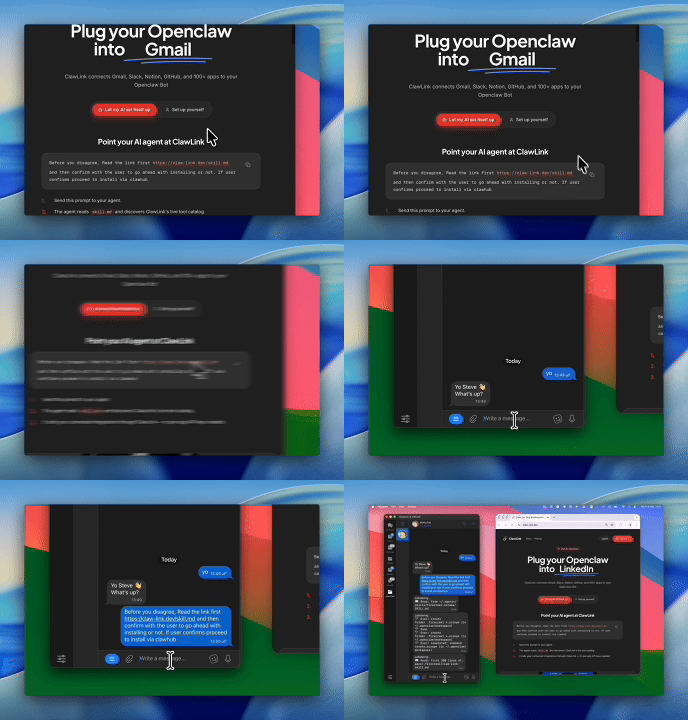
1Install the plugin
Paste the setup prompt into OpenClaw, or install from the terminal and ask OpenClaw to pair:
openclaw plugins install clawhub:clawlink-plugin- 2
Connect Trello
One-click OAuth in the dashboard.
- 3
Use it from chat
Ask OpenClaw: "What can you do with Trello?"
Install by command
The setup prompt above does all of this in one paste. By hand, it is one install command plus a browser approval:
openclaw plugins install clawhub:clawlink-pluginThen ask OpenClaw to set up ClawLink. It starts browser pairing and prints an approval link — open it, approve the device, return to the chat, and say done. Finally, connect Trello in the ClawLink dashboard — a one-click OAuth approval, no API keys.
Verify the connection by asking OpenClaw:
Show me the lists on the board "<board>" and how many cards are in each. Then list the cards in "<list>" with their due dates and members. Do not change anything.
Using a different agent?
The OpenClaw plugin is one client of ClawLink's MCP server. Claude Code, Cursor, Codex, or any agent that can run a shell command pairs with the same ClawLink account through the CLI:
npx -y @useclawlink/cli loginlogin opens the same browser approval and stores a credential locally. Once Trello is connected in the dashboard, that agent calls the same 322 Trello tools over MCP. Full setup for MCP clients and shell agents: connect apps to any AI agent.
Trello MCP for OpenClaw
Looking for a Trello MCP server for OpenClaw? ClawLink connects Trello to OpenClaw and exposes 322 Trello tools your agent can call over MCP, with hosted auth and nothing to run or maintain yourself. Using Hermes instead? The Hermes Trello integration works the same way.
Every other route to Trello hands you three secrets: an API key, a token, and often an OAuth secret, all pasted into a config file and all valid until somebody remembers to revoke them. ClawLink connects through Trello's own authorization flow, so you approve access in the browser once and OpenClaw can call the 322 Trello tools below without a key, a token, or anything in openclaw.json. Your Trello access comes with you unchanged: the agent sees the boards you are a member of, and Trello's own board and organization permissions still decide what it can do on each one.
What the OpenClaw Trello integration can do
322 Trello tools are ready for OpenClaw once the account is connected. The 30 below are the ones people reach for most; your agent can call all 322.
30 of 322 Trello tools for OpenClaw
| Tool | What it does |
|---|---|
Add boards trello_add_boards | Create a new Trello board |
Add cards trello_add_cards | Create a new card in a Trello list |
Add cards actions comments by ID card trello_add_cards_actions_comments_by_id_card | Add a comment to a Trello card |
Add cards attachments by ID card trello_add_cards_attachments_by_id_card | Add an attachment to a Trello card |
Add cards checklists by ID card trello_add_cards_checklists_by_id_card | Add a checklist to a Trello card |
Add checklists trello_add_checklists | Create a new checklist on a Trello card |
Add labels trello_add_labels | Create a new label on a Trello board |
Get actions board by ID action trello_get_actions_board_by_id_action | Retrieves details for the Trello board associated with a specific action ID, returning board |
Get actions board by ID action by field trello_get_actions_board_by_id_action_by_field | Retrieves a specified field from the Trello board associated with the provided Trello |
Get actions by ID action trello_get_actions_by_id_action | Retrieves detailed information about a specific Trello action by its ID |
Get actions by ID action by field trello_get_actions_by_id_action_by_field | Retrieves the value of a specific field (e.g., 'data', 'date', 'type') from a Trello action |
Get actions card by ID action trello_get_actions_card_by_id_action | Retrieves Trello card details for a given idAction, which must be an action specifically |
Get actions card by ID action by field trello_get_actions_card_by_id_action_by_field | Retrieves a specific field from the Trello card associated with the given action ID |
Get actions display by ID action trello_get_actions_display_by_id_action | Retrieves a display-friendly representation of an existing and accessible Trello action for |
Get actions entities by ID action trello_get_actions_entities_by_id_action | Retrieves all entities (e.g., boards, lists, cards, members) associated with a specific |
Get actions list by ID action trello_get_actions_list_by_id_action | Retrieves the Trello list associated with a specific Trello action ID, for actions linked to a |
Get actions list by ID action by field trello_get_actions_list_by_id_action_by_field | Retrieves a specific field of the list associated with a Trello action, returning only that |
Get actions member by ID action trello_get_actions_member_by_id_action | Retrieves the Trello member who was the subject of an action (not the creator) |
Get actions member by ID action by field trello_get_actions_member_by_id_action_by_field | Retrieves a specific field of the member who was the subject of a Trello action |
Get actions member creator by ID action trello_get_actions_member_creator_by_id_action | Retrieves details about the Trello member who created the action with the given idAction |
Get actions member creator by ID action by field trello_get_actions_member_creator_by_id_action_by_field | Retrieves a specific field from the profile of the Trello member who created a given action |
Get actions organization by ID action trello_get_actions_organization_by_id_action | Fetches the organization details for a given Trello action, if the action has an associated |
Get actions organization by ID action by field trello_get_actions_organization_by_id_action_by_field | Retrieves the value of a specific field for the organization associated with a Trello |
Get actions reactions by ID trello_get_actions_reactions_by_id | Retrieves detailed information about a specific reaction on a Trello action |
Get actions reactions by ID action trello_get_actions_reactions_by_id_action | List reactions for a specific action |
Get batch trello_get_batch | Executes multiple Trello API GET requests in a single batch operation for efficient bulk data |
Get boards actions by ID board trello_get_boards_actions_by_id_board | Retrieves actions (e.g., card creations, comments) for a Trello board by its ID, useful for |
Get boards board plugins by ID trello_get_boards_board_plugins_by_id | Get the list of enabled Power-Ups on a Trello board |
Get boards board stars by ID board trello_get_boards_board_stars_by_id_board | Retrieves board stars (user-marked favorites) for a specified Trello board, where idBoard |
Get boards by ID board trello_get_boards_by_id_board | Fetches comprehensive details for a specific Trello board by its ID; this is a read-only action |
Try it: find the Trello tool you need
Browse the 30 Trello tools
Click any tool to see exactly what OpenClaw can do and copy a ready-to-use prompt.
Example prompts
Show me the lists on the board "<board>" and how many cards are in each. Then list the cards in "<list>" with their due dates and members. Do not change anything.
On the board "<board>", find the list "<list>" and create a card titled "<title>" with a description from the notes above and a due date of <date>. Give me the card id.
Find the card "<title>" on "<board>", then add a checklist called "Steps" with the items I listed above. Confirm what you added.
Add a comment to the card "<title>" summarising the decision we just made. Do not move the card or change its due date.
How the Trello tools take their arguments
Details that decide whether a Trello prompt lands on the right card.
- Everything is addressed by id, and ids are opaque. Boards, lists, cards, checklists, and labels all take ids rather than names, so the agent has to walk board to list to card first. A name passed where an id belongs is the usual not-found.
- Actions are the history layer. The
trello_get_actions_*family answers "how did this card get here", "who moved it", and "when was it commented on" — questions the card's current state cannot answer. trello_get_batchreduces call count. Trello work naturally fans out across many objects; batching is what stops a board audit becoming hundreds of calls.- Archiving is not deleting. Archived cards and lists disappear from normal views but remain and can be restored from Trello, which is worth knowing both as a safety net and as an explanation for objects that seem missing.
- Adding a card needs a list, not a board.
trello_add_cardsattaches to a list id, so resolving the list is the required step that prompts most often skip.
ClawLink vs. building it yourself
The alternative to ClawLink is usually manual OAuth app setup plus your own token handling, permission troubleshooting, and tool plumbing for OpenClaw. That is fine if you want to build and maintain the integration yourself. Most teams just want Trello working from chat.
| Manual | ClawLink | |
|---|---|---|
| Connection flow | Register a Trello app, configure redirect URLs, manage consent details, and reconnect users when auth settings drift. | Users connect Trello through the hosted browser flow and ClawLink keeps the token lifecycle out of your app code. |
| Ongoing maintenance | You own refresh logic, permission debugging, environment config, and every provider-specific edge case for Trello. | ClawLink handles the repetitive integration plumbing so your team can focus on the workflow instead of the infrastructure. |
| Agent usability | You still need to expose the right Trello actions to the runtime in a format your agent can reliably use. | 322 tools for Trello are already exposed through ClawLink, so the agent can read and act from chat immediately. |
ClawLink vs. Composio
Composio also exposes Trello to AI agents. It is developer infrastructure: Python and TypeScript SDKs, an MCP server, and a catalog past 1,000 apps, aimed at teams shipping agent products. ClawLink is built for OpenClaw users instead. You install the plugin once, connect Trello in the browser, and the 322 tools above work from chat. There is no SDK, no config file, and no API key handling. Choosing between them? Read the full Composio alternatives comparison.






















Troubleshooting
OpenClaw installed the Trello skill but can't call the tools
The ClawHub skill teaches OpenClaw about Trello, but the calls run through the ClawLink plugin and your connected account. Make sure Trello is connected in the dashboard, then start a fresh chat so OpenClaw reloads the tool catalog. If OpenClaw runs as a persistent gateway, restart it so the new tools register.
Connection succeeds but no tools appear
Reconnect Trello from the dashboard, then start a fresh chat if the runtime still has the old tool catalog loaded.
"Tool schema not loaded yet" error when calling Trello tools
Trello tool schemas load on demand the first time a tool runs and are cached after that, so this error usually clears on its own: wait a few seconds and retry the same request. If every Trello call keeps failing with it in a fresh chat, reconnect from the dashboard, and contact support if it still persists — that pattern points to a configuration problem on our side, not something you can fix by reconnecting again.
Trello returns 403 or "permission denied" on one action while others work
Two usual causes. The connected account may not have access to the specific workspace, inbox, store, or project in the request — check that first. If access looks right, the agent may have sent a placeholder value (like "YOUR_ID" or an example id from documentation) instead of a real one: ask it to run a list or search tool first, then retry the action with a real id from those results. Most failures at this stage are one of these two, not ClawLink bugs.
Trello returns 401 or unauthorized although the connection shows as connected
Check board membership before anything else, because Trello's permission model is per board and this is what usually produces a 401 on one call while everything else works. The connected account must be a member of the board to read a private one and must have the right level to write to it, and an account that is an observer rather than a normal member can read a board and fail on every card change. The second thing to confirm is which account approved the connection: people commonly hold a personal Trello account and one tied to work, and the boards visible to the agent belong to whichever one you signed in as. If neither explains it, reconnect from the dashboard, which reissues the authorization cleanly.
Ask the agent to diagnose it:
Tell me which Trello account this connection is acting as, then list the boards you can actually see and your membership level on each. Do not retry the failed call yet.Trello card or list not found although it is clearly on the board
Trello addresses objects by id, and the ids are opaque strings rather than the names people use. A prompt that names a list "Doing" or a card by its title gives the agent nothing to send, so it either guesses or fails, and a guessed id fails as a not-found. The reliable pattern is to have the agent fetch the board, then the lists on it, then the cards on the list it wants, using the ids from each step. The other cause is archived objects: Trello hides archived cards and lists from normal views but they still exist, so something that seems to have vanished may have been archived rather than deleted.
Ask the agent to diagnose it:
Fetch the board by name, show me its lists with their real ids, then show me the cards on the list I named with their ids. Do not act on anything yet.The agent archived or moved the wrong cards
This is a prompt-shape problem rather than a tool problem, and it is worth designing around because Trello writes are immediately visible to the whole board. An instruction like "clean up the done column" leaves both the selection and the meaning of done to the model. Ask it to list the cards it matched, with names and ids, and wait for your confirmation before it archives or moves anything. If something was archived by mistake it can be restored from Trello's board menu, so the damage is recoverable — but it is noisy in front of your team.
OAuth finished in the browser but the account is still missing
Try reconnecting Trello and complete the consent flow in the same browser session. Partial OAuth approvals or switching accounts mid-flow can leave the connection incomplete.
FAQ
Is there a OpenClaw Trello integration?
Yes. ClawLink is the fastest way to connect OpenClaw to Trello: link your Trello account once in the browser and OpenClaw can call the Trello API through 322 ready-made tools — no custom code or token handling.
How do I add Trello to OpenClaw with ClawLink?
Paste the setup prompt from this page into OpenClaw. It installs the ClawLink Trello skill from ClawHub, then you click Connect in the dashboard to authorize Trello. OpenClaw calls the tools from the next message — no config files or API keys to manage.
How long does it take to connect Trello to OpenClaw?
About two minutes. Sign in, click Connect next to Trello in the dashboard, authenticate, and OpenClaw can use it from the next chat message.
Why use ClawLink instead of wiring Trello up myself?
The alternative to ClawLink is usually manual OAuth app setup plus your own token handling, permission troubleshooting, and tool plumbing for OpenClaw. That is fine if you want to build and maintain the integration yourself. Most teams just want Trello working from chat.
Do I need a Trello API key and token?
No. The usual setup has you generate an API key from Trello's developer page, mint a token against it, and store both wherever the agent can read them — which is why so many Trello automations end up with long-lived credentials in a file. Here the authorization happens in the browser and the credential stays on the ClawLink server. You can disconnect from the ClawLink dashboard or revoke the application from Trello's own account settings, and either one ends access immediately.
Which boards can the agent see?
The ones your account is a member of, plus public boards, exactly as in the Trello web app. Trello scopes access by membership rather than by workspace alone, so a board in your organisation that nobody added you to is invisible to the agent too, and the fix is joining the board in Trello rather than changing anything in ClawLink. This is the most common cause of an agent insisting a board does not exist when you are looking straight at it — usually it is signed in as a different Trello account than the one you assumed.
Can it move cards, add checklists, and comment?
Yes. The toolset is unusually complete: creating and moving cards, managing lists and boards, checklists and checklist items, labels, attachments, comments, due dates, members, and the full action history behind every object. That last part is more useful than it sounds, because Trello records what happened as actions, so an agent can answer questions about how a card got where it is rather than only reading its current state.
Is it safe to connect Trello to an AI agent?
The authorization is Trello's own, so you approve it on Atlassian's screen, the agent never sees a password, and access can be revoked from either side. The practical caution is that Trello writes are immediate and visible to everyone on the board — a card moved or archived by mistake is noticed by your team before it is noticed by you. Archiving in particular is the one to be careful with, so ask the agent to list what it intends to touch and confirm before it acts on a batch.
OpenClaw installed the Trello skill but can't call the tools
The ClawHub skill teaches OpenClaw about Trello, but the calls run through the ClawLink plugin and your connected account. Make sure Trello is connected in the dashboard, then start a fresh chat so OpenClaw reloads the tool catalog. If OpenClaw runs as a persistent gateway, restart it so the new tools register.